What did HE say? (continued)
Thoughts on The Sermon (Part 5)
The Sermon on the Mount is the singular event in the teachings of Christ that puts together in a series of instruction the complete guide to living right. Much is repeated in one way or another throughout the gospels and the synthesis of the entire Sermon is, of course, encapsulated in His one statement “thou shalt love the Lord thy God with all thy heart, and with all thy soul, and with all thy mind. This is the first and great commandment. And the second is like unto it , Thou shalt love thy neighbour as thyself” (Matthew 32:37-39). This Great Commandment is repeated in like fashion in each of the three synoptic gospels and it provides, for those who can understand and perform it, direct entry into the bliss of eternal life and His Presence.
But Jesus did not leave us with this message of Love and just say ‘good luck’. He gave us also a step by step understanding of how to function in that Love so that it builds up within until we are at that point of being able to know the breadth and the depth of the Great Commandment. These steps are in living righteously and according to His word and so here we continue with His words from the Gospel of Matthew.
In His fourth “But I say unto you” statement in The Sermon He tells us, as is His way, that there is a law and the law says such and such but this is the new way and this is what it must really come to mean to you. He says “Again, ye have heard that it hath been said by them of old time, Thou shalt not forswear thyself, but shalt perform unto the Lord thine oaths: But I say unto you, Swear not at all; neither by heaven; for it is God’s throne: Nor by the earth; for it is his footstool: neither by Jerusalem; for it is the city of the great King. Neither shalt thou swear by thy head, because thou canst not make one hair white or black. But let your communication be, Yea, yea; Nay, nay: for whatsoever is more than these cometh of evil” (Matthew 5:33-37). The old law here said that you should not make false oaths but should make your oaths to the Lord and that these oaths before the Lord must be kept; to forswear will incur guilt. Jesus is not saying anything about the truth or the fulfillment of an oath by any person, He is saying that we should swear no oaths at all. What are these oaths but commitments that we make against some Godly thing to convince another of our sincerity. In His teaching He says that it matters not what you swear on because it is not in your control to begin with. Behind this He is also saying that in swearing an oath we do not know the circumstances of tomorrow nor what may befall us to prevent us from fulfilling it. He is telling us that we should all stand on our word; if we say yes it is always yes and in this truth, honesty and integrity there is no need to convince anyone of any thing through the swearing of an oath. Let your word be your bond is a good and necessary ideal and it starts with us; if we lie then we will believe that others lie as well but if we are in the habit of truth, we can believe the same of others.
The Master continues with: “Ye have heard that it hath been said, An eye for an eye, and a tooth for a tooth: But I say unto you, That ye resist not evil: but whosoever shall smite thee on thy right cheek, turn to him the other also. And if any man will sue thee at the law, and take away thy coat, let him have thy cloke also. And whosoever shall compel thee to go a mile, go with him twain. Give to him that asketh thee, and from him that would borrow of thee turn not thou away” (Matthew 5:38-42). Here is the very definition of meekness in the eyes of the Master. Not from fear do we turn the other cheek; not from fear do we give the cloak also and not from fear do more than we are compelled. We do these things because they are the teaching of the Master and the way of God. This is positive harmlessness and in a previous post we said that this is a quality by which “we know that we are capable of doing and saying and believing whatever we want to but as we strive toward the Kingdom we think and know better than to follow the ways of the world; we attend to the ways of the Spirit. We can say things that offend but we do not. We can put things in motion that hurt others but we do not. We can believe we are better or more able than the next person but we do not. We live our lives in accordance with the Word and we resist passions and desires; we resist anger and hate and we resist lusts and greed”. To resist evil is to give power to it in this world but we are not of this world. In the words of The Buddha we find similar Light in this saying: “In this world hate never yet dispelled hate. Only love dispels hate. This is the law, ancient and inexhaustible. You too shall pass away. Knowing this, how can you quarrel?” *◊ There is no place for vengeance and hatreds; these things only grow when we let the anger of perceived abuse take control of our conscious attitude. Thus is Jesus’ example: whatever a person can do to us should not result in our hating or seeking vengeance.
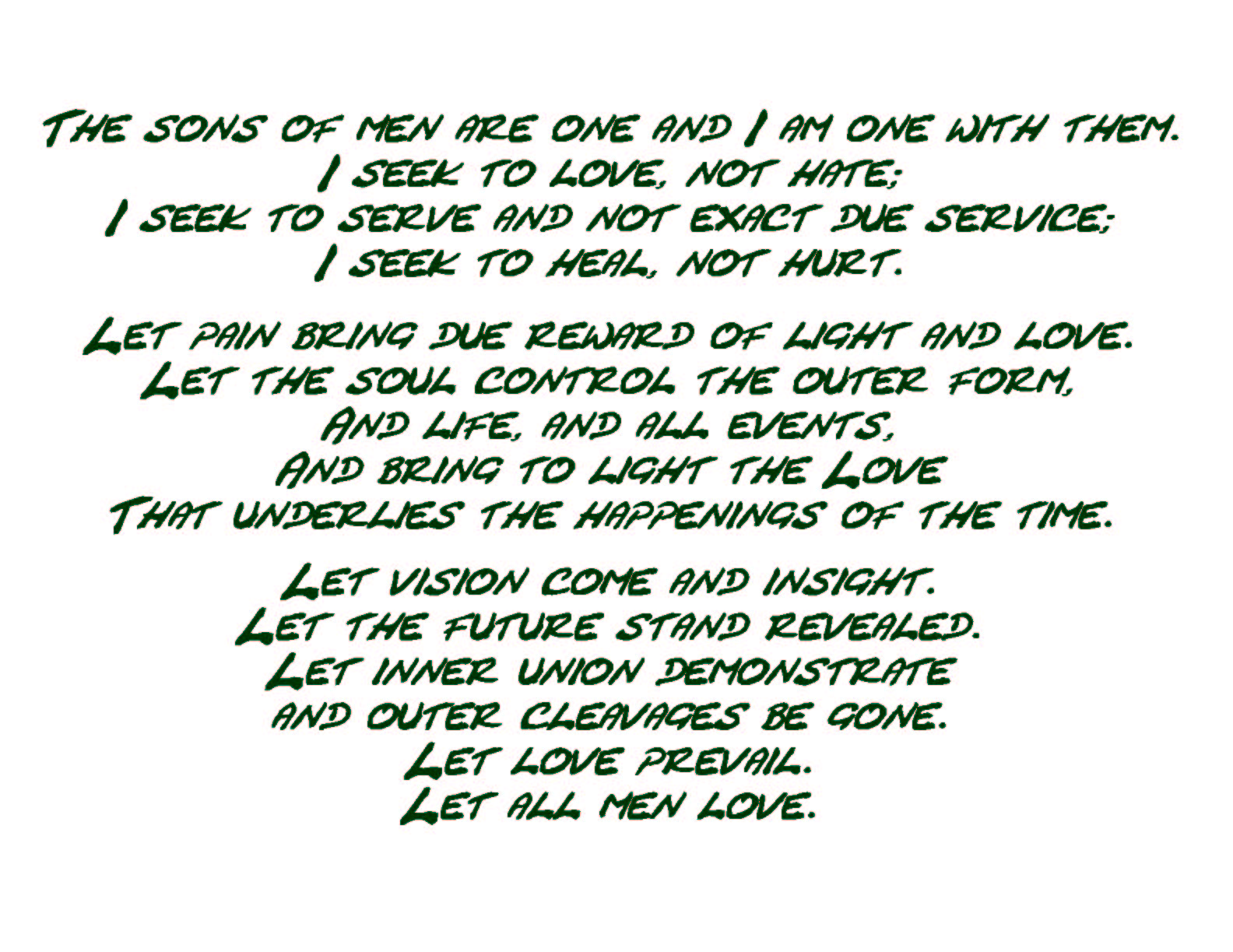
With the sixth “But I say unto you” statement Jesus continues to expand on the teaching above. Not only is He teaching us to not resist and thereby giving power to evil but He is telling us to turn it to Love. He says: “Ye have heard that it hath been said, Thou shalt love thy neighbour, and hate thine enemy. But I say unto you, Love your enemies, bless them that curse you, do good to them that hate you, and pray for them which despitefully use you, and persecute you; That ye may be the children of your Father which is in heaven: for he maketh his sun to rise on the evil and on the good, and sendeth rain on the just and on the unjust. For if ye love them which love you, what reward have ye? do not even the publicans the same? And if ye salute your brethren only, what do ye more than others? do not even the publicans so?” (Matthew 5:46-47). Again this is meekness in action, positive harmlessness and the epitome of goodwill. It is also a very hard saying for a man that is grounded in worldly life. For us, however, who have sensed the Light of the Lord and are trying to enter in at that strait gate it is the very heart of our spiritual life……LOVE. Jesus’ point in this is that anyone can be good to those who are good to us but if we are following His teaching we will be good to all; our enemies, those that hate us or use us or persecute us, we will see them all in the same Love just as our Father in Heaven sees all. Another segment from the Dhammapada is appropriate here. Speaking on violence The Buddha said: “See yourself in others. Then whom can you hurt? What harm can you do? For your brother is like you. He wants to be happy. Never harm him.“*◊ The Buddha is instructing the monks that are His followers as Jesus is instructing the disciples that are following after Him. The message is the same; that we must look past the form and see the Inner Man, the Christ Within, that divine part of each and that just as we know we are Spirit, we know that all are Spirit regardless of how each may appear.
Jesus closes this part of His dialogue with a command that seems impossible. We should know that it is not impossible because He said it and He will not, can not lie. “Be ye therefore perfect, even as your Father which is in heaven is perfect” (Matthew 5:48). What is the perfection of the Father? Perfect is translated from the Greek word teleios which is defined in the lexicon as brought to its end, finished wanting nothing necessary to completeness; perfect; that which is perfect, consummate human integrity and virtue of men; full grown, adult, of full age, mature**. Strong’s says of teleios: perfect, mature, finished***, and Webster’s says that perfect means: Finished; complete; consummate; not defective; having all that is requisite to its nature and kind in the 1828 version and adds without flaw, fault, or blemish; without error; mature; whole; pure; sound; right; correct for the 1913 version*. The reason for bringing in all these defining terms for perfect is that in modern church usage teleios is defined as mature which seems to dilute the intent of the Master and the New Testament writers that use this word. For our purposes, especially in this verse, let us assume the Webster’s version of 1828 for that is much closer to God’s perfection, if His Perfection really could be defined at all. And let us add this: God is Love and His perfection is in Perfect Love. The Apostle John tells us this: ” …..for God is love ….. If we love one another, God dwelleth in us, and his love is perfected in us” (1 John 4:8,12).
When we are living in His Presence, we know our divinity and the divinity of all our brothers and sisters. In this understanding we see in them the Christ Within, their Inner Self. We know that the outer appearance is temporal and is changeable when the Light is sensed and pursued.
Note on the Quote of the Day
This daily blog also has a Quote of the Day which may not be in any way related to the essay. Many of these will be from the Bible and some just prayers or meditations that may have an influence on you and are in line with the subject matter of this blog. As the quote will change daily and will not store with the post, it is repeated in this section with the book reference and comment.
Today’s Quote of the Day is a combination of two scriptures:
….. If any man offend not in word, the same is a perfect man, and able also to bridle the whole body. (James 3:2)
Set a watch, O LORD, before my mouth; keep the door of my lips. (Psalm 141.3)
Words are weapons that can be as lethal as a sword or any modern weapon. They may not injure the body but they do injure nonetheless and some of the wounds inflicted by them are much harder to heal. This goes well with the theme of Jesus teaching over the last few posts. James teaches us that if we can control our tongue and what we say, we are become perfect. This again is Love for if we Love we will not any more speak cruelty than we would do physical violence. The Psalm verse is part of a prayer and asks for the help of the Lord in controlling the tongue; the writer is asking for spiritual guidance from within and from above.
- * Websters Revised Unabridged Dictionary, 1828 and 1913
- ** New Testament Greek Lexicon on BibleStudyTools.com
- *** Strongest Strong’s Exhaustive Concordance of the Bible – 2001
- *◊ Dhammapada Translated by Thomas Byrom