What did HE say? (continued)
Thy Sins Be Forgiven Thee
Having completed the last theme on the sabbath and its treatment by Jesus, we enter now into another area where the Master evoked the ire of the religious rulers of His time; His forgiving of sins. Their attitude toward Him regarding this was harsh and He never took the time to explain to them the reality of what He was saying and doing. Rather, He relied on His whole message on forgiveness to explain it to them. From a single act of healing, let us look at how the gospel writers recorded both the thoughts ascribed to the rulers and Jesus response. From Matthew we will take the story: “And, behold, they brought to him a man sick of the palsy, lying on a bed: and Jesus seeing their faith said unto the sick of the palsy; Son, be of good cheer; thy sins be forgiven thee. And, behold, certain of the scribes said within themselves, This man blasphemeth. And Jesus knowing their thoughts said, Wherefore think ye evil in your hearts? For whether is easier, to say, Thy sins be forgiven thee; or to say, Arise, and walk? But that ye may know that the Son of man hath power on earth to forgive sins, (then saith he to the sick of the palsy,) Arise, take up thy bed, and go unto thine house. And he arose, and departed to his house” (Matthew 9:2-7).
We see here the thoughts of the rulers recorded by Matthew; this is slightly enhanced in the Gospel of Mark as: “Why doth this man thus speak blasphemies? who can forgive sins but God only?“. According to Luke’s Gospel we have: “and the scribes and the Pharisees began to reason, saying, Who is this which speaketh blasphemies? Who can forgive sins, but God alone?” (Luke 5:21) as to admit also that they did not really know who the Master is. Now this is the same gospel story that is told in many churches today with the emphasis on the versions in Mark and Luke It is not told for the reasons of forgiveness however, it is told for the reason of faith. In both Mark and Luke the man with the palsy was brought in through the roof by his friends and the sermons about this center on the faith of both the man who wanted to be healed and those who carried his bed and brought him before Jesus. In all the versions it is said that the Master saw their faith and then said thy sins be forgiven thee. What is the relationship between faith and forgiveness and between healing and forgiveness and between faith and healing is the question that we pose to ourselves today.
Jesus, in His dialogue with the rulers, asks them to tell Him the difference between saying “thy sins be forgiven thee” and “Arise, and walk” and from this we can assume that they meant the same to Him. The words “Arise, take up thy bed, and go unto thine house” were then apparently enough to heal the man. Or was He already healed on Jesus’ saying “thy sins be forgiven thee“. We cannot answer this question but can reasonably say that it does not matter either. The lesson, the message is that there is a relationship between sickness and sin or more accurately between sickness and forgiveness. This is not to discount faith as a important and equal part of this because if this man did not have the faith to be healed he may not have been able to receive it as it were, in unbelief. We should be careful here that we understand that the Master is giving us a message; He uttered no idle words.
We all know in this day and age the power of the mind in the control of the human body but we need to recognize that what is called the mind is in reality the entire complex of the human conscious personality. This is any given persons unique combination of their emotional nature, their mental nature and their physical appetites and urges compounded by their own unique degree of spiritual unfoldment which can range for little to much dependent on the focus of our lives. There is much in this statement that however can be overcome by sincere desire through faith which is believing that what you want you will have. Remember that we are talking only about healing here and we are not addressing the idea of believing for ‘things’ which is in many ways contrary to the teaching of the Master.
Let us imagine that we are a rather emotional person who is ‘down in the dumps’ so to speak and things are not going right for him. This emotional malaise effects the whole of the personality and he begins to think along the same ‘down’ lines which only serves to make his plight worse. In this state one is open to a great array of sickness and careless accident. Now this person is approached by a person of faith who speaks about healing and get this persons attention; he now begins to believe that by faith he can be made whole thus picking up his emotional nature and lifting his mental attitude. The more he believes, the better he feels and, if this is coupled with some spiritual revival in the man or introduces him to some degree of spirituality he becomes ‘whole’ again for as long as he can hold this new found faith. Thus we can say of him that his faith has made him whole. Here we have faith and healing.
Maintaining the same understanding of the complex personality consciousness let us next look at the man that has done, at least in his own mind, some wrong to another. If this man has any conscience (which we will define as at least some inkling of the Spirit of the Christ Within which gives us that understanding of right and wrong) then this wrong that he has done will have some effect on his emotional and his mental well being and, through this, his physical well being as well. Now he may have been forgiven by the person that he wronged and this is good but he may not have forgiven himself for what he has done. He may feel, depending on his level of spirituality, that he is not forgiven by God as well. In this state one can be so under the duress of the sin and the personal conviction of it that he becomes an emotional mess and this effects his health and overall well being. Now if the Christ would come to us and forgive us for our sin which cause our illness all would be well. But this is unlikely except for the Christ Within who can forgive us as well when awakened by some outer or inner force. This too can be done by the intervention of a person of faith who can show us truth of forgiveness and repentance and then, relieved of our burden, we are healed. We must remember the importance of repentance in this as seen the Master’s words to one that He healed: “Behold, thou art made whole: sin no more, lest a worse thing come unto thee” Thus we can say of him that he was forgiven and he repented and was made whole. Here we have forgiveness and healing.
Lastly let us look at the idea of faith and forgiveness and how these interact. We should see in the above example of forgiveness that there is the necessity of faith involved as well, because if we are not believing that we can be healed, how will the healing come or, rather, how would we receive it. Forgiveness is one of the greater parts of the teachings of Jesus and He puts forgiveness hand in hand with the need to believe. Much as we have said that to believe in Christ and in God is to follow and do His word we can also say that if we are to believe in or for any thing that we must at the same time be in forgiveness. Watch His words: “For verily I say unto you, That whosoever shall say unto this mountain, Be thou removed, and be thou cast into the sea; and shall not doubt in his heart, but shall believe that those things which he saith shall come to pass; he shall have whatsoever he saith. Therefore I say unto you, What things soever ye desire, when ye pray, believe that ye receive them, and ye shall have them. And when ye stand praying, forgive, if ye have ought against any: that your Father also which is in heaven may forgive you your trespasses. But if ye do not forgive, neither will your Father which is in heaven forgive your trespasses” (Mark 11:23-26). In this saying faith and forgiveness are forever married. Now we have discussed that there are degrees of faith and belief so as to move mountains or to believe for healing have different requirements. In both extremes however there is the requirement of firm belief, without doubt, and there is also the requirement of forgiveness. In His words if we do not forgive all then our God, both the God within and the God without, will not forgive us. This is the relationship between faith and forgiveness.
Now, since out theme is forgiveness, let us look at some additional examples of the forgiveness of sins from the Master’s words. In the Great Prayer that He taught us to use or to model our prayers against He says: “And forgive us our debts, as we forgive our debtors” which He explains a verse later as “For if ye forgive men their trespasses, your heavenly Father will also forgive you: But if ye forgive not men their trespasses, neither will your Father forgive your trespasses” (Matthew 6:12, 14-15). This is said a bit differently in Luke’s Gospel as: “And forgive us our sins; for we also forgive every one that is indebted to us” (Luke 11:4). Regardless of which version we choose we should see debt as much more that money and, in the view of the church fathers, equivalent to sin or trespass. We also should see here the importance of forgiveness in the teachings of the Master. One time He teaches us to pray and this part of asking for forgiveness is forever entwined with our forgiving others.
Throughout the Old Testament the word forgive is limited to God forgiving the inequity of the people and this, for the most part, through animal sacrifice or the intervention of a leader or a priest or a prophet. There is no talk at all regarding the need of a man to forgive his neighbour or to seek individual forgiveness from God without atonement through the intervention of the priest. It could be said that there was not the need for repentance nor for one to be truly sorry for an offence as the necessary part was the sacrifice, the sin offering. Forgiveness in the Old Testament was, in most every case, from God and not from man to man. Now comes Jesus teaching the doctrine of forgiveness, man to man, as part of His doctrine of Love.
Along with the ideas above, this too is the Master’s teaching on forgiveness:
- “Take heed to yourselves: If thy brother trespass against thee, rebuke him; and if he repent , forgive him. And if he trespass against thee seven times in a day, and seven times in a day turn again to thee, saying , I repent; thou shalt forgive him” (Luke 17:3-4). There should never be any mistake regarding the importance of forgiveness from the Master’s teachings. It should be clear to that the idea of seven times is not meant as a numeric rule of the number of times to forgive but as an example that forgiveness is forever and ongoing.
A last example of the importance of the idea of forgiveness is found in the discussion between the Apostle Peter and Jesus. After teaching them on how they should interact with a brother who trespasses against you. His message is that we try to resolve the issue; first between the parties directly, they with the help of witnesses and third with the church. And, if all fails, then we can regard the man as a heathen man and a publican which is not a good thing. Seems harsh in regard to His teaching on forgiveness but then comes Peter’s question:
- “Then came Peter to him, and said , Lord, how oft shall my brother sin against me, and I forgive him? till seven times? Jesus saith unto him, I say not unto thee, Until seven times: but, Until seventy times seven” (Matthew 18:21-22).
Jesus also teaches us forgiveness in His parables which we will discuss in the next post as well as additional uses of forgiveness and the sense of sin in sickness and in healing.
Note on the Quote of the Day
This daily blog also has a Quote of the Day which may not be in any way related to the essay. Many of these will be from the Bible and some just prayers or meditations that may have an influence on you and are in line with the subject matter of this blog. As the quote will change daily and will not store with the post, it is repeated in this section with the book reference and comment.
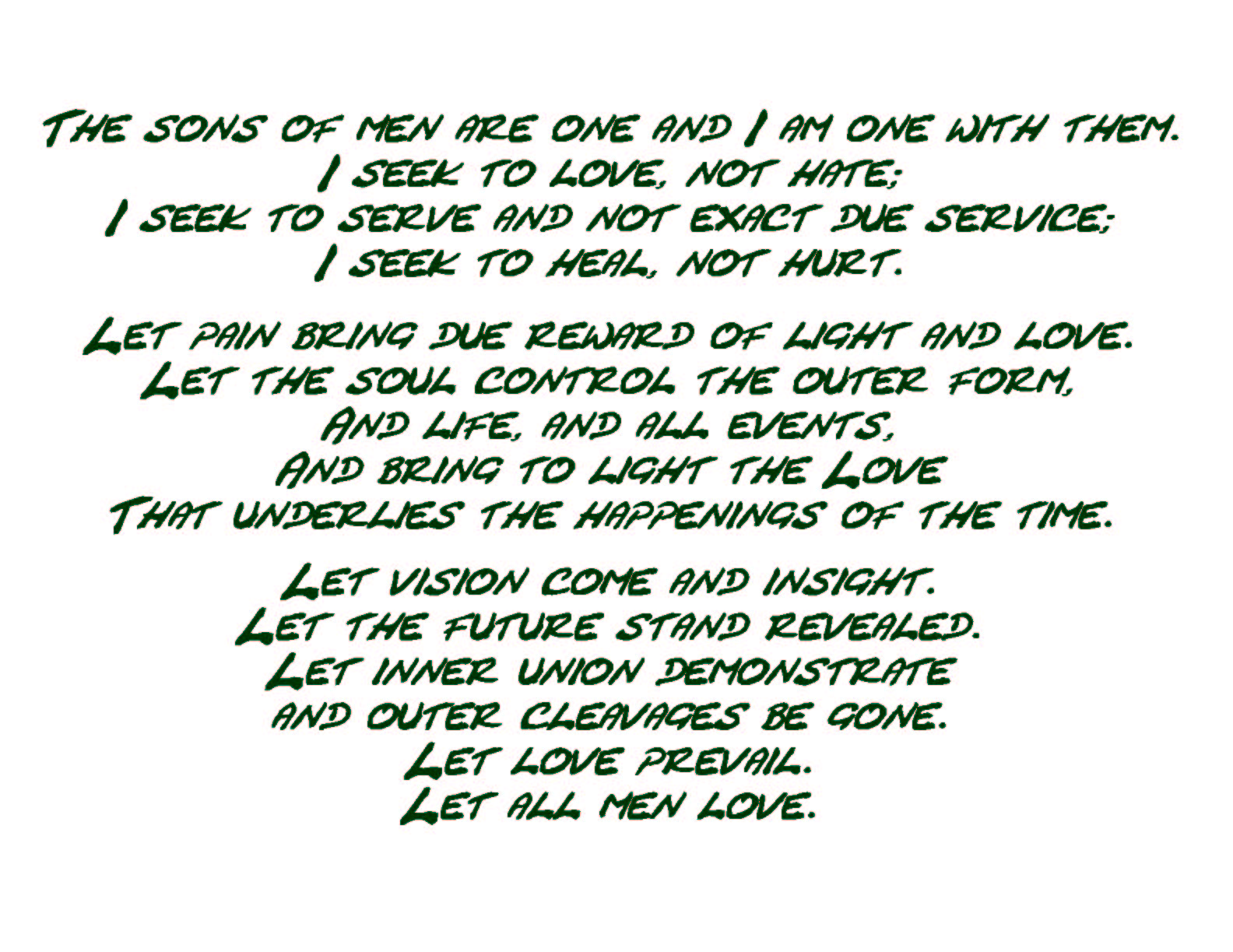
Since this is the weekend of the 10th anniversary of the tragic events of 9/11, we are leaving this as our Quote of the Day for today and for tomorrow in the hope that more people can see it on the front page of this blog. Through these values can future 9/11’s be prevented. The errors on all sides that bring the into the world the hatreds and the anger and the selfishness that results in this type of horror can only be stopped by the Love that Christ and all Sons of God have taught us through the ages.
Values to Live By
A Love of Truth—essential
for a just, inclusive and progressive society;
A Sense of Justice—recognition
of the rights and needs, of all.
Spirit of Cooperation—based
on active goodwill and the principle of right human
relationships;
A Sense of Personal Responsibility—for
group, community and national affairs;
Serving the Common Good— through
the sacrifice of selfishness. Only what is good for all
is good for each one.
The world of the future depends on what each one of us chooses to do today.