What did HE say? (continued)
Thy Sins Be Forgiven Thee (part 2)
In yesterday’s post we tried to show the importance of forgiveness in the teachings of the Master. This from His emphasis on forgiveness as a way of healing to His sayings or commandments that God’s forgiveness for us is dependent on our forgiveness of others; all others. Too, if we believe in prayer for some happening in our lives we know that we will not get what we ask without forgiving all. We should also see from our text yesterday how the idea of the forgiveness of God is related to our forgiveness of ourselves for wrongs that we have committed as well as the role that sin and self condemnation play in sickness and health. Yesterday we looked at the relationships between faith, healing and forgiveness but we did not include Love. Love can be seen in the very nature of forgiveness as they are hand in hand as human virtues and the Master puts them together for us in this parable and teaching. There is a woman of the city who comes into the place where Jesus is dining with the Pharisees; she washes Jesus’ feet and with her tears, dries them with her hair and anoints them with ointment all to the dismay of the Pharisees who say that because the woman is a sinner and Jesus, in their minds, should not have let the woman do this. Then:
“And Jesus answering said unto him, Simon, I have somewhat to say unto thee. And he saith, Master, say on. There was a certain creditor which had two debtors: the one owed five hundred pence, and the other fifty. And when they had nothing to pay, he frankly forgave them both. Tell me therefore, which of them will love him most? Simon answered and said, I suppose that he, to whom he forgave most. And he said unto him, Thou hast rightly judged. And he turned to the woman, and said unto Simon, Seest thou this woman? I entered into thine house, thou gavest me no water for my feet: but she hath washed my feet with tears, and wiped them with the hairs of her head Thou gavest me no kiss: but this woman since the time I came in hath not ceased to kiss my feet. My head with oil thou didst not anoint: but this woman hath anointed my feet with ointment. Wherefore I say unto thee, Her sins, which are many, are forgiven; for she loved much: but to whom little is forgiven, the same loveth little. And he said unto her, Thy sins are forgiven . And they that sat at meat with him began to say within themselves, Who is this that forgiveth sins also? And he said to the woman, Thy faith hath saved thee; go in peace” (Luke 7:40-50).
Here we have, in the Master’s words, the true relationship between Love and forgiveness. We have also to see that healing is of more than just of sickness. This woman was, in those times, considered a sinner and we can only guess at what that means. Nevertheless, by the forgiveness of the Master and the self forgiveness she finds through her own faith, she is saved. Saved from a future life of sin and for a future life in His Presence. And the message for our daily lives is this. If we forgive people for the little things they do us they will love us for it …. a little. But, if we forgive people for the bigger things that they do to us in life they can love us much more. It is not so simple when we look at this all in a purely physical way for the Love shown or received in forgiveness may not be evident when it is diluted and repressed by the life of the personality. But from the inner person the forgiveness is true; for whether a person is in recognition of his spiritual self or not, the spiritual self is there and is active and is trying to get through to his personality and the world.
Before we go further here we should all be on the same page as to just what the word forgive means and what the Master meant by it. Like the word love, the word forgive has lost much of its import over time and our present understanding may not be what Jesus intended when He spoke so strongly of forgiveness and the importance of it. The word translated as forgive is the Greek word aphiemi which is translated in the King James Version as leave 52 times, forgive 47, suffer 14, let 8, forsake 6, let alone 6 and as miscellaneous entries 13 times**. This is quite a range of definitions. In accord with this, the lexicon defines aphiemi as to send away, to bid going away or depart, of a husband divorcing his wife; to send forth, yield up, to expire, to let go, let alone, let be, to disregard, to leave, not to discuss now; of teachers, writers and speakers, to omit, neglect; to let go, give up a debt, forgive, to remit, to give up, keep no longer; to permit, allow, not to hinder, to give up a thing to a person; to leave, go way from one, in order to go to another place, to depart from any one, to depart from one and leave him to himself so that all mutual claims are abandoned, to desert wrongfully, to go away leaving something behind, to leave one by not taking him as a companion, to leave on dying, leave behind one, to leave so that what is left may remain, leave remaining, abandon, leave destitute. Which one of these captures the essence of what the Master is telling us in His words? Strong’s gives little more help to us in saying of aphiemi: to forgive, pardon, remit, cancel; to leave, abandon; to allow, permit, tolerate***. Now on a related word, forgiveness, from the Greek aphesis find in Strong’s forgiveness, pardon, release, cancellation of a debt***. Still not what the Master intended to be sure. The lexicon tells us of this word that it means: release from bondage or imprisonment; forgiveness or pardon, of sins (letting them go as if they had never been committed), remission of the penalty** and this still does not address the forgiveness of offence from person to person.
So we are left again to go to the dictionary. It seems strange that the resources that the church uses to understand scripture, the lexicon and Strong’s, are sometimes inadequate to express the deeper meanings of some very important words in scripture. Currently, modern definitions define forgive as: 1. to grant pardon for or remission of (an offense, debt, etc.); absolve. 2. to give up all claim on account of; remit (a debt, obligation, etc.). 3. to grant pardon to (a person). 4. to cease to feel resentment against: to forgive one’s enemies. 5. to cancel an indebtedness or liability of: to forgive the interest owed on a loan. 6. verb (used without object) to pardon an offense or an offender**!. In this is a better idea of the intent of Jesus in using this word in His teaching but it is still watered down or in need of further qualification of the defining words used; for example to absolve which has come to mean 1. to free from guilt or blame or their consequences: The court absolved her of guilt in his death. 2. to set free or release, as from some duty, obligation, or responsibility (usually followed by from ): to be absolved from one’s oath. 3. to grant pardon for**!. Can we say that the deeper meanings of this to the Christ are found in the combination of these definitions?
Remembering that the meanings and usage of words change much over time, let us look at the definitions as they existed in the 1828/1913 versions of Webster’s Revised Unabridged Dictionary. For forgive we find the following: To pardon; to remit, as an offense or debt; to overlook an offense, and treat the offender as not guilty. The original and proper phrase is to forgive the offense, to send it away, to reject it, that is, not to impute it, [put it to] the offender. But by an easy transition, we also use the phrase, to forgive the person offending. It is to be noted that pardon, like forgive, may be followed by the name or person, and by the offense; but remit can be followed by the offense only. To remit as a debt, fine or penalty*. Remit here should be understood as synonymous with forgive as in Jesus saying: whose soever sins ye remit, they are remitted unto them. (John 20:23).
Can we say that this is closer to the Master’s intent? Is Jesus saying that when we forgive that we need to treat the offender as not guilty? Is overlooking an offense enough and to not impute it to the offender? Continuing with Webster’s definitions we find also: To give up resentment or claim to requital on account of (an offense or wrong); to remit the penalty of; to pardon; — said in reference to the act forgiven. To cease to feel resentment against, on account of wrong committed; to give up claim to requital from or retribution upon (an offender); to absolve; to pardon; — said of the person offending*. To be sure, we can safely say that the entirety of these definitions would still be somewhat lacking when measuring the degree of forgiveness intended by Jesus. The Master forever bound Love and forgiveness and that part is sorely lacking in all the definitions we have seen
Complete pardon, complete absolution, complete forgiveness as an act of Love results in no resentment and no claim to retribution or requital. Add to this that we overlook the offense and not impute it to any person and that we see a person, all persons, as children of God and show an understanding heart toward all. All this still would not measure up to the total intent of the Christ regarding the ideal and virtue of forgiveness. But we, who are aspiring disciples, recognize that one’s outer personality expression may not be under the influence to the true Inner Man and it is not the Inner Man that offends but his worldly expression as we were once wont to do ourselves. It is in Jesus words: “Her sins, which are many, are forgiven; for she loved much: but to whom little is forgiven, the same loveth little” as well as in the parable that preceded this that we can see the direct relationship between Love and forgiveness. Not only in that the one forgiven will Love the forgiver, much for much and less for little, but also in that because she loved much, her many sins were forgiven. Here is found the understanding that we can Love much and still be in sin and, based on that degree Love, our many sins can be forgiven.
And it is also true that the degree of forgiveness that we place on the word forgive will determine the degree of forgiveness we can expect to receive. The Master says that we should “judge not, and ye shall not be judged: condemn not, and ye shall not be condemned: forgive, and ye shall be forgiven: Give, and it shall be given unto you; good measure, pressed down, and shaken together, and running over, shall men give into your bosom. For with the same measure that ye mete withal it shall be measured to you again” (Luke 6:37-38). The measure that we mete will be measured unto us again! This saying is thoroughly entwined with reaping and sowing and every other karmic saying. It is an inescapable law and works as much in forgiveness as in any other endeavor.
In ending this theme we go to another of Jesus parables which graphically shows His intent in telling us that we must forgive; it is called the Parable of the Unmerciful Servant. “Therefore is the kingdom of heaven likened unto a certain king, which would take account of his servants. And when he had begun to reckon, one was brought unto him, which owed him ten thousand talents. But forasmuch as he had not to pay, his lord commanded him to be sold, and his wife, and children, and all that he had, and payment to be made.26The servant therefore fell down , and worshipped him, saying , Lord, have patience with me, and I will pay thee all. Then the lord of that servant was moved with compassion, and loosed him, and forgave him the debt. But the same servant went out, and found one of his fellow servants, which owed him an hundred pence: and he laid hands on him, and took him by the throat, saying , Pay me that thou owest. And his fellow servant fell down at his feet, and besought him, saying, Have patience with me, and I will pay thee all. And he would not: but went and cast him into prison, till he should pay the debt. So when his fellow servants saw what was done, they were very sorry, and came and told unto their lord all that was done. Then his lord, after that he had called him, said unto him, O thou wicked servant, I forgave thee all that debt, because thou desiredst me: Shouldest not thou also have had compassion on thy fellow servant, even as I had pity on thee? And his lord was wroth, and delivered him to the tormentors, till he should pay all that was due unto him. So likewise shall my heavenly Father do also unto you, if ye from your hearts forgive not every one his brother their trespasses“
There should be no mistake about the importance of forgiveness. It is an act of Love and of Mercy and, as Jesus had compassion on the people, so He tells us that we should have compassion too.
Note on the Quote of the Day
This daily blog also has a Quote of the Day which may not be in any way related to the essay. Many of these will be from the Bible and some just prayers or meditations that may have an influence on you and are in line with the subject matter of this blog. As the quote will change daily and will not store with the post, it is repeated in this section with the book reference and comment.
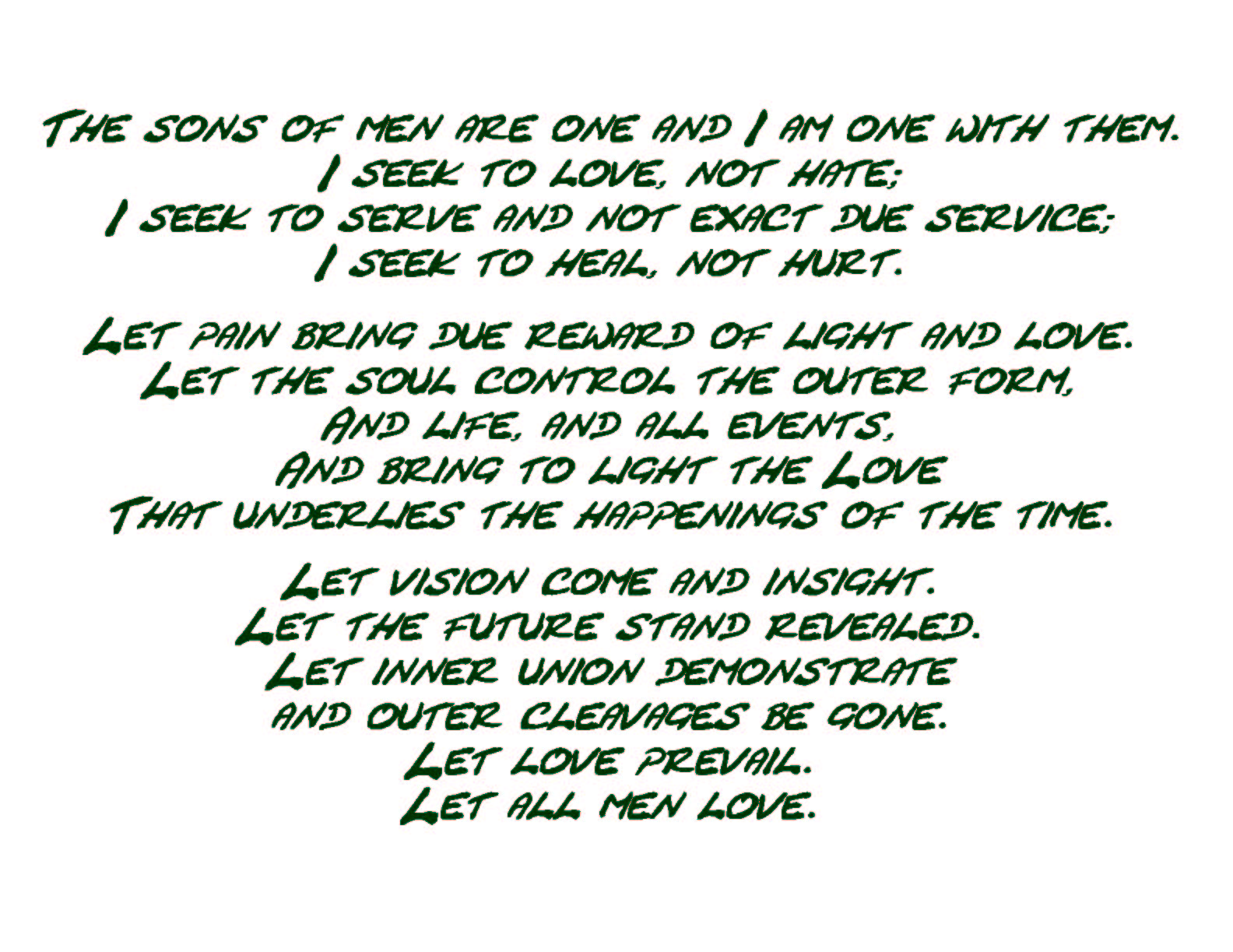
Since this is the weekend of the 10th anniversary of the tragic events of 9/11, we are leaving this as our Quote of the Day for today and for tomorrow in the hope that more people can see it on the front page of this blog. Through these values can future 9/11’s be prevented. The errors on all sides that bring the into the world the hatreds and the anger and the selfishness that results in this type of horror can only be stopped by the Love that Christ and all Sons of God have taught us through the ages.
Values to Live By
A Love of Truth—essential
for a just, inclusive and progressive society;
A Sense of Justice—recognition
of the rights and needs, of all.
Spirit of Cooperation—based
on active goodwill and the principle of right human
relationships;
A Sense of Personal Responsibility—for
group, community and national affairs;
Serving the Common Good— through
the sacrifice of selfishness. Only what is good for all
is good for each one.
The world of the future depends on what each one of us chooses to do today.