Love is the Fulfilling of the Law
ON GOD; Part CXXVII
In yesterday’s post we set forth the synergy of six ways to KNOW God from the perspective of the teachings of the Master as regards what we see as the goal and the objective of the human race. These six we said can be seen as interchangeable because if one can accomplish one of these he will be deemed to have fulfilled them ALL. These were listed as the Will of the Father and the Will of the Son, the word of the Father plus the word of the Son and the Kingdom of God and the fact of True discipleship.
- In his teachings He tells us that the way to the Kingdom is to do the Will of the Father and we should see this as it is intended and that is the complete and total Will of the Father. If there is any confusion regarding this one need only to read the bible to clear that up. From the Ten Commandments to the litany of rules and laws of Leviticus and Deuteronomy to the words of God as repeated by the prophets and the Kings of the Old Testament, and to every word of the Master especially those of the Sermon on the Mount, there is the written testimony of the Will of the Father. “Not every one that saith unto me, Lord, Lord, shall enter into the kingdom of heaven; but he that doeth the will of my Father which is in heaven” (Matthew 7:21)
- Then what is the Will of the Son? Simply the Will of the Father as expressed by the Master. Jesus tells us that they are one and the same saying that ”I and my Father are one” (John 10:30). He tells us also that He does the Will of the Father and that He came among us to finish the work of the Father which, if we read the New Testament correctly, is to bring ALL Sons of God into the Kingdom In many ways, we can look at the Master as speaking most of His words directly to His disciples and to aspirants in that day and then, through them to us, the men who read the words through the ages. As we have been saying, somewhere through the last 2000 years and likely early on, the message of the Master was diluted and taken away from its True intent insofar as we should all readily understand that His words are, for the most part, commandments and not suggestions. Now commandment is a much misunderstood word insofar as scripture goes; these are rules and laws and commands but they should not be seen as though any variance from them is under penalty. Variance from the law is in the very nature of carnal living and in the selfish attitudes that govern it; in fact, variance can be said to be that selfishness itself. However, despite the teachings of the church, there is no punishment, no Hell of fire and brimstone but there are consequences. The consequences are in the fact that when one attends to the ways of the flesh then he is not progressing spiritually and this, along with the karmic consequences of actual actions and thoughts, can prevent a Soul’s advancement and even make his next attempt, his next incarnation, of a more difficult nature. The Master then is speaking through His disciples to us today and, in the same way, with the presumption that we are disciples or we are aspirants and that we are ready to do His Will and this thereby gives the idea of commandment the proper weight; if we keep His words we will gain the Kingdom and we will be His disciples. For the casual reader and listener there are the outer meanings of His words and His parables. “Jesus saith unto them, My meat is to do the will of him that sent me, and to finish his work” (John 4:34).
- The words of the Father can be seen in the same light as the first point on His Will as we should understand that the former is the expression of the latter but this is not entirely true from the perspective that His words are interpretable but His Will is not. We have posited that the Will of God is His intentional focused attention and this because there is no way of our comprehending this reality of Will as it applies to God. His words then are the expression of this Will which is understood by a man by the way in which it is interpreted. This idea may appear to make our premise of the synergy of these terms of no effect but this is not the case and the reality of this is found in the concepts of illusion and glamour and the resultant deception. This idea can be seen in the same light as the Wisdom from above that we recently discussed; there is a Wisdom and an attitude and a way of living that is brought into the consciousness of a man from the Soul. Conversely there is also a wisdom and an attitude and a way of living that is brought into consciousness by the personality that exists within the world of things. It is here that one can find the meeting place of the words of God and His Will and the key here is tied to the Will of the Soul as it becomes the Will of the man; it is here that his intentional focused attention is on the Christ Within and, thereby, as disciples and aspirants, one can KNOW. “But he answered and said, It is written, Man shall not live by bread alone, but by every word that proceedeth out of the mouth of God” (Matthew 4:4).
- The words of the Son are also of the same nature as the Will of the Son as we express this above albeit they are a bit clearer in their intent for the man of today. In the Old Testament the text is oriented toward the Jewish Nation of those days and although we can take from these writings much that is pertinent to us today this was never really the intent and regardless of the attempted application of types and shadows as done by many parts of the church, there is no real effect of these teachings on the man of today. They are of historical value though there are parts that beautifully portray the intent of the word of God as it should effect man; these parts which include the Psalms and Proverbs to name some are of importance and are reflected upon by the Master. Much of the balance is however the history of the Jews and is of little consequence and with little effect on us as aspirants today. This should not be misunderstood; as scripture it is important to understand our history and how it is that we have moved from age to age but as a guiding Light for the man of today, this should be set aside as it is frozen in time except for those parts that transcend its value as a historical document. And this is not to say that adherents to this as the foundation of their religion are wrong for if one Truly follows the precepts of these writings and can commit themselves to the Love that is taught therein, he is as well on the same path as one who studies the words of the Master. We should remember that the origin of one of our favorite sayings which is repeated as our guiding Light by the Master is found in the Old Testament laws of Leviticus. In the words of Jesus we find TODAY’S approach to divinity; the Master’s words are clear and concise in many ways as regards the rules of the Way as is evident in the Sermon on the Mount and they are rather obscure in so many of His parables and other sayings. Taken together these are His Will and there is nothing in His words that contradicts any of that which is in the Old Testament and its laws; there is only an expansion of those ideas and a concentration on the effect of His words on the heart, the consciousness, of the man. “It is the spirit that quickeneth; the flesh profiteth nothing: the words that I speak unto you, they are spirit, and they are life” (John 6:63).
- The Master’s teachings on the Kingdom of God are mostly couched in His parables but there are clear indications on how to attain this state of being. As we have said, one of the most profound statements and one that is not a parable regarding the Kingdom is virtually ignored by the majority of the Christian community and this is that “the kingdom of God is within you” (Luke 17:21). It is interesting to note here that many translations, some of the more renowned included, have taken to change these words as to be translated as among or in the midst and this has contributed much to the misunderstandings of this saying. Why? Likely because this is a hard saying to understand given the overall teachings on heaven and hell over the centuries and their inability to fit the idea of within you into these teachings. The Greek word entos is however called to be within, inside; within you i.e. in the midst of you: within you i.e. your soul2, according to the lexicon although those who take advantage of the idea of in the midst of you make it to mean that it is among you instead. Strong’s tells us that entos means simply inside, within3 and this is clear. Both Vine’s and Vincent put a doctrinal twist on this word which is readily noted in their words: Vine’s tells us that * Note: This is a translation of (a) entos: see INSIDE, No. 1; in Luke 17:21 the RV marg., “in the midst of,” is to be preferred; the kingdom of God was not in the hearts of the Pharisees; (b) en, “of thinking or saying within oneself,” e.g., Luke 7:39, 49 (marg., “among”); and for inside Vine’s tells us that <1,,1787,entos> an adverb denoting “within,” or “among,” is once used with the article, as a noun, of “the inside (of the cup and of the platter),” Matt. 23:26, RV (AV, “that which is within etc.”); elsewhere, Luke 17:21. See WITHIN6. Vincent says of this word as used in this verse: Within. Better, in the midst of. Meyer acutely remarks that “you refers to the Pharisees, in whose hearts nothing certainly found a place less than did the ethical kingdom of God.” Moreover, Jesus is not speaking of the inwardness of the kingdom, but of its presence. “The whole language of the kingdom of heaven being within men, rather than men being within the kingdom, is modern” (Trench, after Meyer)4. The doctrinal bent is apparent in both of these entries and it should be given that this saying is a difficult one to understand if one approaches the idea of the Kingdom as a place instead of a state of being. For us the saying remains quite clear in its intent and, as we can see above, in the strict translation of the word entos and the whole of this difference in understanding is a testimony to our idea above regarding interpretation. The difference in perspective for so many in the church will be found in the proper teaching of this idea of the Kingdom in that there is no place to go and one need not die first; the Kingdom of God is here and now and this the Master tried to convey clearly, but we did not understand. “But woe unto you, scribes and Pharisees, hypocrites! for ye shut up the kingdom of heaven against men: for ye neither go in yourselves, neither suffer ye them that are entering to go in” (Matthew 23;13). “And when Jesus saw that he answered discreetly, he said unto him, Thou art not far from the kingdom of God” (Mark 12:34).
- True discipleship is found in the words of the Master with are ever so clear in the Gospel of Luke and in the Gospel of John and for our discussion of this point we need only repeat His words: “Then said Jesus to those Jews which believed on him, If ye continue in my word, then are ye my disciples indeed” (John 8:31). This is clear, as True disciples men must continue in His word, they must be “doers of the word, and not hearers only, deceiving your own selves” (James 1:22). In Luke we read: “If any man come to me, and hate not his father, and mother, and wife, and children, and brethren, and sisters, yea, and his own life also, he cannot be my disciple. And whosoever doth not bear his cross, and come after me, cannot be my disciple…..So likewise, whosoever he be of you that forsaketh not all that he hath, he cannot be my disciple“(Luke 14:26-27, 33) and here we also have much clarity of Jesus intent except for the understanding of the idea of hate which we can only interpret as it appears in Matthew’s Gospel; as to love less. To be sure each and every disciple that we read about in the New Testament possessed these qualities which are summarized in the last verse…they had forsaken ALL that they had.
Can we see in these ideas above the symmetry and the synergy of these six ideas; can we see how that if we can do any one, we would have done them ALL? And, can we see the intent of the entirety of the Master’s teachings, to bring the whole of humanity to the strait gate, to the Kingdom and to discipleship? Can we see also what He means in telling us to STRIVE?
We conclude our post here for today and will pick up with our thoughts on God as we began in the last essay in the next post.
Note on the Quote of the Day
This daily blog also has a Quote of the Day which may not be in any way related to the essay. Many of these will be from the Bible and some just prayers or meditations that may have an influence on you and are in line with the subject matter of this blog. As the quote will change daily and will not store with the post, it is repeated in this section with the book reference and comment.
May the Power of the One True God flow through His group of all true servers;
May the Love of the Christ characterize the lives of all who seek to aid in His work;
May I fulfill my part in the one work through self-forgetfulness, harmlessness and right speech
(Evening Reflection)
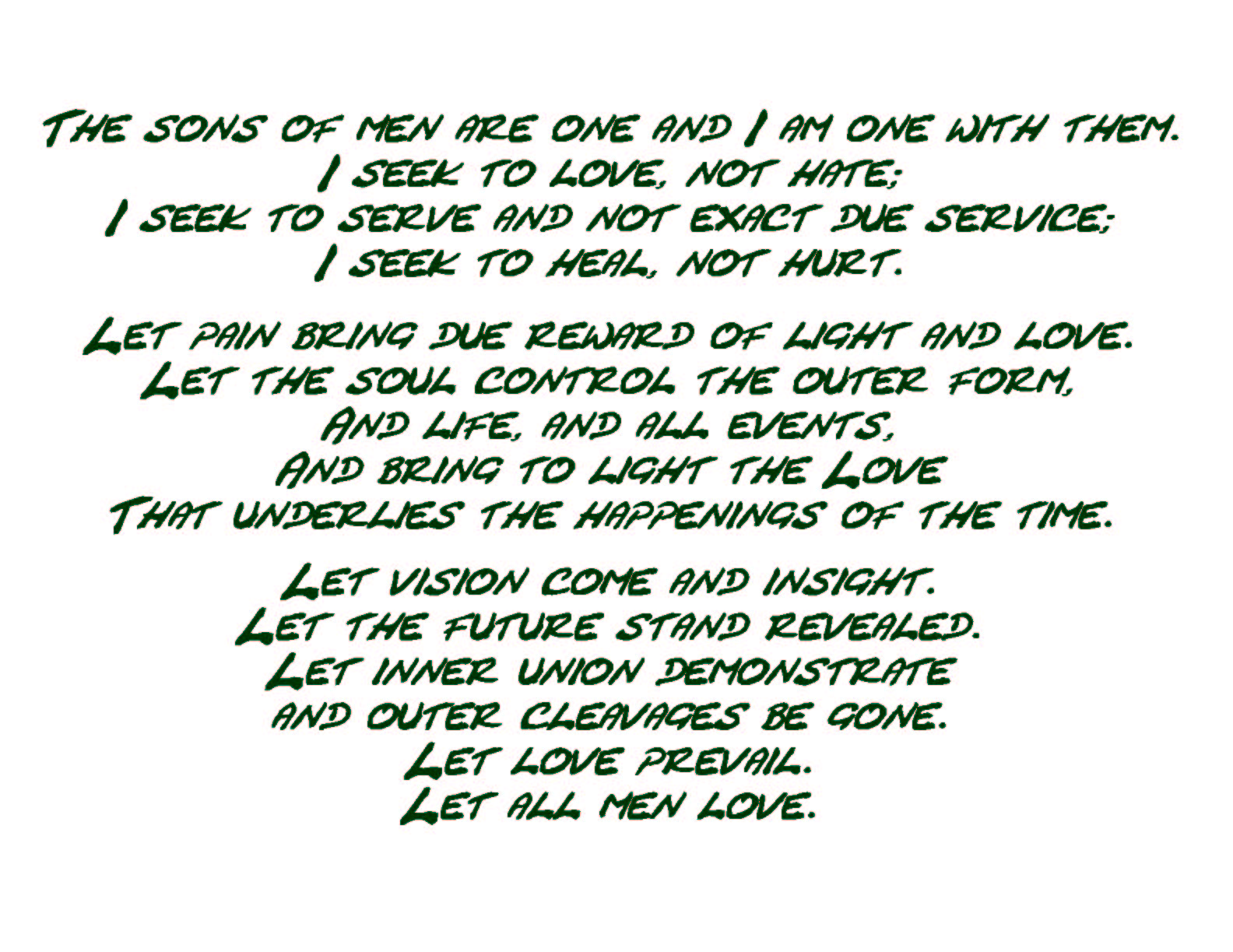
Today’s Quote of the Day is a repeat of a previous quote and is also featured in our Prayers and Meditations section with some additional comments regarding it. It appears today again because is sets in order our understanding that it is the Power of God that flows through those that serve Him and in this Power is the Love that can heal. When the Love of the Christ can become the character of one’s Life then this Power can be made available in a predictable way and the precepts of the last line will become our mode of conduct.
- 2 New Testament Greek Lexicon on BibleStudyTools.com
- 3 Strongest Strong’s Exhaustive Concordance of the Bible – 2001
- 4 Word Studies in the New Testament; Marvin R Vincent D.D. 2nd edition, 1888
- 6 Vine’s Complete Expository Dictionary of Old and New Testament Words, 1996