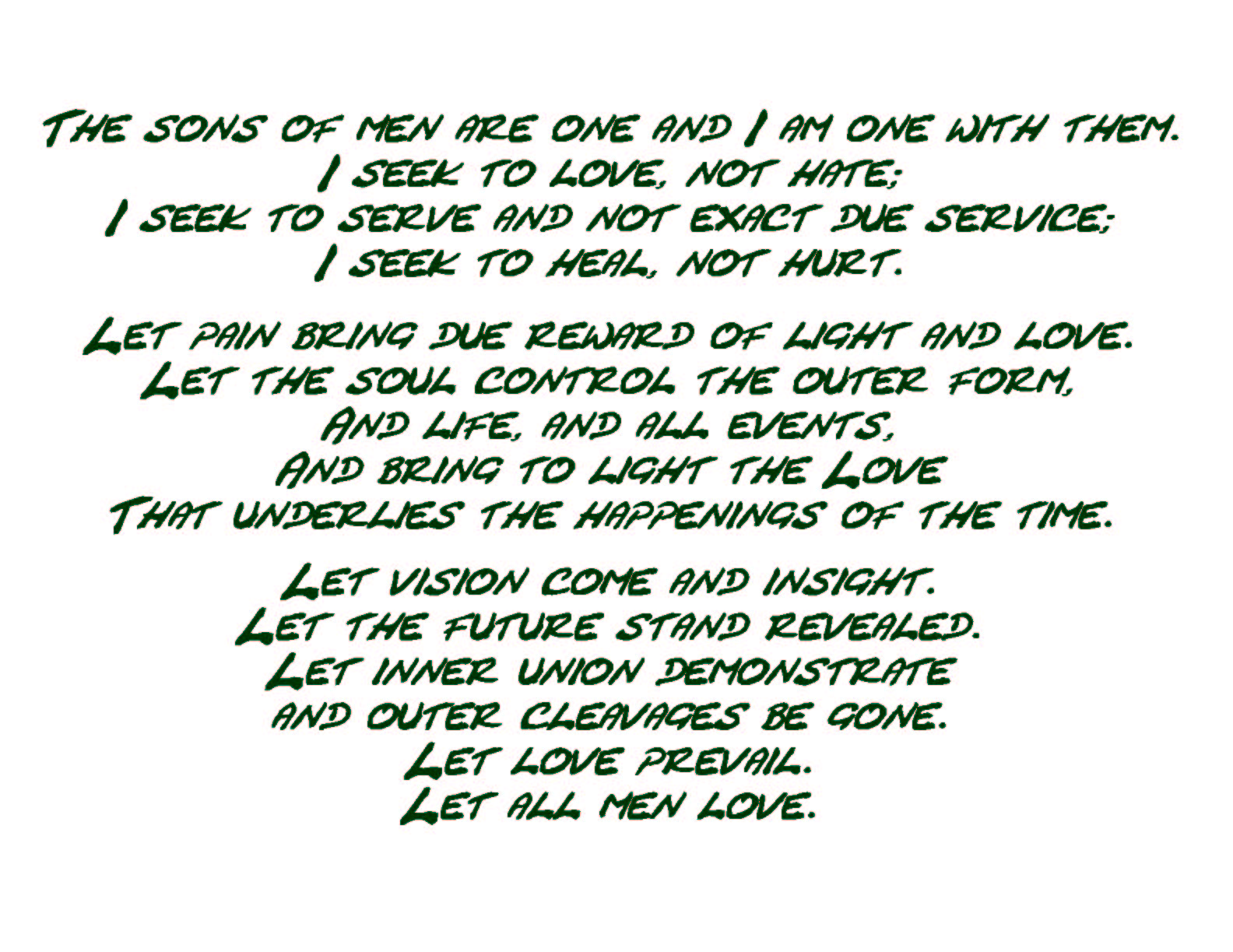
ON LOVE; PART MDXLXIV
ΑΩ•ΑΩ•ΑΩ•ΑΩ•ΑΩ•ΑΩ•ΑΩ•ΑΩ•ΑΩ•ΑΩ•ΑΩ•ΑΩ•ΑΩ•ΑΩ•ΑΩ•ΑΩ•ΑΩ•ΑΩ
FIRST IS THE GREAT COMMANDMENTS: “The first of all the commandments is, Hear, O Israel; The Lord our God is one Lord: And thou shalt love the Lord thy God with all thy heart, and with all thy soul, and with all thy mind, and with all thy strength: this is the first commandment. And the second is like, namely this, Thou shalt love thy neighbour as thyself. There is none other commandment greater than these” (Mark 12:29-31).
ΑΩ•ΑΩ•ΑΩ
WHAT THEN IS LOVE? In a general sense love is benevolence, good will; that disposition of heart which inclines men to think favorably of their fellow men, and to do them good. In a theological sense, it includes supreme love to God, and universal good will to men. While this IS from an older definition of Charity, which IS rendered in the King James Bible from the same Greek word agape which IS generally rendered as Love, we should amend our own definition here to include the idea that in the reality of Love a man will accord to ALL men ALL things that he would accord to himself and to say that Love IS our thoughts and attitude of the equality of ALL men regardless of their outward nature or appearance…that ALL ARE equally children of Our One God.
ΑΩ•ΑΩ•ΑΩ
PLUS THE EVER IMPORTANT AND HIGH IDEAL TAUGHT TO US BY THE CHRIST: “Therefore all things whatsoever ye would that men should do to you, do ye even so to them” (Matthew 7:12).
ΑΩ•ΑΩ•ΑΩ•ΑΩ•ΑΩ•ΑΩ•ΑΩ•ΑΩ•ΑΩ•ΑΩ•ΑΩ•ΑΩ•ΑΩ•ΑΩ•ΑΩ•ΑΩ•ΑΩ•ΑΩ
While we were discussing the Master’s words from Matthew’s Gospel regarding what many believe ARE the end times, we went off into a side discussion on the idea of “the Son of man“. Most ALL of the church sees these words by which the Master often refers to Himself as a way to express His humanity against the divinity that IS often on display but this IS but a partial Truth. There IS a definite reason for Jesus to refer to Himself this way and, as we cited in the last essay, this reason revolves around the way that He DOES NOT call Himself the Messiah which IS what the Jews understood from the word christos; a word which technically means anointed. When Peter acknowledges that Jesus IS the Messiah saying “Thou art the Christ, the Son of the living God“, the Master responds by saying “Blessed art thou, Simon Barjona: for flesh and blood hath not revealed it unto thee, but my Father which is in heaven” (Matthew 16:16-17). Can we see here that none “were able to identify “the Son of man” as the Christ, as the Messiah? We did cite places where others whom the Master healed and some ‘possessed by unclean spirits’ proclaimed that the Master was the “the Son of God” but to these the Master response was that He “straitly charged them that they should not make him known” (Mark 3:11-12). Such was also His response to others whose healing was to be hidden from public view, likely before such healings were more commonplace; Jesus, after healing a leper “charged him to tell no man” (Luke 5:14). Our point here IS that rather than the Master proclaiming Himself to be the Christ, to be the Messiah or to be “the Son of God“, He wanted the people to come to this realization on their own. Again, the idea that we use to refer to the Master, the Christ, was NOT KNOWN in those days when the Jews were expecting their Messiah which can be rendered from the same Greek word christos.
Our discussion then brought us to the idea that we ARE ALL sons of men and, we ARE ALL, as Souls or Sons of God. It IS in this regard that we then looked at the Master’s words that tell us that we can be as He IS, a “Son of man” with the ability to express himself in the same way as DOES the Master, as Christ. Jesus tells His disciples “Verily, verily, I say unto you, He that believeth on me, the works that I do shall he do also; and greater works than these shall he do” (John 14:12). We went on then to our trifecta which we repeat here and then into parsing the many ideas that ARE in His words above and our trifecta. The Master tells us:
- “If ye continue in my word, then are ye my disciples indeed; And ye shall know the truth, and the truth shall make you free” (John 8:31-32).
- “Not every one that saith unto me, Lord, Lord, shall enter into the kingdom of heaven; but he that doeth the will of my Father which is in heaven” (Matthew 7:21).
- “He that hath my commandments, and keepeth them, he it is that loveth me: and he that loveth me shall be loved of my Father, and I will love him, and will manifest myself to him. Judas saith unto him, not Iscariot, Lord, how is it that thou wilt manifest thyself unto us, and not unto the world? Jesus answered and said unto him, If a man love me, he will keep my words: and my Father will love him, and we will come unto him, and make our abode with him. He that loveth me not keepeth not my sayings: and the word which ye hear is not mine, but the Father’s which sent me” (John 14:21-24).
We begin again with the idea of believing which should be understood in terms of KNOWING and this we discussed in some detail in the last essay. KNOWING brings us to the first part of our trifecta where it IS shown to us as the result of keeping His words. This IS a most important point; it IS in our KNOWING the Truth that we can move the mountain, wither the “fig tree” and, in essence, be the he that the Master shows us saying “the works that I do shall he do also; and greater works than these shall he do“. While the New Testament renders pistis as faith and pisteuo as believing, both rather nebulous ideas, the reality of both these words IS KNOWING which idea IS clearly shown to us in the Master’s words on these subjects, the “fig tree” and moving the mountain. Our point on our being able to DO as DOES the Master IS reinforced for us by John who tells us “as many as received him, to them gave he power to become the sons of God, even to them that believe on his name” (John 1:12). We covered this idea of receiving Him according to Vincent’s conclusion that the idea IS: As many as by accepting Him, received Him 4. This IS one way then of becoming a son of God. We ended with the second way that John shows us which IS to “believe on his name“.
This brought us again to Vincent and to an idea that we had NOT used in quite some time in our writing. Regarding the idea of “them that believe on his name“, we should understand that to “believe on his name” IS a complex idea of which Vincent tells us: To believe in, or on, is more than mere acceptance of a statement. It is so to accept a statement or a person as to rest upon them, to trust them practically; to draw upon and avail one’s self of all that is offered to him in them. Hence to believe on the Lord Jesus Christ is not merely to believe the facts of His historic life or of His saving energy as facts, but to accept Him as Savior, Teacher, Sympathizer, Judge; to rest the soul upon Him for present and future salvation, and to accept and adopt His precepts and example as binding upon the life 4. Here, whether we consider pisteuo as believing or as KNOWING DOES NOT matter as these words take the idea of believing out of the nebulous context of doctrines and into the realm of keeping His words. Finally, we again discussed the idea of “his name“; we must understand that Jesus name IS NOT merely a name as ordinary names to but there IS the reality of Vincent’s idea that can be seen in the lives of many whose names represent them in the world. Ordinary people also, although it requires a full name for most, can be seen through their name when we understand that one’s name is: the formula in which all his attributes and characteristics are summed up. It is equivalent to his person 4. Regarding the Master, this takes on additional meaning which we should see as: The name, as in the Lord ‘s Prayer (“Hallowed be thy name”), is the expression of the sum total of the divine Being : not his designation as God or Lord, but the formula in which all his attributes and characteristics are summed up. It is equivalent to his person 4. Can we see the point here regarding John’s simple words that tell us that the Power to be as Jesus IS available to “as many as received him….even to them that believe on his name“.
As we approached this section of our discussion, we did so from two places. First from the idea of the “Son of man” and ALL that this means in the lives of men. We should try to see that Jesus’ message IS simply that He IS a man, anointed by God, the Christ, and, as we too ARE sons of men, the Master shows us that we too can DO as He has DONE, that there IS naught that separates us from the Truth except our own vanity. As we allow the Christ principal, the Christ Within, to become the expression of our mortal lives, we too become anointed. Second we came to this part of our discussion through our trifecta from which we should understand that our ability to KNOW IS based in our ability to keep His words; our ability to accept and adopt His precepts and example as binding upon the life. This IS from the first part of our trifecta. Equally important to our understanding of the “Son of man” however IS the third part which relates the idea of the anointing to the same reality of keeping His words. We begin with the idea that “He that hath my commandments, and keepeth them, he it is that loveth me: and he that loveth me shall be loved of my Father, and I will love him, and will manifest myself to him“
Of course we begin here with keeping His words which we should note IS equivalent to both receiving Him and believing “on his name“. This Jesus Himself tells us saying “He that believeth on me, the works that I do shall he do also; and greater works than these shall he do” and we should here remember His words on moving the mountain and withering the “fig tree“. In this saying however there ARE other important dynamics at play; first keeping His words IS our insignia that we DO Love the Lord and here of course the idea IS agape and NOT the common ideas of Love. Secondly this idea of keeping His words opens up an entire realm of ‘benefits’ if we can use that idea here and among them IS the reality of the Presence of the Lord in our lives. This Presence works through agape but this IS NOT our point here; in His manifestation to the man who keeps His words IS the manifestation of the Christ Within in one’s worldly Life and in this we should try to see our own individual sense of anointing. It IS through this anointing that we become able to DO the works that He had done and while the church downplays these ideas, they ARE nonetheless shown to us by the Master. We must remember the idea of measure here; we must understand that in our striving to keep His words we DO NOT instantaneously change our lives; this change takes time and continuous effort as IS noted in the first part of our trifecta. This we also recently discussed by using the stages of the Parable of the Sower to depict our Repentance and Transformation. It IS our Transformation that we ARE striving toward as we first decide to and then pursue through our striving to keeping His words.
We should note from the dialogue of the third part of our trifecta that the apostles DO NOT completely understand what the Master IS saying. They DO NOT understand this idea of manifestation nor DO they relate the idea to their own Souls, their own Christ Within. The apostles’ measure of the Truth at this point IS NOT sufficient to understand what the Master IS saying and so He repeats the point saying “If a man love me, he will keep my words: and my Father will love him, and we will come unto him, and make our abode with him“. We should remember here that “God is love agape” and that from this perspective ALL DO have the Love of God in their lives because, as Souls, we ARE part and parcel of the Godhead, part and parcel of this idea of agape. The understanding that we should try to see in His words here IS that while we ARE as Souls in the Love, agape, of the Father, we DO NOT have this realization in our mortal minds until they ARE Transformed. We may have an inkling of it as our measure increases but, as we see here, we ARE NOT yet aware as the apostles who were with Him ARE NOT yet aware. Finally, in the idea that the Godhead, the Father and the Son, will “make our abode with him” we should be able to sense the reality of the Presence of God as we come to have fuller and fuller realization of the Truth. This Presence IS our anointing, our bringing into world view our individual measure the Christ as men in this world. Returning to our main discussion and the relevance of “the Son of man” we repeat here our subject verses:
“Behold, I have told you before. Wherefore if they shall say unto you, Behold, he is in the desert; go not forth: behold, he is in the secret chambers; believe it not. For as the lightning cometh out of the east, and shineth even unto the west; so shall also the coming of the Son of man be. For wheresoever the carcase is, there will the eagles be gathered together. Immediately after the tribulation of those days shall the sun be darkened, and the moon shall not give her light, and the stars shall fall from heaven, and the powers of the heavens shall be shaken: And then shall appear the sign of the Son of man in heaven: and then shall all the tribes of the earth mourn, and they shall see the Son of man coming in the clouds of heaven with power and great glory. And he shall send his angels with a great sound of a trumpet, and they shall gather together his elect from the four winds, from one end of heaven to the other. Now learn a parable of the fig tree; When his branch is yet tender, and putteth forth leaves, ye know that summer is nigh: So likewise ye, when ye shall see all these things, know that it is near, even at the doors. Verily I say unto you, This generation shall not pass, till all these things be fulfilled. Heaven and earth shall pass away, but my words shall not pass away. But of that day and hour knoweth no man, no, not the angels of heaven, but my Father only” (Matthew 24:25:36).
As we began this discussion, we noted that the idea here that “they shall say unto you, Behold, he is in the desert; go not forth: behold, he is in the secret chambers” IS NOT the same as the ideas from the prior section of this same narrative from Matthew’s Gospel where the Master warns that “there shall arise false Christs, and false prophets, and shall shew great signs and wonders; insomuch that, if it were possible, they shall deceive the very elect” (Matthew 24:24). These previous words were specific to men who will claims to be Christs or have the Power of Christ or “false prophets“. These ARE NOT necessarily men who will come in the name of Christ but ARE rather those of whom the Master speaks earlier saying “Beware of false prophets” as He warns us that “Ye shall know them by their fruits” (Matthew 7:15, 16). In this section we ARE warned of “the Son of man” who will come “as the lightning cometh out of the east, and shineth even unto the west“. In the last essay tried to understand just what the Master means by calling Himself “the Son of man” and we did come to some conclusions that ARE worth considering over the doctrinal idea that this IS just a name by which Jesus refers to Himself. Simply put, the Master, for much of His time with us, DID NOT want to proclaim Himself as the Christ oras the Messiah in those days as the word Christ was rather meaningless. He wanted for men, His disciples included, to to come to this realization on their own. While we did considerable research into this idea regarding the way that the words “the Son of man” ARE used in the gospels, we DID NOT review ALL and we did NOT address this particular use of the saying. Here of course the common doctrinal idea IS that the Master IS referring to Himself saying that He will come “as the lightning” comes: out of the east, and shineth even unto the west.
John Gill gives us a flavor of the doctrinal ideas saying that this coming IS: not of his last coming to judgment. Mr. Gill continues saying that this is: his coming in his wrath and vengeance to destroy that people, their nation, city, and temple: so that after this to look for the Messiah in a desert, or secret chamber, must argue great stupidity and blindness; when his coming was as sudden, visible, powerful, and general, to the destruction of that nation, as the lightning that comes from the east, and, in a moment, shines to the west 8. Mr. Gill applies the Master’s words here to the destruction of Jerusalem in 70 AD and there IS NOT much agape in this commentary on the Master. We should note here that Mark’s Gospel misses these ideas regarding “the Son of man“; here Mark inserts “then if any man shall say to you, Lo, here is Christ; or, lo, he is there; believe him not: For false Christs and false prophets shall rise, and shall shew signs and wonders, to seduce, if it were possible, even the elect. But take ye heed: behold, I have foretold you all things“. These ideas ARE included in the first section of Matthew but in Mark they immediately precede what IS the next idea in both gospels, that of “the sun be darkened, and the moon shall not give her light“. This leaves us even more questions about the idea that we ARE discussing: that He will come “as the lightning” comes: out of the east, and shineth even unto the west IS missing from Mark’s Gospel. In Luke’s Gospel these words regarding “the Son of man” ARE found in an earlier chapter that IS NOT related to the sacking of Jerusalem. Luke shows us the Master answering the Pharisee’s question; we read that “he was demanded of the Pharisees, when the kingdom of God should come, he answered them and said, The kingdom of God cometh not with observation: Neither shall they say, Lo here! or, lo there! for, behold, the kingdom of God is within you. And he said unto the disciples, The days will come, when ye shall desire to see one of the days of the Son of man, and ye shall not see it. And they shall say to you, See here; or, see there: go not after them, nor follow them. For as the lightning, that lighteneth out of the one part under heaven, shineth unto the other part under heaven; so shall also the Son of man be in his day. But first must he suffer many things, and be rejected of this generation” (Luke 17:20-25).
Here Luke IS framing the Master’s words as to reflect the idea that it IS the Master that IS “the Son of man” but we should note that this IS NOT clearly shown us save for the words saying “first must he suffer many things, and be rejected of this generation“. Also, the reference here IS to “the Son of man be in his day” and He says to His disciples that “The days will come, when ye shall desire to see one of the days of the Son of man, and ye shall not see it“. There IS little clarity in any of these references to “the Son of man” and perhaps we can gain some insight through some words of importance which ARE ONLY found in Luke; the Master says: “The kingdom of God cometh not with observation: Neither shall they say, Lo here! or, lo there! for, behold, the kingdom of God is within you“. As we often discuss, these words ARE disputed in the doctrinal church which chooses to say that “the kingdom of God is among you“, that IS to say it IS in the world, or the similar idea that “the kingdom of God is in your midst“. It IS the Greek word entos that IS used here; entos IS defined by the lexicon as: within, inside; within you i.e. in the midst of you; within you i.e. your soul 2. Despite this the idea that the Kingdom IS in the world IS the understanding that most doctrines subscribe to. Strong’s defines entos simply as inside 9a while Thayer’s seems to be the source of the lexicons defining ideas. Vincent seems to agree that the idea of “in your midst” IS correct citing the writings of Trench and Meyer who claims that “you refers to the Pharisees, in whose hearts nothing certainly found a place less than did the ethical kingdom of God”; Trench adds that “The whole language of the kingdom of heaven being within men, rather than men being within the kingdom, is modern”4. For us the idea IS clearly that “the kingdom of God is within you” as a matter of fact; as Souls we ARE ever in the Kingdom. Trench, Meyer, Vincent and most ALL of the doctrinal commentators miss the fact that man IS NOT this body. Man IS the Soul living for a time in this body and, since the Soul IS ever in the Kingdom and the Soul IS the Inner Man, the Christ Within, then surely the “the kingdom of God is within you“. This IS yet another Truth that comes upon a man as he strives to keep His words; this IS yet another realization that comes through our Repentance and our Transformation.
While Luke chose this place to insert the idea of “the Son of man” and the comparison to lightning, he DOES NOT show us the Master as speaking in any way about the end times as seems implied, through errors in the rendering of words, in Matthew’s Gospel. The error of seeing the doctrinal idea in Matthew’s Gospel where the question IS rendered as “what shall be the sign of thy coming, and of the end of the world?” IS clearly error in the context in which it appears. The entirety of the Master’s words which we call the first section ARE in regard to the sacking of Jerusalem in 70 AD. This IS discussed in some detail in the last essay. Luke DOES go on to cite some of the same ideas as Matthew in a later chapter where he places Jesus’ words regarding the sacking of Jerusalem and we will discuss these as we continue with our discussion of Matthew which we refer to as the second section. Summing this ALL up, the part in Matthew where the Master refers to “the Son of man” IS related to us in Luke in a separate chapter while Mark ONLY shows us the former idea that “false Christs and false prophets shall rise” (Mark 13:22). While it IS unfortunate that these ideas ARE so jumbled in the gospels, with no two showing us the same ideas in the same contexts, the three synoptic gospels DO include most points. Our point here IS that while we see the sacking of Jerusalem, the jumbled nature of the order of the ideas has in a way encouraged doctrines to see the end times despite Luke’s reference in chapter 17 saying “But first must he suffer many things, and be rejected of this generation” (Luke 17:25) and Matthew’s citing of the Master’s words saying “This generation shall not pass, till all these things be fulfilled“.
Matthew goes on to show the Master’s next words as “For wheresoever the carcase is, there will the eagles be gathered together“. Luke shows these words at the end of chapter 17 against what will be the third section of our study in Matthew. These words should NOT be taken literally nor should they be understood as doctrines portray them. Vincent describes the words ONLY leading us to the literal interpretation saying that carcase IS: originally a fall, and thence a fallen body; a corpse and of the eagle that: Rev. puts vultures in margin. The griffon vulture is meant, which surpasses the eagle in size and power 4. Thayer’s tells us that the idea of the saying should be seen as: where there are sinners (cf. πτῶμα), there judgments from heaven will not be wanting 9 after defining the words much the same as Vincent. John Gill tells seems to tell us that the carcase IS the Jews in sin while the eagles ARE the Roman legions which would: find them out, and make an utter destruction of them 8. The various ideas surrounding this verse should show us that the meaning IS uncertain and we can get little understanding from its following the Master’s words on “the Son of man” without first understanding that. Perhaps the placement of these words in Luke’s Gospel can help us. In Luke this phrase ends the chapter in this context: “Whosoever shall seek to save his life shall lose it; and whosoever shall lose his life shall preserve it. I tell you, in that night there shall be two men in one bed; the one shall be taken, and the other shall be left. Two women shall be grinding together; the one shall be taken, and the other left. Two men shall be in the field; the one shall be taken, and the other left. And they answered and said unto him, Where, Lord? And he said unto them, Wheresoever the body is, thither will the eagles be gathered together” (Luke 17:33-37).
As we say above, the saying, though a bit changed, appears after the ideas concerning ‘there ARE two and one is taken’ which appears in a different place in Matthew. The change from carcase to body should be seen as much the same thing as the primary definition of soma in the lexicon IS: the body both of men or animals, a dead body or corpse 2 before going on to say that soma represents all bodies. The placement herein Luke however follows a question posed by the disciples, the question NOT of when but rather of where will there be these things happening. We should note here that the common understanding in Matthew’s Gospel IS that the Master had moved on from His foretelling of the sacking of Jerusalem but if we can take these words into that event and presume the question being asked in Matthew’s Gospel as well, we can perhaps find a reasonable answer in this seemingly rambling dialogue. As we proceed here we will skip our analysis of the ideas of the bodies, the carcases and the eagles or vultures and address these when we come to the next section Matthew’s Gospel as for us the idea seems out of place here in Matthew. While we ARE NOT saying that Luke’s placement is better, it IS earlier in a separate chapter, we DO see that relating it to the idea of where will there be two and one taken can help us to understand. We continue then with the next verse saying “Immediately after the tribulation of those days shall the sun be darkened, and the moon shall not give her light, and the stars shall fall from heaven, and the powers of the heavens shall be shaken“. These words ARE surely among those that lead men to the doctrinal idea that the subject IS the end times. However, even in the end times these words would be very allegorical as they can make NO sense in either view. In today’s world we can perhaps see the idea of “the sun be darkened, and the moon shall not give her light” from the perspective of men in this world. Nuclear holocaust or the eruption of volcanic ash can DO both of these in parts of the world. The IS idea that “the stars shall fall from heaven” however IS far beyond imagination and, based on our knowledge of the Universe CAN NOT happen; there ARE billions upon billions of stars with most ALL many times the size of this tiny planet upon which we live. It is estimated that there ARE over 100 billion stars in our galaxy alone and that the number of galaxies is uncountable in real terms.
The whole of this verse then IS an allegory behind which there IS a practical meaning and we should try to see that this meaning IS more pertinent to those times than to ours. The ideas here ARE so obtuse that Vincent skips this verse entirely and ONLY touches upon words in many of the surrounding verses. The tribulation cited in this verse IS the tribulation of the sacking of Jerusalem cited in a previous verse so that we should try to see that whatsoever the meaning IS here, it comes “Immediately after the tribulation of those days“. Two posts back we addressed this tribulation according to the Master’s words saying “then shall be great tribulation,such as was not since the beginning of the world to this time, no, nor ever shall be” (Matthew 24:21). Pertaining to the destruction of Jerusalem we cited the first time that the temple was destroyed and, against this verse, we said: from the perspective of the Jews and their temple based religion, this IS the final end. The reality IS that there was never another destruction of the temple or of the Jews’ religion of such force before and there will never be again. We also cited the reality of the Roman siege and the human toll that this took and in these ideas we should try to see the idea of this “great tribulation“. In our current verse we ARE reading that “Immediately after the tribulation” the cosmic things mentioned will happen and, of course, we KNOW that they DID NOT happen according to the literal ideas presented.
These ideas ARE framed a bit differently by Mark and Luke. Luke tells us that “there shall be signs in the sun, and in the moon, and in the stars; and upon the earth distress of nations, with perplexity; the sea and the waves roaring” (Luke 21:25). Luke’s words ARE less dramatic than Matthew’s version telling us simply that “there shall be signs“. Mark’s version of the Master’s words IS similar to Matthew’s saying that “in those days, after that tribulation, the sun shall be darkened, and the moon shall not give her light, And the stars of heaven shall fall, and the powers that are in heaven shall be shaken” (Mark 13:24-25). While both Matthew and Mark show us the idea of “after that tribulation“, Luke DOES NOT. Luke instead shows us a more graphic picture of the tribulation itself saying “woe unto them that are with child, and to them that give suck, in those days! for there shall be great distress in the land, and wrath upon this people.
And they shall fall by the edge of the sword, and shall be led away captive into all nations: and Jerusalem shall be trodden down of the Gentiles, until the times of the Gentiles be fulfilled” (Luke 21:23-24). Here we should remember that the idea of gentiles IS NOT necessarily as the idea IS portrayed by doctrines. The Greek word here IS ethnos and it IS defined as a race 9a by Strong’s and as: a multitude (whether of men or of beasts) associated or living together; a company, troop, swarm; a multitude of individuals of the same nature or genus, the human race; race, nation. From here Thayer’s then goes into the doctrinal ideas saying that ethnos IS: foreign nations not worshipping the true God, pagans, Gentiles9a. This latter idea has become the chosen understanding of the idea of ethnos and gentiles. While Luke’s words ARE less dramatic than those of Mark and Matthew, we should note that the ending phrase, “until the times of the Gentiles be fulfilled” embodies yet another type of confusion. The doctrinal church enjoys this phrasing of the Master’s words as it plays into their doctrinal thinking or, better, enables it. John Gill relates the doctrinal view that the idea here IS: till the fulness of the Gentiles is brought in; until the Gospel is preached all over the world, and all God’s elect are gathered in out of all nations; and then the Jews will be converted, and return to their own land 8.
Against the sacking of Jerusalem, this idea make little or NO sense; nor DOES the rendering of these words by Young’s which sees past the idea of gentiles and uses instead the rendering of ethnos as nations. Young’s Literal Translation tells us “and they shall fall by the mouth of the sword, and shall be led captive to all the nations, and Jerusalem shall be trodden down by nations, till the times of nations be fulfilled” (Luke 21:24). Here the prophecy IS turned away from the idea of the sacking by the Romans to the idea that Jerusalem will be “trodden down by nations“. Between Matthew and Luke we now have two ideas that must be understood in terms of the destruction of Jerusalem. From Matthew we have the problem of the idea that “the sun be darkened, and the moon shall not give her light, and the stars shall fall from heaven” and from Luke, who DOES NOT include this idea, we have the problem of discerning the meaning of the idea “until the times of the Gentiles be fulfilled“. We will begin with these ideas in the next essay but here, as we close, we should try to understand that the idea provided by Matthew and Mark must perforce be an allegory; there IS NO reality in this idea. Granted the ideas regarding the sun and the moon can be understood as we discussed above, but this IS unlikely and the final part regarding the stars IS NOT possible even under the idea that “with God all things are possible” (Matthew 19:26); this based on the reality of our tiny planet. We must also try to understand the True meaning of the Master’s use of “the Son of man“.
We will continue with our thoughts in the next post.
| Aspect | Potency | Aspect of Man | In Relation to the Great Invocation | In relation to the Christ |
| GOD, The Father | Will or Power | Spirit or Life | Center where the Will of God IS KNOWN | Life |
| Son, The Christ | Love and Wisdom | Soul or Christ Within | Heart of God | Truth |
| Holy Spirit | Light or Activity | Life Within | Mind of God | Way |
- 2 New Testament Greek lexicon on biblestudytools.com
- 4 Word Studies in the New Testament; Marvin R Vincent D.D. 2nd edition
- 8 Bible commentaries on BibleStudyTools.com
- 9 Thayer’s Greek Lexicon on blueletterbible.org
- 9a The New Strong’s Exhaustive Concordance of the Bible on blueletterbible.org
Those who walk on the well-trodden path always throw stones at those who are showing a new road
Voltaire, Writer and Philosopher