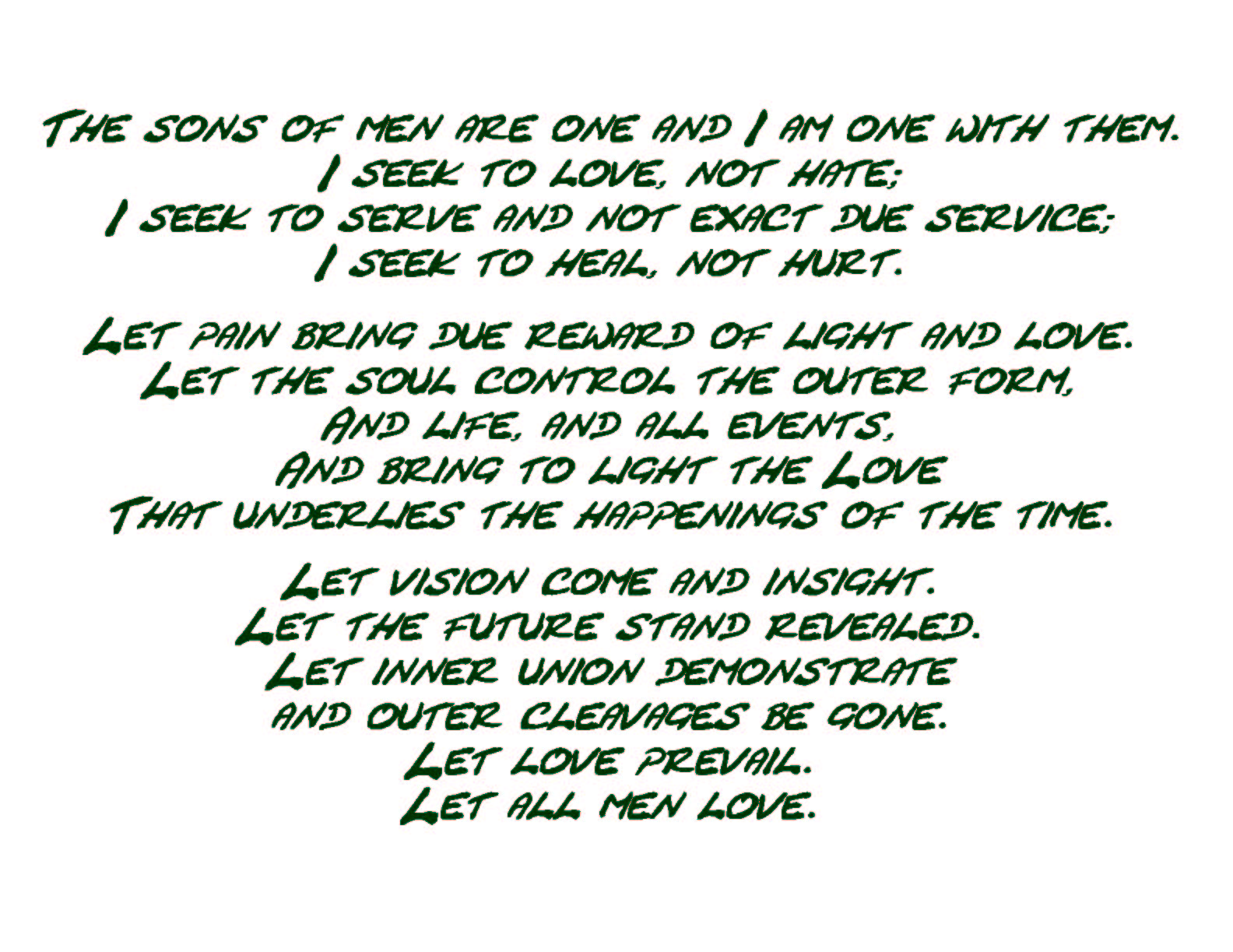
ON LOVE; PART MDXLXVII
ΑΩ•ΑΩ•ΑΩ•ΑΩ•ΑΩ•ΑΩ•ΑΩ•ΑΩ•ΑΩ•ΑΩ•ΑΩ•ΑΩ•ΑΩ•ΑΩ•ΑΩ•ΑΩ•ΑΩ•ΑΩ
FIRST IS THE GREAT COMMANDMENTS: “The first of all the commandments is, Hear, O Israel; The Lord our God is one Lord: And thou shalt love the Lord thy God with all thy heart, and with all thy soul, and with all thy mind, and with all thy strength: this is the first commandment. And the second is like, namely this, Thou shalt love thy neighbour as thyself. There is none other commandment greater than these” (Mark 12:29-31).
ΑΩ•ΑΩ•ΑΩ
WHAT THEN IS LOVE? In a general sense love is benevolence, good will; that disposition of heart which inclines men to think favorably of their fellow men, and to do them good. In a theological sense, it includes supreme love to God, and universal good will to men. While this IS from an older definition of Charity, which IS rendered in the King James Bible from the same Greek word agape which IS generally rendered as Love, we should amend our own definition here to include the idea that in the reality of Love a man will accord to ALL men ALL things that he would accord to himself and to say that Love IS our thoughts and attitude of the equality of ALL men regardless of their outward nature or appearance…that ALL ARE equally children of Our One God.
ΑΩ•ΑΩ•ΑΩ
PLUS THE EVER IMPORTANT AND HIGH IDEAL TAUGHT TO US BY THE CHRIST: “Therefore all things whatsoever ye would that men should do to you, do ye even so to them” (Matthew 7:12).
ΑΩ•ΑΩ•ΑΩ•ΑΩ•ΑΩ•ΑΩ•ΑΩ•ΑΩ•ΑΩ•ΑΩ•ΑΩ•ΑΩ•ΑΩ•ΑΩ•ΑΩ•ΑΩ•ΑΩ•ΑΩ
While we ended our last essay with our trifecta, our current subject was the Master’s words saying “the Son of man coming in the clouds of heaven with power and great glory” from our discussion on the twenty fourth chapter of Matthew’s Gospel. Repeating the first and second parts of our discussion from this chapter for clarity we read:
“For many shall come in my name, saying, I am Christ; and shall deceive many. And ye shall hear of wars and rumours of wars: see that ye be not troubled: for all these things must come to pass, but the end is not yet. For nation shall rise against nation, and kingdom against kingdom: and there shall be famines, and pestilences, and earthquakes, in divers places. All these are the beginning of sorrows. Then shall they deliver you up to be afflicted, and shall kill you: and ye shall be hated of all nations for my name’s sake. And then shall many be offended, and shall betray one another, and shall hate one another. And many false prophets shall rise, and shall deceive many. And because iniquity shall abound, the love of many shall wax cold. But he that shall endure unto the end, the same shall be saved. And this gospel of the kingdom shall be preached in all the world for a witness unto all nations; and then shall the end come. When ye therefore shall see the abomination of desolation, spoken of by Daniel the prophet, stand in the holy place, (whoso readeth, let him understand:) Then let them which be in Judaea flee into the mountains: Let him which is on the housetop not come down to take any thing out of his house: Neither let him which is in the field return back to take his clothes. And woe unto them that are with child, and to them that give suck in those days! But pray ye that your flight be not in the winter, neither on the sabbath day: For then shall be great tribulation, such as was not since the beginning of the world to this time, no, nor ever shall be. And except those days should be shortened, there should no flesh be saved: but for the elect’s sake those days shall be shortened. Then if any man shall say unto you, Lo, here is Christ, or there; believe it not. For there shall arise false Christs, and false prophets, and shall shew great signs and wonders; insomuch that, if it were possible, they shall deceive the very elect” (Matthew 24:5-24).
“Behold, I have told you before. Wherefore if they shall say unto you, Behold, he is in the desert; go not forth: behold, he is in the secret chambers; believe it not. For as the lightning cometh out of the east, and shineth even unto the west; so shall also the coming of the Son of man be. For wheresoever the carcase is, there will the eagles be gathered together. Immediately after the tribulation of those days shall the sun be darkened, and the moon shall not give her light, and the stars shall fall from heaven, and the powers of the heavens shall be shaken: And then shall appear the sign of the Son of man in heaven: and then shall all the tribes of the earth mourn, and they shall see the Son of man coming in the clouds of heaven with power and great glory. And he shall send his angels with a great sound of a trumpet, and they shall gather together his elect from the four winds, from one end of heaven to the other. Now learn a parable of the fig tree; When his branch is yet tender, and putteth forth leaves, ye know that summer is nigh: So likewise ye, when ye shall see all these things, know that it is near, even at the doors. Verily I say unto you, This generation shall not pass, till all these things be fulfilled. Heaven and earth shall pass away, but my words shall not pass away. But of that day and hour knoweth no man, no, not the angels of heaven, but my Father only” (Matthew 24:25:36).
We have already spent much time on the idea of “the Son of man” as it IS used in the context of these words. To summarize, the idea here IS to show both the humanity and the divinity of the disciple in the same way as the Master uses these words to express His own humanity and divinity. While the church has uses the ideas in this chapter to construct their various end times theories, the reality IS that the entirety of Jesus’ words so far ARE in regard to the sacking of Jerusalem in 70 AD. We should try to see that the idea of “the coming of the Son of man” IS Jesus’ prediction of the rise of what would eventually become Christianity as His disciples and their converts begin to exert their presence on the world. We should take a moment to refresh this idea of presence which IS a valid rendering of the Greek word parousia which IS rendered as coming by most ALL bible translations in our library save for Young’s Literal Translation. Young’s renders the idea as “for as the lightning doth come forth from the east, and doth appear unto the west, so shall be also the presence of the Son of Man” (Matthew 24:27). Vincent also offers us the same idea saying of parousia that the word IS: originally, presence, from pareinai, to be present. At a minimum, this idea of presence should have been able to deflect the ‘second coming’ ideas that have been attached to this verse and others in this same chapter. It IS the presence of the True disciples that should be looked for over the claims of men which Jesus warns against in several places in His words cited above. It IS the True disciples that will be as the lightning, it IS the True disciples that will shineth. This word, shineth, IS rendered from the Greek word phaino, a derivative of phos which IS used to express the idea that the disciple IS “the light of the world” (Matthew 5:14); we discussed this idea in some detail in the last essay. We should also note that we use the idea of True disciple according to the first part of our trifecta that tells us that “If ye continue in my word, then are ye my disciples indeed” (John 8:31); here the idea of indeed IS rendered from the Greek word alethos which IS defined by Strong’s simply as truly 9a.
We should try to see here that it IS the True disciple that IS “the Son of Man” whose Light shineth according to the Master’s instruction saying “Let your light so shine before men, that they may see your good works” (Matthew 5:16). It IS the True disciple that will usher in what will become Christianity and we should try to see here that although this religion was begun in earnest humility by the True disciples and without a proper name, it has devolved into what IS called Christianity today. It IS this idea of “the Son of Man” that we should see in the context of this dialogue and in our current verse segment saying “the Son of man coming in the clouds of heaven with power and great glory“. Having addressed this idea of “the Son of Man“, we went on to the idea of coming which IS from a different Greek word than what we describe above from an earlier verse. Here in this verse erchomai, reflects an actual idea of coming in a physical sense. Perhaps we should try to see here an actual arrival of “the Son of Man“, the actual arrival of the True disciples of the Lord on the world stage. This arrival IS partially chronicled for us in the Book of Acts and while the timeline of this, as well as ALL of the New Testament gospels and epistles, IS in doubt, we can somewhat understand this element of the evolving story. As we cited earlier, the sacking of Jerusalem, an important event in Jewish and Roman history IS NOT mentioned in any gospel or epistle or in the Book of Acts which further confuses the True timeline of events against the fixed time of the destruction of Jerusalem. Our theory here IS rather simple. Scholars, likely well educated men steeped in some doctrinal philosophy, claim that the gospels were written both before and after the destruction of Jerusalem. The most common ideas ARE that Mark was written first, between 65 and 70 AD; followed by Matthew and Luke being written between 80 and 85 AD and finally John’s Gospel being written between 90 and 100 AD. Many ‘scholars’ believe that both Matthew and Luke used Mark’s writings as their own template but there IS NO real evidence of this nor of the suggested timelines.
We should try to see here that even Mark, supposed as being written close to the year of the destruction of the temple and the city of Jerusalem, should have contained some note of the turmoil of the times as this destruction by the Romans DID NOT originate and happen in an instant. Many events like the clashes between Jews and Greeks in Caesarea Maritima, the Jewish riots of 66 AD, and the eventual ‘First Jewish-Roman War’ occurred well before 70 AD. Surely these were times of much turmoil in ALL of Judea, and likely ALL of Israel, which perforce would have been recognized by the gospel writers and the writers of the epistles. Even the Book of Acts, which records in a historical way the travels and the acts of the Apostles, primarily Peter and Paul, makes no mention of the sacking of Jerusalem and shows the free movement of the Jews in the surrounding areas. That NONE would mention the sacking of Jerusalem nor the resultant diaspora IS a very unrealistic assumption and we should add here that even the apocryphal New Testament books make NO mention of any of the events between 65 and 70 AD. So our theory here IS that the entire New Testament was written NOT ONLY before 70 AD but before the first revolts some five years earlier. In this we should be able to see the idea that our subject verses and chapter from Matthew’s Gospel ARE indeed prophetic; that they predicted the end of the city and the religion that they Jews had KNOWN for 1500 years.
Again then, the ideas to be taken from the Master’s words on “the Son of Man“, being acknowledged to have been in regard to the destruction of Jerusalem, ARE NOT in regard to that future ‘second coming’ of Christ which IS still awaited 2000 years later. We should try to see that this idea of “the Son of Man“, in this context, shows us the birth of Christianity in Israel. It DOES so with a special warning that those promising relief from the turmoil of the times, be they “in the secret chambers” or “in the desert“, should NOT be believed and that they should look for those True disciples who ARE bearing the Light; it will be such that will be “coming in the clouds of heaven with power and great glory“. We should note here again that this word coming, from the Greek word erchomai IS a word that reflects an actual coming, an arrival if you will and NOT the idea of presence that is reflected in the previous word rendered as coming. We should try to understand this as an actual arrival of “the Son of Man“, the actual arrival of the True disciples of the Lord on the world stage. This brings us to the idea of the method of this coming which IS stated as “in the clouds of heaven“. These words have engendered many of the ‘second coming’ theories of the churches despite the reality that they pertain to a specific time after the tribulation that IS the events of 70 AD and those that led to this point. The word rendered as clouds here IS from the Greek word nephele which has little or NO reference to the idea of clouds that IS used in the weather; this idea of clouds IS used only once in the gospels. The idea to be taken from nephele which IS rendered as clouds IS rather that kind of cloud of which we read in the Old Testament story of the exodus of the Jews: “And the LORD went before them by day in a pillar of a cloud” (Exodus 13:21). This theme continues into the New Testament in such occurrences as the Transfiguration of the Lord where we read “a bright cloud overshadowed them: and behold a voice out of the cloud, which said, This is my beloved Son, in whom I am well pleased; hear ye him” (Matthew 17:5). We read also that after His final appearance to His disciples according to Luke, that “when he had spoken these things, while they beheld, he was taken up; and a cloud received him out of their sight” (Acts 1:9).
When we remove the idea that this reference to clouds IS a reference to the everyday clouds that we see in the sky, we can they better understand the allegorical ideas that ARE being presented here. These ARE NOT ordinary clouds but rather “the clouds of heaven” and perhaps NOT clouds as we understand that word at ALL. This brings us to the next word idea, heaven. The idea of heaven has been hijacked by much of Christianity and assigned to the idea that it IS the place where good Christians go after they die….it IS seen as the realm of God. Few give any credence to a literal understanding of the Master’s words saying that “the kingdom of God is within you” (Luke 17:21) and we should understand that the “kingdom of God” and “kingdom of heaven” ARE one and the same with the latter Matthew’s choice in several parts of his gospel. An example of this can be seen in the comparison of Matthew’s words saying “Suffer little children, and forbid them not, to come unto me: for of such is the kingdom of heaven” (Matthew 19:13) with the nearly identical sayings in Luke and Mark where we read “Suffer the little children to come unto me, and forbid them not: for of such is the kingdom of God” (Mark 10:14, Luke 18:16). We should note here one more thing which IS that the idea that “the kingdom of God is within you” in Luke’s Gospel IS in the same chapter where parts of the Master’s words on the destruction of Jerusalem ARE found; this we discussed in a previous post on this subject.
Returning to the idea that we were discussing, that of “the Son of man coming in the clouds of heaven“, we should probably understand that the use of the word heaven may actually be in the same intent as Matthew uses it to denote the Kingdom. While the context seems quite different, to best understand the idea we should look at the way that the Greek word ouranos IS defined. Strong’s offers us a diverse array of meanings for ouranos saying that it IS: perhaps from the same as (through the idea of elevation); the sky; by extension, heaven (as the abode of God); by implication, happiness, power, eternity; specially, the Gospel (Christianity):—air, heaven(-ly), sky. While it IS easy to see why the doctrinal church has agreed on the meaning here of both clouds and heaven as weather clouds in the sky, there IS a deeper reality in this phrase. Going back to the previous verse where the word ouranos IS used to say that it will be the place of “the sign of the Son of man” should help us to understand the deeper meaning. In the last essay, we tried to show that the reality of this sign IS related to what we see as the Light of the Soul and we arrived here through the question posed earlier in this chapter which asks “what shall be the sign of thy coming” (Matthew 24:3) where the Greek word rendered as coming, parousia, IS better understood as presence. Taking this idea of presence and the Greek word semeion, which IS rendered as sign and IS often rendered in terms of miracles,, as a heavenly sign should enable us to see past the doctrinal ideas. Using these ideas with the verse that compares “the coming of the Son of man” to lightning brings us to the idea of Light through the Greek words astrape and phaino which IS a derivative of phos. In phaino we have the idea of shining and in phos the idea of Light and these we related to the Master’s words saying “Ye are the light of the world” and that we should “Let your light so shine before men, that they may see your good works, and glorify your Father which is in heaven” (Matthew 5:14, 16). ALL of this is a reframing of the ideas offered in our last essay; while the ideas here can be confusing, we should note that most of the confusion IS found in trying to deflect the doctrinal ideas into which the church IS indoctrinated. The idea we ARE presenting IS actually rather simple.
Taking ALL this, we can distill it into a much simpler idea which IS that the Light IS “sign of the Son of man“, the sign of a True disciple in this world; and that it IS their Inner Light, it IS the Light which IS “within you“. This we should see through the reality of the Master’s words saying “the kingdom of God is within you“. Putting this ALL into the context of the Master’s words speaking of “the Son of man coming in the clouds of heaven” should now be an easier task. The Master tells us first that it IS the “tribes of the earth” that will see; this IS not the whole world as many seem to believe but that part of the earth in which the whole of these things will happen. The Master IS speaking of “the tribes of the earth” which ideas can themselves be distilled down to the reality of the twelve tribes of Judaism that ARE in this part of the earth. The Greek word ge, shown by some as genesis with the same pronunciation of ghay, IS defined by Strong’s as: contracted from a primary word; soil before adding that it IS:by extension a region, or the solid part or the whole of the terrene globe (including the occupants in each application). For us the operative idea here IS region for which Strong’s gives a list of useable renderings for ge as: country, earth(-ly), ground, land, world 9a. It IS these people that ARE the they in the remainder of this verse as well as the continuing dialogue where Jesus says “they shall see the Son of man coming in the clouds of heaven“. If we can understand the idea of “the Son of man” and the “sign of the Son of man” as we depict it above, we can then also see that this idea of “the clouds of heaven” will also fit into these ideas.
As we discuss above this idea of clouds IS NOT the clouds of weather as depicted by the doctrinal ideas of men; it IS rather the idea of clouds that we read about in the gospels. That this idea of clouds IS perhaps modeled after the Old Testament idea that “the LORD went before them by day in a pillar of a cloud” in the Jews’ exodus from Egypt IS likely a True point. The idea of this heavenly or spiritual cloud IS more of a sign of the Presence of the Lord than it IS an actual cloud although the Exodus story DOES give the idea a definite physical nature to go with the other idea of “a pillar of fire“. In the story both the cloud and the fire ARE to “give them light; to go by day and night” but this IS nonsensical save for the idea of the Light of the Presence of God in the journey of the Jews. Far too many take the Pentateuch as a literal depiction of the exodus of the Jews and the establishment of their religious society. Our point here IS that this IS likely the origination of this use of the idea of a cloud and we should try to see here that clouds actually obnubilate or obscure the Light and the actual idea of cloudiness makes ALL less visible. In the New Testament the idea of the cloud IS used in a similar way; we cite above the idea of the Transfiguration where we read that “there was a cloud that overshadowed them: and a voice came out of the cloud, saying, This is my beloved Son: hear him“. Again, we should try to see a Presence of the Lord over an actual cloud and, to be sure, this whole sequence should be seen to refer to presence. We should ALSO wonder here how that Peter, James and John would KNOW that “there appeared unto them Elias with Moses: and they were talking with Jesus” (Mark 9:7,4). It should be easier to see how that this idea of “the clouds of heaven” IS NOT a reference to actual clouds but rather to a spiritual or heavenly presence in the form of “the Son of man“.
In using the idea here of a spiritual or heavenly presence, we ARE using the same idea of heaven that IS in this verse. In both ideas, spiritual and heavenly, we ARE referring to things NOT carnal, NOT mortal and NOT mundane and such IS the Presence of the Lord or, as in our understanding here, the presence of the True disciple of the Lord. What we should try to see here IS that “the sign of the Son of man in heaven” IS this LIght of spiritual presence and while it may have been easier for the Master to depict it this way, we should try to understand that it IS His desire that men break out of their carnal mold and come to KNOW the Truth on their own. In much the same way as things exist yet today, the plain Truth would be quite incomprehensible to the man who has NO spiritual basis from which to see that Truth. This KNOWING relies upon the idea of measure against the Master’s words saying “with the same measure that ye mete withal it shall be measured to you again” (Luke 6:38). We should remember here that breaking down the Master’s words here in this chapter, and in the similar ideas presented in Mark and Luke, IS contrary to the thoughts of the church from the time of the church fathers who constructed doctrines from which it IS difficult to escape. But escape we must if we ARE to progress past the doctrinal ideas of a stagnant church and the secular ideas that choose to ignore it ALL.
The Master’s next words ARE even more outwardly ‘confusing’ than the last and here we should understand that we ARE NOT so confused as the doctrinal church has been for centuries. The Master tells us “And he shall send his angels with a great sound of a trumpet, and they shall gather together his elect from the four winds, from one end of heaven to the other“. First we must put these words into the right perspective which IS that they ARE spoken in regard to the destruction of Jerusalem in 70 AD. Most ALL of the church DOES NOT see this as these words have been used to feed into the doctrinal ideas of the end times for centuries. We begin here with the idea of angels which IS yet another word that has been hijacked by the doctrines of men to pertain to a ‘heavenly being’, ofttimes with wings and a halo, that represents the Lord in certain instances. The idea of such angels again begins in the Old Testament where it IS angels that carry out the ‘will’ of the Lord. The idea of the Greek word angelos, sometimes aggelos, IS simply: a messenger 9a. This however IS doctrinally expanded; Strong’s also tells us that it IS: especially an “angel”; by implication, a pastor 9a. Similarly Thayer’s tells us that the idea of angelos IS: a messenger, envoy before going on to say that it IS the angel, messenger of God and then continuing to cite the idea of guardian angels of individuals and the angels of the churches which ARE mentioned in Revelations. We should try to understand here that while there IS a spiritual realm, that it DOES NOT interfere in the goings on of this world; this we have tried to establish using the words of Paul and James who tell us of the dichotomy between the spiritual realm and this carnal world. Paul tells us that “to be carnally minded is death; but to be spiritually minded is life and peace. Because the carnal mind is enmity against God: for it is not subject to the law of God, neither indeed can be” (Romans 8:6-7) while James tells us that “the friendship of the world is enmity with God? whosoever therefore will be a friend of the world is the enemy of God” (James 4:4). We should try to see here that there IS NO compatibility between these realms of Life which idea IS evident in the failure of divine intervention at the times of greatest need in this world; from the Crusades to the World Wars the Godhead has NOT intervened.
While there IS much esoteric literature on the idea of the Solar Angel as highly evolved beings, we take a different tact in regard to our subject verse and perhaps the whole idea of a deva or angelic evolution. What we see here IS that the Souls of men, their True identity, IS the messenger of the Godhead to the human individual and perhaps on a broader more corporate scale through groups of disciples. The fundamental idea here IS that He, the Lord, “shall send his angels” and if we can see this through the idea that as Souls, as Spiritual Beings functioning in this realm as Souls, we ARE the messengers, the angels if you will, to our carnal selves. The message here would simply be the Light of the Soul functioning through the True disciple; “the sign of the Son of man in heaven” expressing the Will of God in this world. We should try to see here that this IS what actually IS happening in the birth of the church as True disciples promote the Truth in such ways as we read of in the Book of Acts and the epistles. That nothing IS written by any regarding the destruction of Jerusalem remains for us a mystery and that we seem to KNOW that some lived past this time adds more to that mystery. If, as we say above, ALL biblical documents ARE written before 70 AD, there IS an even greater mystery in why there IS NO further communication from the original disciples. Just as there ARE NO reliable records of the time of their deaths save for Judas Iscariot and James, the son of Zebedee, there ARE also NO additional documents attributed to them. Mysteries aside, we should try to see this verse as a continuation of the last and NOT as any form of unique occurance.
The next point IS that these angels, these True disciples, come “with a great sound of a trumpet“. These words have been used by many doctrinal ‘scholars’ to be a sort of harbinger of the end times but what really IS this “great sound“? We begin here with the idea of sound from the Greek word phone; the word IS most often rendered as voice and it IS defined by Strong’s as: a tone (articulate, bestial or artificial) 9a which IS a broad range of possibilities. It IS noted here as sound because of the next word IS rendered as trumpet, a musical instrument. The Greek word here IS salpigx which IS at best an obscure term defined by Strong’s as: perhaps from G4535 (through the idea of quavering or reverberation); a trumpet:—trump(-et) 9a. Here G4535 IS the Greek word salos which IS used but once in the New Testament and IS rendered in the phrase “the sea and the waves roaring” as “the waves“. To get the idea of trumpet from this IS to DO so based upon the presumed context of the verses in which it appears as well as the use of the idea in the Septuagint. However, understanding that the “great sound” can be a great voice roaring, we can continue with our view of these ideas from the Master. Again, it IS “the sign of the Son of man” that will appear; it IS “the Son of man” that “they shall see….coming in the clouds of heaven” and, it IS “the Son of man” that will employ a “great sound of a trumpet” or as we should be able to see, it IS “the Son of man” that will be that great voice roaring. Now we should try to see that this idea of roaring IS NOT limited to the ideas assigned to it in the use of a voice but rather we should try to see it in regard to the force and the Power alluded to in the idea of “the sea and the waves roaring” (Luke 21:25). We should note here that these words from Luke ARE in the same chapter of his gospel that we ARE discussing here in Matthew; they ARE concerning the same events.
Relating “his angels with a great sound of a trumpet” to the ideas we discuss above should enable us to understand that we ARE still talking about “the Son of man” who, as the True disciple, as a Soul expressing through form the Truth and agape Love of the Godhead, IS with a roaring voice proclaiming the beginning of a new era. While the result of this IS history and was the beginnings of what has come to be called Christianity, it was also short lived as the self-centered nature of men, their vanity if you will, crept in to ‘humanize’ the Truth. While there IS NO certainty as to the True identity of the Jude, Judas in Greek, who writes a one chapter New Testament epistle, we cite a part of that epistle here because it highlights for us the short lived reality of True Christianity. And, while we DO NOT here agree with the entirety of his viewpoint, he DOES show us how that the self-centered nature of men DID creep in. Jude tells us “Beloved, when I gave all diligence to write unto you of the common salvation, it was needful for me to write unto you, and exhort [you] that ye should earnestly contend for the faith which was once delivered unto the saints. For there are certain men crept in unawares, who were before of old ordained to this condemnation, ungodly men, turning the grace of our God into lasciviousness, and denying the only Lord God, and our Lord Jesus Christ” (Jude 1:3-4). Understanding that Jude IS a contemporary of the other disciples, we should try to see that this divergence from the Truth DID NOT take long to have “crept in unawares“. This divergence IS at the hands of men who ARE among those of which Jesus’ warns us saying “many shall come in my name, saying, I am Christ; and shall deceive many” and “there shall arise false Christs, and false prophets, and shall shew great signs and wonders; insomuch that, if it were possible, they shall deceive the very elect”. Peter also speaks of certain men saying that “there were false prophets also among the people, even as there shall be false teachers among you, who privily shall bring in damnable heresies, even denying the Lord that bought them, and bring upon themselves swift destruction. And many shall follow their pernicious ways; by reason of whom the way of truth shall be evil spoken of. And through covetousness shall they with feigned words make merchandise of you” (2 Peter 2:1-3). These warnings ARE NOT heeded however as the “false prophets” and “false teachers” prevailed and the church responded unawares. The end result was a church that devolved into chaos; chaos that is clearly seen in the Crusades, the Reformation wars and so many other anti-Truth scenarios over the centuries. Essentially this IS the church of today of which we often cite the esoteric words saying: “The church today is the tomb of the Christ and the stone of theology has been rolled to the door of the sepulchre“^.
We close here for today and if we ponder the ideas above regarding the Master’s words versus the doctrinal ideas, we could come away with a greater understanding of the Truth or, as much of that Truth as we ARE able to understand; our measure if you will. We again DID NOT get to include our trifecta and DO so here:
- “If ye continue in my word, then are ye my disciples indeed; And ye shall know the truth, and the truth shall make you free” (John 8:31-32).
- “Not every one that saith unto me, Lord, Lord, shall enter into the kingdom of heaven; but he that doeth the will of my Father which is in heaven” (Matthew 7:21).
- “He that hath my commandments, and keepeth them, he it is that loveth me: and he that loveth me shall be loved of my Father, and I will love him, and will manifest myself to him. Judas saith unto him, not Iscariot, Lord, how is it that thou wilt manifest thyself unto us, and not unto the world? Jesus answered and said unto him, If a man love me, he will keep my words: and my Father will love him, and we will come unto him, and make our abode with him. He that loveth me not keepeth not my sayings: and the word which ye hear is not mine, but the Father’s which sent me” (John 14:21-24).
We will continue with our thoughts in the next post.
| Aspect | Potency | Aspect of Man | In Relation to the Great Invocation | In relation to the Christ |
| GOD, The Father | Will or Power | Spirit or Life | Center where the Will of God IS KNOWN | Life |
| Son, The Christ | Love and Wisdom | Soul or Christ Within | Heart of God | Truth |
| Holy Spirit | Light or Activity | Life Within | Mind of God | Way |
- 4 Word Studies in the New Testament; Marvin R Vincent D.D. 2nd edition
- 9 Thayer’s Greek Lexicon on blueletterbible.org
- 9a The New Strong’s Exhaustive Concordance of the Bible on blueletterbible.org
- ^ From The Reappearance of the Christ by Alice A Bailey; © 1948 by Lucis Trust
Those who walk on the well-trodden path always throw stones at those who are showing a new road
Voltaire, Writer and Philosopher