YES, HE is Talking to YOU! (continued)
Love is the Fulfilling of the Law
We have reached the end of the dialogue that the Master had with His disciples after sending the multitudes away. Three parables were spoken by the Master to the disciples alone; the Parable of the Hidden Treasure, the Parable of the Pearl of Great Price and the Parable of the Drag-Net. Each of these is commonly considered by the mainstream church and by commentators to be parables even though it is a common opinion that Jesus spoke parables only to the general public and not to His disciples. The Master Himself however says that He did; speaking to His disciples about the Father and the Kingdom, the Master tells them “These things have I spoken unto you in proverbs: but the time cometh, when I shall no more speak unto you in proverbs, but I shall shew you plainly of the Father” (John 16:25) and we know that the same Greek word is translated as both parable and proverb. From this perspective, it should be seen that Jesus spoke in parable to both His disciples and the people and we should remember that, from our perspective, even some of His explanations to His disciples are as much a parable as that which He was explaining. This does not take away from the saying in the Gospel of Mark that tells us “But without a parable spake he not unto them: and when they were alone , he expounded all things to his disciples” (Mark 4:34) seeing that the idea of expounded can just mean Jesus explained. Perhaps some of the explanations that we see as parabolic were perfectly understood by the disciples or, perhaps they understood them at a different level for their time.
Regardless of what they understood the truth remains that the Master spoke to the people in parables and that these three parables plus the explanation of the Parable of the Tares were spoken to the disciples alone. What is the point here? Simply that during this discussion with His disciples, toward the end of it where the Master conveys His last thoughts concerning how they should teach, He does ask them “Have ye understood all these things?” to which “They say unto him, Yea, Lord” (Matthew 13:51). Now this is a clear sign that they understood the teaching of the Master but what was it that they understood? There is no place where we can see the disciples as teaching anything that the Master had taught them other than in the work of the Epistles of John, Peter and James and if we look closely at these do we see their writings as confirming the ideas promulgated by the churches over the last 2000 years regarding the Kingdom or do we see what we have been seeing here In the Words of Jesus? This is a hard question to ask and a more difficult question to answer. James and John seem clear to the Master’s teachings; for the most part they echo, in their own tone, the same straightforward ideas for attaining the Kingdom. Peter is much the same albeit with much more thought to writing on the specifics of how one should live and conduct his mortal life as does Paul who was not a direct partaker of the teachings of the Master.
We who are reading and writing these posts have a unique perspective on these things and one which would likely be met with scorn by the orthodox Christian mind. But this does not make us wrong; this only makes us different and as long as what we say meets with the New Testament tests of the Master and from the writings of James regarding Wisdom and of Paul regarding our focus and our fruit, then we can go forward in confidence. What are these tests?
- From the Master it is simple. Follow in His word in Love and in Faith and bear good fruit because He tells us that “by their fruits ye shall know them” (Matthew 7:20). Do we lead people down the right Path, the Path to His Kingdom or do we lead them astray? Do we love all and do we Love the Master and show it by keeping His words? Do we understand and follow the Great Commandment and the Golden Rule? Can we be seen as His disciples in His context of “By this shall all men know that ye are my disciples, if ye have love one to another“? (John 13:35). Are we truly born again?
- From the Epistle of James we should be able to see our thoughts and our revelations in the light of Wisdom from above. As James explains it “…the wisdom that is from above is first pure , then peaceable, gentle, and easy to be intreated, full of mercy and good fruits, without partiality, and without hypocrisy” (James 3:17). James also tells us what this Wisdom is not saying: “…if ye have bitter envying and strife in your hearts, glory not, and lie not against the truth. This wisdom descendeth not from above, but is earthly, sensual, devilish. For where envying and strife is, there is confusion and every evil work” (James 3:14-16). And for our own self edification James tells us to “…be ye doers of the word, and not hearers only, deceiving your own selves” (James 1:22).
- From Paul there is first the list of things to think on, a list of virtues that should encompass all we say and think: “…whatsoever things are true, whatsoever things are honest, whatsoever things are just, whatsoever things are pure, whatsoever things are lovely, whatsoever things are of good report; if there be any virtue, and if there be any praise, think on these things” (Philippians 4:8). We are the first measure of our thoughts and writings against this list and though some of this would be left to judgement, the any judge would be hard pressed to show us wrong in the words of scripture albeit probably not against one’s own understanding of it. To this Paul add the fruit saying: “the fruit of the Spirit is love, joy, peace, longsuffering, gentleness, goodness, faith, Meekness, temperance” (Galatians 5:22-23) which we must strive for in all we say and do.
There are vast networks of denominations and churches and bible schools and seminaries and bible colleges producing lay ministers, deacons, pastors, bishops, teachers, evangelists and self styled prophets and apostles. The modern church is as much a business venture as it is a service to the Lord and for some even more. Mega churches, TV evangelism and Christian conferences abound. In all of this we will seem odd and small but so long as our message is the same as our Master’s message we will not be lost nor forsaken.
All this to say that the Master did teach some things to His disciples in private and that we have a record of them; those teachings cited above concern the Kingdom of God and its meaning of which right interpretation is not found in the popular view of heaven and hell and judgement and punishment. And although this seems to be the Masters words on this to the Jews who already believed in this way, it is not necessarily His message to us, His disciples of today, who have ears to hear and eyes to see. When the citation of scripture is that the Master always spoke in parables, we should see that in nearly everything He spoke is a parable. He anticipates that the disciples will understand and, as we have seen, they say that they do. By their separate teachings we see, in each their own style of teaching, the same truths and some in the same parabolic way. We have taken their sayings and have created vast doctrines and dogmas and traditions through which many people see their own beliefs and live. Away from the tradition and the legend and the superstitions there is a reality and a Truth and this is what we seek to find in every word that He uttered.
In our parable from yesterday, in the end part came the question “”Have ye understood all these things?” which we should understand while knowing His insight and remembering the fact that He always knew. He knew when they murmured of things, He knew what the Pharisees were thinking; generally, He knew and knows all things as testified by the Apostle John albeit in a different context saying “But Jesus did not commit himself unto them, because he knew all men, And needed not that any should testify of man: for he knew what was in man“(John 2:24-25). He does however ask this question while presumably already knowing the answer and they answer saying yes. We should remember too that only two parables earlier, while in this same place, the disciples did ask the Master to explain the Parable of the Tares and this because they did not understand. Remember also that in other gospels, Luke’s and Mark’s, that the disciples did not understand the Parable of the Sower which they heard in this same series of talk and to which the Master said to them in one version: “Know ye not this parable? and how then will ye know all parables?” (Mark 4:13). Remember also that we had discussed the idea that the explanations to the Parables of the Sower and of the Tares were as much a parable as were the original stories and we should add here but on a higher level.
The question cited above along with the following text about the scribes is not, in some books, regarded as part of the Parable of the Drag-net as we discussed it yesterday. We left it in because in it is a final instruction, in parable form, for how they are to teach what they have said that they understand and this idea, we take from Jesus saying to the disciples “Therefore every scribe which is instructed unto the kingdom of heaven is like unto a man that is an householder, which bringeth forth out of his treasure things new and old” (Matthew 13:52). On this saying we remarked yesterday on the obscurity of it but in going forward we were able to discern what for us is the meaning of it and which, after pondering upon it, can be seen as a guiding Light for any of us who desire to teach anyone; that we : “bringeth forth out of his treasure things new and old“. This was for them a guide because of the timely change that was necessary from the letter of the Law to the Law being in their hearts; this is for us a guide because of the stagnation of His word after 2000 years and the need to bring into it a new life and a new understanding especially as concerns His Great Commandment which is said by the Master as: “The first of all the commandments is, Hear, O Israel; The Lord our God is one Lord: And thou shalt love the Lord thy God with all thy heart, and with all thy soul, and with all thy mind, and with all thy strength: this is the first commandment. And the second is like, namely this, Thou shalt love thy neighbour as thyself. There is none other commandment greater than these” (Mark 12:29-31).
And this is our commandment as well. We should understand that the one, “love the Lord thy God” is impossible with out the other “love thy neighbour as thyself“. We see Christ as ONE with the Father and so He is and in this we should also see His saying: “If ye love me, keep my commandments” (John 14:15), as testifying that the two parts of the Great Commandment are inseparable; loving God and our fellowman. We should see this also in the testimony of John who says boldly to us all “If a man say, I love God, and hateth his brother, he is a liar: for he that loveth not his brother whom he hath seen, how can he love God whom he hath not seen? And this commandment have we from him, That he who loveth God love his brother also” (1 John 2:20-21). There is no shortage of verses throughout the New Testament that testify to either the importance of Love or the importance of keeping His word which, in so many respects, is simply Love. So where are we, His disciples of today or, as we have positioned ourselves, His aspiring disciples; are we not set into the same mold as is the scribe who is, or is aspiring to be, a disciple of the Kingdom (as Vincent helped us define this) and are we not then to “bringeth forth out of his treasure things new and old” in teaching and in putting forward the Kingdom of God.
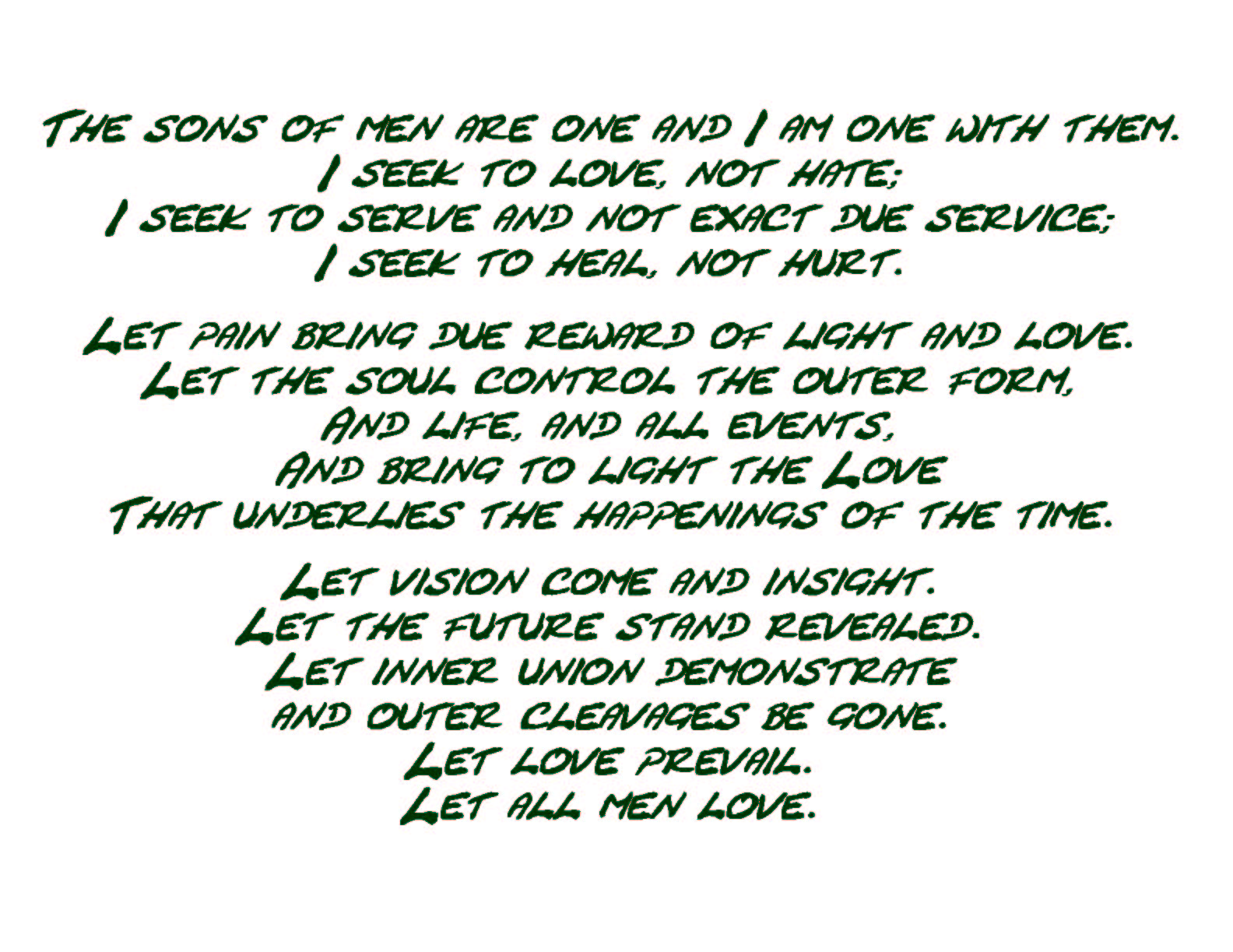
Part of another meditation that I learned and use and of which I have told you of before says “My soul must foster love among the sons of men, this is its major purpose“. Looking at this with our understanding being what it is today we should see this as the fact that it is; our Souls, our Inner Man, our Christ Within is a spiritual being and our True self who is not corrupted by the world and for whom this saying remains His mission. This mission is however only accomplished through the use of the conscious personality, by our ardent focus on the Kingdom of God as men in form we bring the Light and the Love of the Soul through the personality so that we can perform His work here on Earth.
I intended to go into the idea of Faith as it concerns our own beliefs but we went rather long here so we will begin with this in the next post along with a look at Jesus’ parables and sayings on Faith. We can however set the tone for this talk on Faith by saying that the Master’s standard on Faith is that “If ye have faith as a grain of mustard seed, ye shall say unto this mountain, Remove hence to yonder place; and it shall remove ; and nothing shall be impossible unto you” (Matthew 17:20) and this is a high standard to match and even to properly understand. He also puts this in other terms for us who cannot fathom Faith as a mustard seed saying: “whosoever shall say unto this mountain, Be thou removed , and be thou cast into the sea; and shall not doubt in his heart, but shall believe that those things which he saith shall come to pass; he shall have whatsoever he saith” (Mark 11:23) thereby making us to see the sameness in His standard of Faith; as Faith that is not doubting and Faith as a grain of mustard seed.
Today is 11-11-11 and there was a news story this morning that claimed this is a one in a century event and so it is and this is how many look at it, many have even looked forward to it. Something about perspective is in this statement though; is not every day a once in a century event? A similar idea about perspective can be found, at least in our thinking, in regard to the idea of Faith and the mustard seed which we will continue with in the next post.
Note on the Quote of the Day
This daily blog also has a Quote of the Day which may not be in any way related to the essay. Many of these will be from the Bible and some just prayers or meditations that may have an influence on you and are in line with the subject matter of this blog. As the quote will change daily and will not store with the post, it is repeated in this section with the book reference and comment. If you have not seen this before, this should be viewed as, like John and Jesus to the Jews, something new and different.
Love not the world, neither the things that are in the world. If any man love the world, the love of the Father is not in him. For all that is in the world, the lust of the flesh, and the lust of the eyes, and the pride of life, is not of the Father, but is of the world (1 John 2:15-16)
Borrowed this from today’s Verse of the Day from www.biblegateway.com as it shows the zeal of the Apostle for the accurate teachings of the Christ and the true meaning of following the Master, a meaning that is mostly lost in our view of Christianity today.