What did HE say? (continued)
Not on the Sabbath (part 3)
Completing our short look at the sabbath and the view that the Christ had regarding it as it appears in the gospels we come now to the spiritual idea enclosed and the intent of this commandment. It should be clear that He never refuted keeping the sabbath as a practice but always tried to instill some degree of the spirit of the law into what had become a purely mechanical practice in His eyes. He taught that for man to stop doing those things that were prudent and merciful because of what day it is has no place in real spiritual communion with God. For the most part, the sabbath and its ideals have left us today though the reasons are unclear. There are a few scattered Christian sects that do practice it although not in the way that it was intended and, it has been, for most who observe it, moved to Sunday.
Lost also is the whole idea of setting a day apart to focus on spiritual things. The commandment was “Remember the sabbath day, to keep it holy” (Exodus 20:8) and “Keep the sabbath day to sanctify it, as the LORD thy God hath commanded thee” (Deuteronomy 5:12). All the other words were to explain what a person should do as his part of this first word of the commandment which is to keep it holy, to sanctify it. The relationship between do no work and the 39 prohibited activities are ordinances made by men. The idea of do no work and that one would require no work from his servants and animals was intended to be seen from the perspective of holy and sanctified; do no work in honor of the Lord and keep the day holy and sanctify it. In addition to this there is the merciful treatment that it commanded toward one’s servants and beasts. What does holy and sanctify mean:
The single Hebrew word quadash is translated as both holy and sanctify. The Hebrew Lexicon says of quadash: to consecrate, sanctify, prepare, dedicate, be hallowed, be holy, be sanctified, be separate** which seems to be pretty straightforward. Webster’s 1913 dictionary gives us a bit more guidance in understanding this word holy as set apart to the service or worship of God; hallowed; sacred; reserved from profane or common use*. From this definition we can glean an understanding to the commandment as it was first formed. To do no work was the way of saying to those people that the day is reserved from profane or common tasks that it is set aside for the worship of God and thus is it kept holy and kept sanctified. However, men being men, the rulers and powers of the time turned this into a less than spiritual endeavor and, from the perspective of the law, set forth the doctrines of you can do this but you cannot do that. We cannot talk of their thoughts and their attitudes back in that day and only know what is passed on in scripture. The sabbath day was their day of worship and on that day they made their sacrifices as they were required.
There appears however no Love of God functioning as the reason for the day of rest, at least in the view that we have from the gospels and from the books of the Old Testament. This is not to be assumed true of all the people as there were likely devout and understanding Jews as well as those that the Master tells us about. Now Jesus took what He saw and described it as we have been discussing in the last posts on the theme of the sabbath creating a picture of an out of control church ritually going through the motions of the law but never bringing it to bear on their lives and of a people complacent in their reliance on the church for their salvation. Jesus chides the people concerning their ideas of holiness when, quoting Esaias, He says “…..Thus have ye made the commandment of God of none effect by your tradition. Ye hypocrites, well did Esaias prophesy of you, saying, This people draweth nigh unto me with their mouth, and honoureth me with their lips; but their heart is far from me. But in vain they do worship me, teaching for doctrines the commandments of men” (Matthew 15:6-9). Here is found the true understanding of the purport of the commandment on the sabbath and here too is found the carnal interpretation of men and the establishment of their tradition. Much of the same can be said today in regard to Christianity or, for that matter, any religion where the truth of bringing one’s heart to God is supplanted by a rite or a ritual that treats the matter only on the surface. In time we begin to believe that the tradition or the rite or the ritual is the required part. How hard it is then to change our focus back to our Source and to our God.
Now this is not the only place that the Master speaks to us of the heart and we have discussed this at length before. The heart is our conscious personality and it is this part of us that we need to give to the Lord and not to the everyday life we live in this world. This, of course, is done by focusing on the things of the Spirit, the things of God, and not looking for the convenient or the easy way to accomplish our religious life. This is Jesus’ message and it is this that is the foundation for all true religious life. For the Jews in the days of Moses the objective may have been to get the people to observe one day per week as holy to the Lord and to focus on Him on that day. To put aside all other things that could take up our attention other than worship and family. As we said earlier Jesus never did tell us to do away with the sabbath and what it represents. Rather, He left us with a deeper message as was His way regarding many of the commandments. Remember that He tells us that thinking lustfully about a woman is committing adultery in one’s heart and that being angry is likened to killing as that in anger is the cause of murders.
The deeper message is the Christian message. The Master never refuted any of the commandments that the Jews had from Moses. In fact, to the contrary He said: “Think not that I am come to destroy the law, or the prophets: I am not come to destroy, but to fulfil. For verily I say unto you, Till heaven and earth pass , one jot or one tittle shall in no wise pass from the law, till all be fulfilled” (Matthew 5:17-18). What the Master did say is encapsulated for us by the Apostle Paul in this saying: “….. but to love one another: for he that loveth another hath fulfilled the law. For this, Thou shalt not commit adultery, Thou shalt not kill, Thou shalt not steal, Thou shalt not bear false witness, Thou shalt not covet; and if there be any other commandment, it is briefly comprehended in this saying, namely, Thou shalt love thy neighbour as thyself. Love worketh no ill to his neighbour: therefore love is the fulfilling of the law” (Romans 13:8-10).
The great message of the Master is Love. In Love are all of the commandments fulfilled as there is no thing that we would do to another or to ourselves or to our sense of God if we truly Love. For the sake of clarity and for any who have not been reading these posts until now, let us again define Love and perhaps even expand a bit on it. First Love is active GoodWill and it is universal GoodWill. Love is found in the simple words of a recent Quote of the Day from Emmet Fox when he says that “I send out thoughts of love and peace and healing to the whole universe: to all trees and plants and growing things, to all beasts and birds and fishes, and to every man, woman and child on earth, without any distinction“. Without any distinction and to the whole universe is the kind of Love taught by the Christ and this is the Love that we are to be in and practicing every day. For the Jew it was one day a week; a start on spiritual living. For us, when we sense the way of Love, it is everyday and it is the way to the Kingdom.
Let us not forget that the Greek word for Love is agape (or agapao) which is translated as both Love and Charity. Now, for our definition of Love we combine the two and speak of Love and Charity together. The Greatest Commandment that Christ tells us of is a combination of two as well in saying “Thou shalt love the Lord thy God with all thy heart, and with all thy soul, and with all thy mind. This is the first and great commandment. And the second is like unto it, Thou shalt love thy neighbour as thyself. On these two commandments hang all the law and the prophets.” (Matthew 22:37-40). All the law and all the prophets and this including the law of the sabbath for if we Love God we are focused on Him at all times, we do not require the sabbath any longer.
What then is the Love the Lord thy God part of our definition from Webster’s? It is: In short, we love whatever gives us pleasure and delight, whether animal or intellectual; and if our hearts are right, we love God above all things, as the sum of all excellence and all the attributes which can communicate happiness to intelligent beings. In other words, the christian loves God with the love of complacency in his attributes, the love of benevolence towards the interest of his kingdom, and the love of gratitude for favors received“*. Having said this, what then is the Love thy neighbour? It is: In a general sense, love, benevolence, good will; that disposition of heart which inclines men to think favorably of their fellow men, and to do them good. In a theological sense, it includes supreme love to God, and universal good will to men“*
In these definitions from 1828 we get a clearer look at what the intent was of the translators and most importantly we get a glimpse of what the Christ meant in His sayings.
This then was the Master’s message when He spoke to the rulers regarding what He was doing on the sabbath; it was His message to those people as well and it is His message to us today. Avoid rites and rituals and tradition that do not bring one closer to God or show one’s Love toward his neighbour. In that day honoring the sabbath for the sake of the sabbath accomplished nothing; honoring the sabbath as a day set aside for God accomplished the goal. In Christ’s teaching for us however there is much more. His message to us is that we should honor God every day by honoring our brother. His message is that we should “seek ye the kingdom of God” (Luke 13:31) above all else.
This ends our look at the sabbath and what the Master had to say regarding it. As with all the law and the commandments that were, and still are, in effect from Moses, the Master taught us that we should not have any need to know them or perform them if the Greatest Commandment is kept in our hearts. As we have said in past posts His great commandment of Love is also taken up in the simple phrasing of the Golden Rule which is, as commonly put, DO UNTO OTHERS AS YOU WOULD HAVE THEM DO UNTO YOU. This is the way to true peace and Love.
Note on the Quote of the Day
This daily blog also has a Quote of the Day which may not be in any way related to the essay. Many of these will be from the Bible and some just prayers or meditations that may have an influence on you and are in line with the subject matter of this blog. As the quote will change daily and will not store with the post, it is repeated in this section with the book reference and comment.
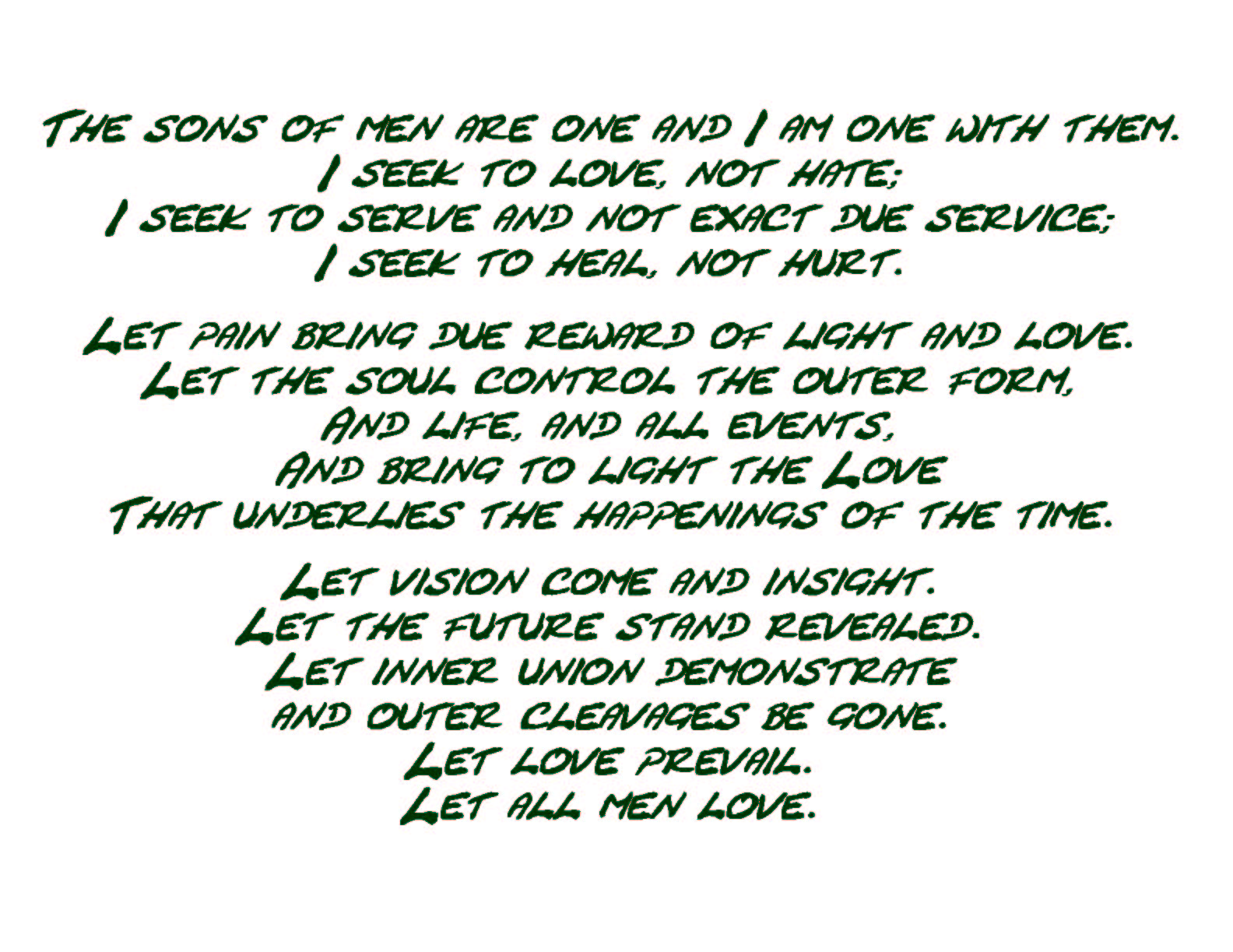
Yesterday’s Quote of the Day is the working out of this Golden Rule in our lives everyday and so we leave it again for today. The everyday Christian values that are cited here can be seen as the working of GoodWill, of Love for both God and our fellow man. In Truth, Justice and Cooperation with all; in knowing each our own responsibility to the Plan of God; and, in our willingness to sacrifice all selfishness in attitude to the good of all will be found our own salvation and the salvation of the World.
Values to Live By
A Love of Truth—essential
for a just, inclusive and progressive society;
A Sense of Justice—recognition
of the rights and needs, of all.
Spirit of Cooperation—based
on active goodwill and the principle of right human
relationships;
A Sense of Personal Responsibility—for
group, community and national affairs;
Serving the Common Good— through
the sacrifice of selfishness. Only what is good for all
is good for each one.
The world of the future depends on what each one of us chooses to do today.
This Quote of the Day is from World Goodwill
- * Websters Revised Unabridged Dictionary, 1828 and 1913
- ** Old Testament Hebrew Lexicon on BibleStudyTools.com