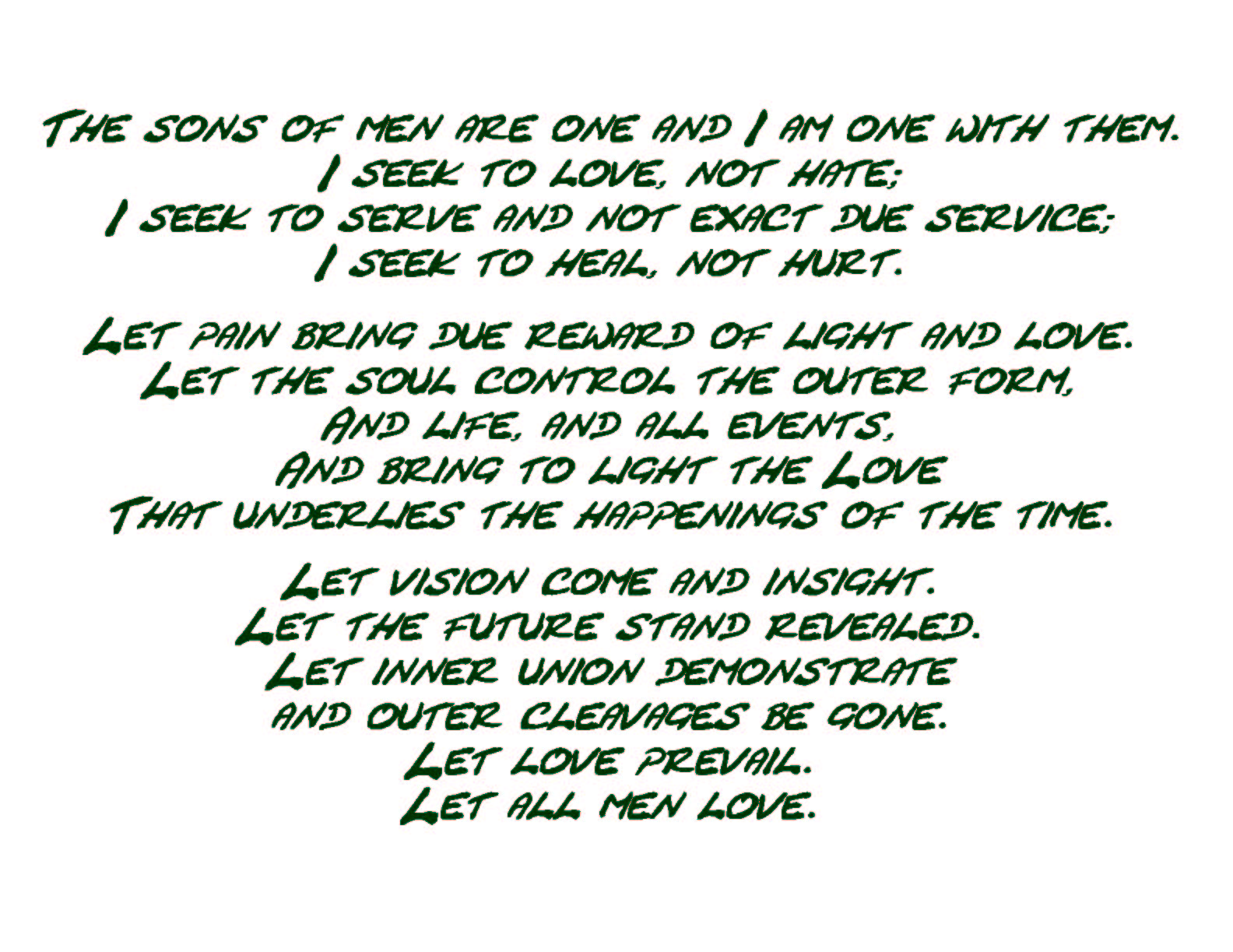
ON LOVE; PART MDXLXX
ΑΩ•ΑΩ•ΑΩ•ΑΩ•ΑΩ•ΑΩ•ΑΩ•ΑΩ•ΑΩ•ΑΩ•ΑΩ•ΑΩ•ΑΩ•ΑΩ•ΑΩ•ΑΩ•ΑΩ•ΑΩ
FIRST IS THE GREAT COMMANDMENTS: “The first of all the commandments is, Hear, O Israel; The Lord our God is one Lord: And thou shalt love the Lord thy God with all thy heart, and with all thy soul, and with all thy mind, and with all thy strength: this is the first commandment. And the second is like, namely this, Thou shalt love thy neighbour as thyself. There is none other commandment greater than these” (Mark 12:29-31).
ΑΩ•ΑΩ•ΑΩ
WHAT THEN IS LOVE? In a general sense love is benevolence, good will; that disposition of heart which inclines men to think favorably of their fellow men, and to do them good. In a theological sense, it includes supreme love to God, and universal good will to men. While this IS from an older definition of Charity, which IS rendered in the King James Bible from the same Greek word agape which IS generally rendered as Love, we should amend our own definition here to include the idea that in the reality of Love a man will accord to ALL men ALL things that he would accord to himself and to say that Love IS our thoughts and attitude of the equality of ALL men regardless of their outward nature or appearance…that ALL ARE equally children of Our One God.
ΑΩ•ΑΩ•ΑΩ
PLUS THE EVER IMPORTANT AND HIGH IDEAL TAUGHT TO US BY THE CHRIST: “Therefore all things whatsoever ye would that men should do to you, do ye even so to them” (Matthew 7:12).
ΑΩ•ΑΩ•ΑΩ•ΑΩ•ΑΩ•ΑΩ•ΑΩ•ΑΩ•ΑΩ•ΑΩ•ΑΩ•ΑΩ•ΑΩ•ΑΩ•ΑΩ•ΑΩ•ΑΩ•ΑΩ
We ended the last essay with a note saying that here in this new series of essays we will explore the True meanings of both fruit and of works. These words ARE ill understood by most ALL of the church and most DO not understand that the word rendered as fruit, karpos, offers us the same idea as works whenever it DOES NOT specifically refer to actual botanical fruit. Thayer’s defines the metaphoric use of karpos for us saying that: the idea IS: equivalent to ἔργον, work, act, deed 9; here ἔργον IS the Greek word ergon which IS always rendered in terms of works. While karpos IS used in both a good and a bad sense, good fruits versus bad fruits, ergon has the singular meaning of works. The point here IS that when we see the New Testament use of either word, the reference IS the same and what we should take from the idea IS that karpos, fruit, IS: that which originates or comes from something; an effect, result 9. There IS a compound reality here; while the ideas of works and fruits ARE used rather synonymously, fruit IS also the result of works according to this definition from Thayers.
That most ALL of the church believes that this idea of works IS unnecessary for one’s ‘salvation‘ IS Truly unfortunate and contrary to the Master’s own words. We ended the last essay with the Master’s words saying “Ye are the light of the world. A city that is set on an hill cannot be hid. Neither do men light a candle, and put it under a bushel, but on a candlestick; and it giveth light unto all that are in the house. Let your light so shine before men, that they may see your good works, and glorify your Father which is in heaven” (Matthew 5:14-16). These words alone should have been able to deflect the doctrinal ideas that works ARE NOT necessary to one’s ‘salvation‘ as it IS works, “good works” to be sure, that ARE men’s display of the Light that flows through them as Truth and agape Love. This idea of works IS used to refer to ALL that the Master DOES in this world; this we see through such sayings as “John had heard in the prison the works of Christ” (Matthew 11:2). We should also understand this idea of works in regard to the Godhead; this the Master shows us saying “I must work the works of him that sent me” (John 9:4). This idea of works should be easy to understand and we should see as well how that this transfers to the True believer which Jesus shows us saying “Verily, verily, I say unto you, He that believeth on me, the works that I do shall he do also; and greater works than these shall he do; because I go unto my Father” (John 14:12). We have discussed these words several times over the course of our essays, most often to discover the True meaning of “He that believeth on me” where we use Vincents words to show that the idea IS simply ‘he that keeps my words‘. “He that believeth on me” has a specific value; a value that we cite from Vincent as: to believe on the Lord Jesus Christ is not merely to believe the facts of His historic life or of His saving energy as facts, but to accept Him as Savior, Teacher, Sympathizer, Judge; to rest the soul upon Him for present and future salvation, and to accept and adopt His precepts and example as binding upon the life 4.
Today however our focus IS on the idea of works and the Master’s clear statement that those that keep His words which IS the ultimate reality of works, will have the same abilities as DID the Master who tells us that “the works that I do shall he do also; and greater works than these shall he do“. While most ALL of the church accepts this idea of “greater works” ONLY in regard to ministry, this IS NOT what the Master IS saying nor IS it in accord with His use of this idea of works. If works ARE ALL that the Master DOES, then the idea CAN NOT be reduced to ministry alone and we should try to see here that this idea of ministry IS NOT used by the Master in the gospels but IS introduced later by the Apostle Paul to describe the totality of Jesus’ works in this world. While these ideas should clearly show us that the idea of works IS a Christian principle, the church has relied upon their interpretations of the use of the idea by Paul. A clearer understanding of the Master’s use of the idea of works can be seen in such sayings as “the works that I do in my Father’s name, they bear witness of me” (John 10:25) and “the works which the Father hath given me to finish, the same works that I do, bear witness of me, that the Father hath sent me” (John 5:36). The Master’s point should be understood to be that He IS DOING the works of God, carrying forth the Power of the Godhead, and that we too can be “partakers of the divine nature” (2 Peter 1:4) as Peter shows us.
Paul’s use of this idea of works IS NOT the same as that of the Master but IS rather intended to show the ways of the Jews, their doctrinal practices if you will. While Paul rails against this idea of works, which we define as DOING what we doctrinally believe IS scriptural rather than what IS actually scriptural, he does so in a way of comparison by using the ideas of faith and grace. Most ALL of the church has lost the reality of Paul’s words as they have converted his ideas into their doctrinal interpretations. These interpretations serve the purpose of the need for the carnal man to ‘believe’ that he IS ‘saved‘ without having to DO anything and it IS this deception that IS pointed out by James who tells us to “be ye doers of the word, and not hearers only, deceiving your own selves” (James 1:22). In past essays we have pointed to James words on faith and works, words that seem contrary to Paul’s words, as his attempt to correct the misuse and misunderstanding of Paul’s words and while we DO NOT KNOW that this was James’ intent, his words DO serve that purpose. But James’ words have NOT been able to correct the misuse and misunderstanding of Paul’s words and, from our point of view, this IS become a major problem for the churches.
A compounding of the churches’ problem IS found in the way that the apostles’ words have been segmented and taken out of context, used as standalone statements if you will. Much of the apostles’ intent IS lost in DOING so as their words ARE made to apply to specific doctrinal ideas rather than the context in which they were offered. Perhaps another way of looking at Paul’s words, one that we have NOT studied much in past essays, can be found in the dichotomy between carnal and spiritual; works DONE as a carnal man according to the Master’s words ARE those against which Paul rails in his epistles. The Master gives us three examples of such carnal works along with a spiritual idea that would NOT qualify as works according to Paul’s text. We should understand however that Paul DOES NOT get into the spiritual ideas save for his promotion of the ideas of pistis and pisteuo which ARE rendered as the nebulous ideas of faith and believing. Jesus tells us:
“Take heed that ye do not your alms before men, to be seen of them: otherwise ye have no reward of your Father which is in heaven. Therefore when thou doest thine alms, do not sound a trumpet before thee, as the hypocrites do in the synagogues and in the streets, that they may have glory of men. Verily I say unto you, They have their reward. But when thou doest alms, let not thy left hand know what thy right hand doeth: That thine alms may be in secret: and thy Father which seeth in secret himself shall reward thee openly. And when thou prayest, thou shalt not be as the hypocrites are: for they love to pray standing in the synagogues and in the corners of the streets, that they may be seen of men. Verily I say unto you, They have their reward. But thou, when thou prayest, enter into thy closet, and when thou hast shut thy door, pray to thy Father which is in secret; and thy Father which seeth in secret shall reward thee openly. Moreover when ye fast, be not, as the hypocrites, of a sad countenance: for they disfigure their faces, that they may appear unto men to fast. Verily I say unto you, They have their reward. But thou, when thou fastest, anoint thine head, and wash thy face; That thou appear not unto men to fast, but unto thy Father which is in secret: and thy Father, which seeth in secret, shall reward thee openly” (Matthew 6:1-6, 16-18).
While these instructions ARE clearly stated, they ARE for the most part ignored by most men, Christian and non-Christian alike. There seems an overriding need in the hearts of most to make public their ‘spiritual’ intentions. However, should we understood the ideas presented by the Master in terms of those works derided by Paul, we can perhaps come to a better understanding of his point and be better able to comport Paul’s words with those of James. The Master’s point IS taken from the habits of the Jews who made public ALL forms of the worship that they performed and performed here IS the active idea. Their giving becomes works, their prayer becomes works and their fasting becomes works. We should understand here that these ARE but examples and that ALL performances by men seeking to have themselves seen as better by other men ARE the type of works that Paul IS concerned with. It IS the motivation that makes what men DO works according to Paul’s words and it IS the same motivation that makes what men DO works according to the framing of the ideas by James. That this has been missed in the churches for centuries has caused many millions to miss the reality of their own True ‘salvation‘ in their Lifetimes. Our works ARE the result of our pistis and our pisteuo which Greek words have been minimized by referring them to the common ideas of faith and believing. As we have discussed often in our blog posts, these Greek words should be understood in terms of KNOWING God and thereby KNOWING some measure of the Truth. It IS this that we should take from such words from the Master as “whosoever shall say unto this mountain, Be thou removed, and be thou cast into the sea; and shall not doubt in his heart, but shall believe that those things which he saith shall come to pass; he shall have whatsoever he saith” (Mark 11:23). This IS KNOWING and NOT the doctrinally nebulous idea of believing and it IS this KNOWING that unleashes the Power of the Godhead in our lives.
It IS in the KNOWING that comes upon us as pistis that enables men to DO what they KNOW they can and must DO and in this DOING IS the spiritual reality of works as that idea IS used biblically. But the church has NOT seen this reality as they interpret Paul’s words into their doctrinal assertion that a man need DO nothing but believe and have faith while these nebulous ideas fail to bring about the DOING and the KNOWING that IS the necessary component for True salvation. We should note here that this word salvation IS also a nebulous idea in Christianity; it has little or no True meaning in the lives of men who await an also nebulous heaven after death. This idea of salvation IS from the Greek word soteria which Strong’s defines simply as: feminine of a derivative of G4990 as (properly, abstract) noun; rescue or safety (physically or morally)9a. In this we should see the simplicity of the rescue or safety of our spiritual lives from the abyss of the vanity into which ALL ARE born. Paul’s use of the idea of works has been used as a crutch in most ALL of Christianity and one that allows men to believe that they ARE saved without any concern about being “doers of the word, and not hearers only, deceiving your own selves“. In this belief that IS a primary teaching of much of the church, men never realize their own deception and this IS a grave error for the Souls of men to try to overcome.
Paul’s use of the idea of works which IS from the Greek word ergon IS understood ONLY as a carnal conception of things done. This IS according to the defining ideas applied to the Greek word which Strong’s shows us as: (to work); toil (as an effort or occupation); to this they add the idea that the word IS: by implication, an act but this later part IS also seen carnally. In these ideas the works that the Master refers to ARE absent and we should try to understand that it IS neither of these understandings of ergon, works, that Paul IS using in his words on the failure of works. Paul IS essentially speaking to Jews and while his audience contains Christians, most ALL of these ARE converted from Judaism. It IS in the Jew’s traditions and in their doctrines that Paul sees the problem of ergon and it IS a specific problem that Christianity has largely misunderstood and misapplied to include the more spiritually minded ideas of works; those of which the Master speaks. To understand this we need ONLY to look at the Master’s words that condemn the actions of the Jews who supplanted the Truth with their traditions and their doctrines. In Jesus’ dialogue that tells us of the fruitlessness of the doctrines of men, He shows us examples of such things that the Jews DID to supplant the Truth and make Life easier for the man in this world. In Mark’s Gospel we read:
“Then came together unto him the Pharisees, and certain of the scribes, which came from Jerusalem. And when they saw some of his disciples eat bread with defiled, that is to say, with unwashen, hands, they found fault. For the Pharisees, and all the Jews, except they wash their hands oft, eat not, holding the tradition of the elders. And when they come from the market, except they wash, they eat not. And many other things there be, which they have received to hold, as the washing of cups, and pots, brasen vessels, and of tables. Then the Pharisees and scribes asked him, Why walk not thy disciples according to the tradition of the elders, but eat bread with unwashen hands? He answered and said unto them, Well hath Esaias prophesied of you hypocrites, as it is written, This people honoureth me with their lips, but their heart is far from me. Howbeit in vain do they worship me, teaching for doctrines the commandments of men. For laying aside the commandment of God, ye hold the tradition of men, as the washing of pots and cups: and many other such like things ye do. And he said unto them, Full well ye reject the commandment of God, that ye may keep your own tradition. For Moses said, Honour thy father and thy mother; and, Whoso curseth father or mother, let him die the death: But ye say, If a man shall say to his father or mother, It is Corban, that is to say, a gift, by whatsoever thou mightest be profited by me; he shall be free. And ye suffer him no more to do ought for his father or his mother; Making the word of God of none effect through your tradition, which ye have delivered: and many such like things do ye” (Mark 7:1-13).
Mark offers us the most expansive view of this encounter with the Pharisees and scribes; Matthew’s version IS much shorter and Luke and John DO NOT cover it at ALL. it IS in this section however that we should see the idea of the traditions and doctrines that Paul calls works and against which he ofttimes rails. Following their traditions IS works; adhering to their doctrines IS works and it IS against these that Paul offers the better way in faith and believing, in pistis and pisteuo rightly understood. Can we see Paul’s point that the Jews should look away from their practices of traditions and adherence to their doctrines, “the commandments of men“, and toward the spiritual sense of KNOWING that IS encompassed in the Truth of the commandments by which the Jews lived. The idea was never meant to be understood as it IS today. What would have been subject to Paul’s use of the idea of works in the Christian church IS the way in which the Christian world followed the Jews by their establishment of doctrines that supplant the Truth of the Master’s words. It IS the practices of the Christian world that ARE the works against which Paul writes and the faith that should replace these works IS found in simply keeping His words. This reality of faith IS according to the defining ideas of pistis; Strong’s tells us that pistis IS: persuasion, i.e. credence; moral conviction (of religious truth, or the truthfulness of God or a religious teacher 9a. True faith then IS being persuaded by His words, giving credence to His edicts by accepting His words as True and having the moral conviction that in His word IS the Truth. Contrary to these realities of faith stands the churches’ faith which IS NOT in the words of the Master but rather in the dictates of their own doctrines. It IS here again that we should apply the Master’s words saying “in vain do they worship me, teaching for doctrines the commandments of men“.
Understanding this gives a whole new meaning to Paul’s words on works and faith. In his Epistle to the Galatians Paul tells us that “Knowing that a man is not justified by the works of the law, but by the faith of Jesus Christ, even we have believed in Jesus Christ, that we might be justified by the faith of Christ, and not by the works of the law: for by the works of the law shall no flesh be justified” (Galatians 2:16). We begin here with the idea of being justified which IS rendered from the Greek word dikaioo. The simple meaning here IS: to render (i.e. show or regard as) just or innocent 9a and we should note that there IS NO religiosity in this definition. Vincent offers us a view of being justified from another of Paul’s epistles saying that Paul IS: emphasizing the actual moral renewal, which is the true idea of justification 4 and this idea of actual moral renewal works well with our understanding of pistis above which, we should also note, IS the reality of KNOWING. KNOWING IS our moral conviction; KNOWING persuades us to give credence to the words of the Master. A man then has NO moral renewal through “the works of the law” and here we should understand that the reference IS NOT to the True laws of Moses but rather to the doctrinal manipulation that became the Jews’ religion. This IS an important distinction and we should be able to understand this through the defining ideas applied to nomos which IS rendered as law. Strong’s tells us that nomos IS both law and regulation 9a and here we should understand that it can apply to the actual laws of Moses as well as the doctrinal manipulation that became the Jews’ religion. Thayer’s goes a bit further saying that nomos IS: anything established, anything received by usage, a custom, usage, law; before saying clearly that nomos IS any law whatsoever. While it IS difficult to separate the actual spiritual laws given to the Jews by Moses from the ancillary laws that he himself established in an effort to guide the people, we DO get some help from the Master who speaks openly and reinterprets the True laws of the Godhead.
The Master focuses on only a few of the 613 commandments that comprise the Jews’ mitzvah, their doctrinal view of the laws. Here we should try to understand that the rest ARE rather meaningless as ALL that IS necessary IS bound to those that Jesus DOES address. We should add here that the Master also includes ideas that were NOT in the Ten Commandments or, better, NOT in the versions that have been handed down in the writings of men. One of these IS become the primary commandment of Christianity albeit one that IS NOT understood because of its presentation over the last 2000 years. This IS of course the commandment that “Thou shalt love thy neighbour as thyself” (Matthew 19:19). This commandment IS cited in this way eight times in the gospels and epistles and it IS offered twice by Paul to show its importance in True Christianity. Paul tells us that “all the law is fulfilled in one word, even in this; Thou shalt love agapao thy neighbour as thyself” (Galatians 5:14) and that “For this, Thou shalt not commit adultery, Thou shalt not kill, Thou shalt not steal, Thou shalt not bear false witness, Thou shalt not covet; and if there be any other commandment, it is briefly comprehended in this saying, namely, Thou shalt love agapao thy neighbour as thyself” (Romans 13:9). The church however seems to ignore these words from Paul while they accept as commandments his words on faith and works, words that ARE taken both out of context and applied with little or NO understanding of their real intent. We should remember as well that when asked about “the great commandment in the law” (Matthew 22:36) or “Which is the first commandment of all” the Master replies saying “thou shalt love agapao the Lord thy God with all thy heart, and with all thy soul, and with all thy mind, and with all thy strength: this is the first commandment. And the second is like, namely this, Thou shalt love agapao thy neighbour as thyself. There is none other commandment greater than these” (Mark 12:30-31).
These foundational precepts of the New Testament and therefore Christianity itself ARE ignored by most ALL of the church in favor of their doctrinal ideas regarding works, faith and grace by some and an array of sacraments and rituals by others. What we should, must is the better idea, see however IS that DOING this, expressing agape to ALL, IS the works that ALL men from ALL religions and in ALL the world should DO for True salvation. Again, Paul’s idea of the law in regard to works IS NOT these commandments, nor any of those that the Master reinterprets for us, nor any that Paul repeats in his Epistle to the Romans cited above. Paul’s idea of the law IS the doctrinal ideas of the Jews and, by extension the doctrinal ideas of Christianity that DO NOT comport with the Master’s words. This however IS NOT understood in the church yet today where any attempt by men to comport their lives with the True commandments of the Lord IS considered as works.
Having discussed the ideas of justification and the law from Paul’s words on faith and works, we move on to the next phrase for discussion: “the faith of Jesus Christ“. The idea of faith from the Greek word pistis has been one of the words, like agape, that we have put into a class of words that ARE entirely misunderstood and incorrectly applied to the lives of men. Pistis should be understood ONLY as KNOWING some measure of the Truth and NOT according to the nebulous ways that it IS used in the churches, ways that ARE ever more related to hope than to the certainty that IS the intent. Our position on this defining idea of pistis IS from the Master’s words as well as the many uses by His apostles. Jesus tells us such things as “Because of your unbelief: for verily I say unto you, If ye have faith as a grain of mustard seed, ye shall say unto this mountain, Remove hence to yonder place; and it shall remove; and nothing shall be impossible unto you” (Matthew 17:20). Two things here; first IS the idea of “faith as a grain of mustard seed“. In this phrase there IS NO relationship to the size of the seed as supposed by many but rather the reality that the “mustard seed” KNOWS ONLY one thing, that it IS a seed and that if properly cared for will become “the greatest among herbs, and becometh a tree, so that the birds of the air come and lodge in the branches thereof” (Matthew 13:32). This IS what the “mustard seed” KNOWS, this IS its faith. The second IS the outcome of this KNOWING, of this KNOWING God and being able to express this KNOWING through one’s heretofore carnal nature: that “nothing shall be impossible unto you“. In Matthew’s Gospel this idea IS further clarified by the Master who tells us “If ye have faith, and doubt not, ye shall not only do this which is done to the fig tree, but also if ye shall say unto this mountain, Be thou removed, and be thou cast into the sea; it shall be done” (Matthew 21:21). Here the idea of the “mustard seed” IS replaced by the idea of having faith without doubt and in this the idea of KNOWING should be clearly understood as that this IS NOT hope by simply KNOWING.
Mark offers us another version of this and one that IS abused by much of the church and made to reinforce their doctrinal ideas of faith. In Mark we read “Have faith in God. For verily I say unto you, That whosoever shall say unto this mountain, Be thou removed, and be thou cast into the sea; and shall not doubt in his heart, but shall believe that those things which he saith shall come to pass; he shall have whatsoever he saith. Therefore I say unto you, What things soever ye desire, when ye pray, believe that ye receive them, and ye shall have them” (Mark 11:22-24). The True KEY here IS the idea that one “shall not doubt in his heart“; this IS the equivalent of KNOWING and a phrase that gives extra strength to the Greek word pisteuo which IS rendered as believe. The doctrinal KEY, especially for the so called ‘name it and claim it’ denominations and sects, IS however the idea of “whatsoever he saith” followed up by the ideas of the next verse saying “What things soever ye desire, when ye pray, believe that ye receive them, and ye shall have them“. Without the modifying idea of KNOWING these words ARE used doctrinally to enable a man to gain whatsoever IS his desire but we should note here that as with any doctrinal idea of faith, there IS little success. It IS here that doctrines will claim that one’s lack of success in any desire IS because one DOES NOT have sufficient faith to claim that desire. It IS here that the True nebulous nature of the doctrinal ideas of faith and believing ARE exposed. This doctrinal interpretation of the Master’s words according to Mark ARE a foundational aspect, along with numerous Old Testament ideas, of the intended success of the so called prosperity gospel teachings, teachings that most always result in the fortunes of the leaders of the church with ONLY hope and despair for the congregants. While the problems with these doctrinal views ARE many because the conflict with the majority of the Master’s words, they ARE nonetheless used and most often in regard to money; fame and fortune ARE what men inherently desire. A simple example of this conflict IS shown in the Master’s words saying:
- “Lay not up for yourselves treasures upon earth, where moth and rust doth corrupt, and where thieves break through and steal: But lay up for yourselves treasures in heaven, where neither moth nor rust doth corrupt, and where thieves do not break through nor steal: For where your treasure is, there will your heart be also” (Matthew 6:19-21) with treasure understood as ALL things carnal that take the attention of men.
- “No man can serve two masters: for either he will hate the one, and love the other; or else he will hold to the one, and despise the other. Ye cannot serve God and mammon” (Matthew 6:24) with mammon properly understood as ALL things carnal.
- “How hardly shall they that have riches enter into the kingdom of God! And the disciples were astonished at his words. But Jesus answereth again, and saith unto them,Children, how hard is it for them that trust in riches to enter into the kingdom of God! It is easier for a camel to go through the eye of a needle, than for a rich man to enter into the kingdom of God” (Mark 10:23-25).
The last idea here IS countered by doctrines using the Master’s words on salvation as He responds to the disciples question asking “Who then can be saved?“. Here Jesus answers saying “With men it is impossible, but not with God: for with God all things are possible” (Mark 10:26, 27). Through this many believe that God will grant them the ability to be both rich and have salvation. The entirety of the denominations that teach the prosperity gospel, the ‘name it and claim it’ groups, indeed much of the ‘word of faith’ groups, ARE deluded by their own manipulation of the Master’s words and, in our view, much of this IS done by the leaders of these groups for their personal benefit. That they hold out the hope, disguised as faith, for the fulfillment of men’s desires IS a True abomination and one that IS called out by the Master in such sayings as “Beware of false prophets, which come to you in sheep’s clothing, but inwardly they are ravening wolves“. And while Jesus includes the way that men can discern the false from the True, His words ARE overwhelmed by the hopes of men that ARE put forth by such wolves. The Master tells us that “Ye shall know them by their fruits” and that “by their fruits ye shall know them” (Matthew 7:15, 16, 20) but His words ARE NOT measured against the reality of the fruits of their teachers by rather by their own hopes and desires for the profits of their vanity. And vanity it IS that encompasses much of the church that relies upon their doctrines, their own sense of works which ARE disguised as faith in such ways as to make moot James’ words saying “be ye doers of the word, and not hearers only, deceiving your own selves” (James 1:22). While it may be hard to fathom the idea that so much of the church IS deluded and deceived, we should note that this IS self-deception. While the “false prophets” and false teachers may encourage men to feign the very idea of works as such ARE described in the doctrines of men, it IS ultimately the responsibility of every individual to rise above such teachers and understand the Truths that ARE the Master’s words.
Throughout this essay we have tried to establish the reality of the works that Paul refers to in his epistles, a reality that IS seemingly intentionally missed by so much of the church. Paul IS railing against the DOING of those things that the Jews DID in place of the True essence of the True commandments. Above we cited the examples that the Master offers regarding the commandment to “Honour thy father and thy mother” and the Jews work around ideas that avoid this. Above also IS the idea of washing, a doctrinal requirement of the Jews which may be related to the ideas of cleansing and purity from the Old Testament but which rules ARE made up out of whole cloth. This IS the type of works that Paul addresses and, for the Christian world, there ARE equally similar requirements that ARE NOT so in the words of the Master, “the author and finisher of our faith“. Jesus deals equally with such ideas as stoning through His encounter with the woman caught in adultery and in regard to sacrifice He tells the Jews to “go ye and learn what that meaneth, I will have mercy, and not sacrifice“. ALL of these ideas ARE among the works that Paul decries in his epistles and, to be sure, such works DO NOT include those that result from keeping His words; this the Master shows us saying “Ye are the light of the world.….Let your light so shine before men, that they may see your good works, and glorify your Father which is in heaven“. We end today with our trifecta of Jesus’ words saying:
- “If ye continue in my word, then are ye my disciples indeed; And ye shall know the truth, and the truth shall make you free” (John 8:31-32).
- “Not every one that saith unto me, Lord, Lord, shall enter into the kingdom of heaven; but he that doeth the will of my Father which is in heaven” (Matthew 7:21).
- “He that hath my commandments, and keepeth them, he it is that loveth me: and he that loveth me shall be loved of my Father, and I will love him, and will manifest myself to him. Judas saith unto him, not Iscariot, Lord, how is it that thou wilt manifest thyself unto us, and not unto the world? Jesus answered and said unto him, If a man love me, he will keep my words: and my Father will love him, and we will come unto him, and make our abode with him. He that loveth me not keepeth not my sayings: and the word which ye hear is not mine, but the Father’s which sent me” (John 14:21-24).
We will continue with our thoughts in the next post.
| Aspect | Potency | Aspect of Man | In Relation to the Great Invocation | In relation to the Christ |
| GOD, The Father | Will or Power | Spirit or Life | Center where the Will of God IS KNOWN | Life |
| Son, The Christ | Love and Wisdom | Soul or Christ Within | Heart of God | Truth |
| Holy Spirit | Light or Activity | Life Within | Mind of God | Way |
- 2 New Testament Greek lexicon on biblestudytools.com
- 4 Word Studies in the New Testament; Marvin R Vincent D.D. 2nd edition
- 9 Thayer’s Greek Lexicon on blueletterbible.org
- 9a The New Strong’s Exhaustive Concordance of the Bible on blueletterbible.org
those who walk on the well-trodden path always throw stones at those who are showing a new road
Voltaire, Writer and Philosopher