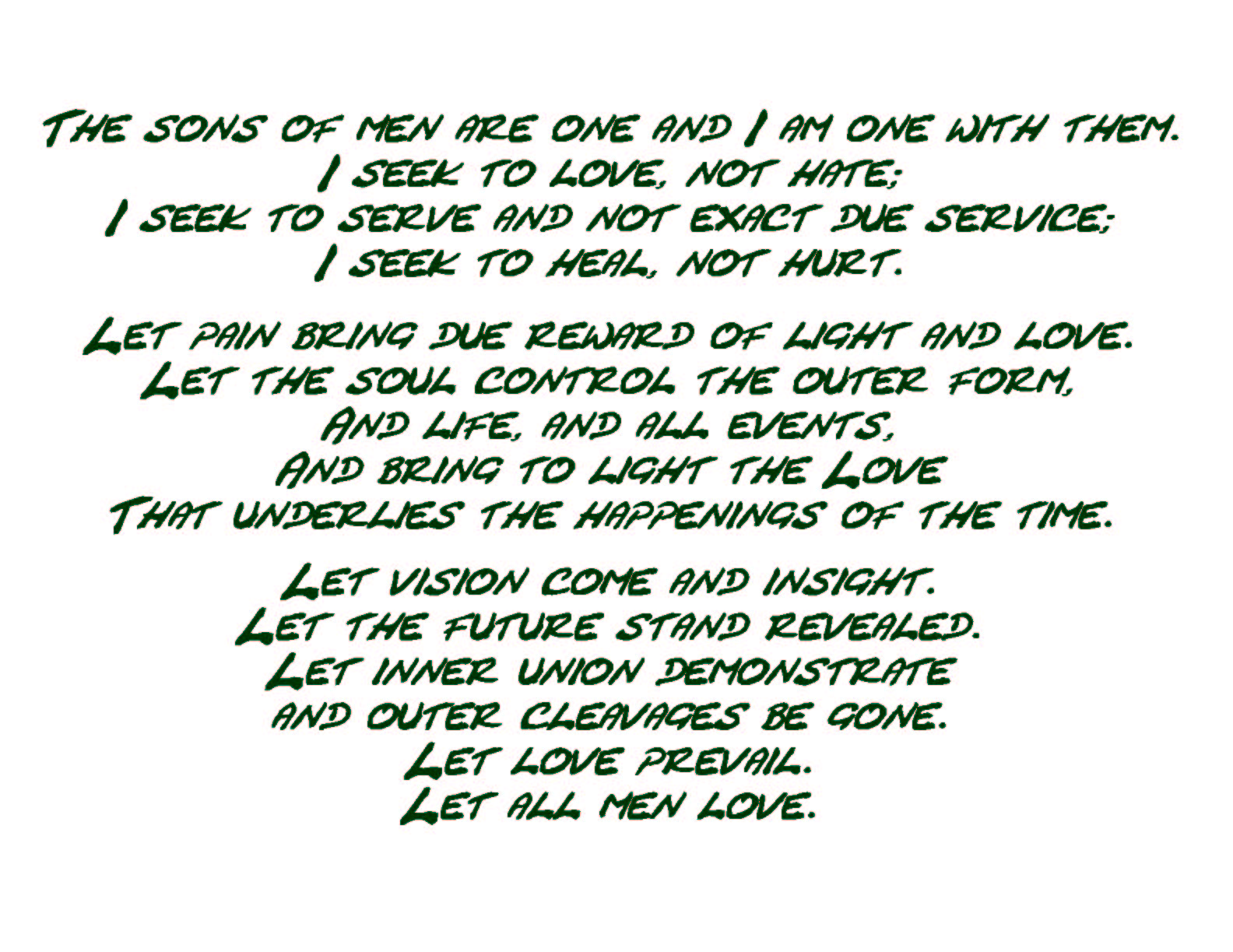
ON LOVE; PART MDLXVI
ΑΩ•ΑΩ•ΑΩ•ΑΩ•ΑΩ•ΑΩ•ΑΩ•ΑΩ•ΑΩ•ΑΩ•ΑΩ•ΑΩ•ΑΩ•ΑΩ•ΑΩ•ΑΩ•ΑΩ•ΑΩ
FIRST IS THE GREAT COMMANDMENTS: “The first of all the commandments is, Hear, O Israel; The Lord our God is one Lord: And thou shalt love the Lord thy God with all thy heart, and with all thy soul, and with all thy mind, and with all thy strength: this is the first commandment. And the second is like, namely this, Thou shalt love thy neighbour as thyself. There is none other commandment greater than these” (Mark 12:29-31).
ΑΩ•ΑΩ•ΑΩ
WHAT THEN IS LOVE? In a general sense love is benevolence, good will; that disposition of heart which inclines men to think favorably of their fellow men, and to do them good. In a theological sense, it includes supreme love to God, and universal good will to men. While this IS from an older definition of Charity, which IS rendered in the King James Bible from the same Greek word agape which IS generally rendered as Love, we should amend our own definition here to include the idea that in the reality of Love a man will accord to ALL men ALL things that he would accord to himself and to say that Love IS our thoughts and attitude of the equality of ALL men regardless of their outward nature or appearance…that ALL ARE equally children of Our One God.
ΑΩ•ΑΩ•ΑΩ
PLUS THE EVER IMPORTANT AND HIGH IDEAL TAUGHT TO US BY THE CHRIST: “Therefore all things whatsoever ye would that men should do to you, do ye even so to them” (Matthew 7:12).
ΑΩ•ΑΩ•ΑΩ•ΑΩ•ΑΩ•ΑΩ•ΑΩ•ΑΩ•ΑΩ•ΑΩ•ΑΩ•ΑΩ•ΑΩ•ΑΩ•ΑΩ•ΑΩ•ΑΩ•ΑΩ
We ended the last essay with some thoughts on the final line of the Apostle James’ segment on faith and works. Throughout James tells us that “faith, if it hath not works, is dead“; he frames this in several ways with his final entry being “as the body without the spirit is dead, so faith without works is dead also“. Comparing “faith without works” to “the body without the spirit” IS perhaps the most emphatic way to tell us that the relationship between faith and works IS indelible. When we began this discussion on James’ words we tried to show that his words ARE NOT in conflict with the words of Paul with which we began this series of essays. Paul tells us that “by grace are ye saved through faith; and that not of yourselves: it is the gift of God: Not of works, lest any man should boast. For we are his workmanship, created in Christ Jesus unto good works, which God hath before ordained that we should walk in them” (Ephesians 2:8-10). We tried to explain that in Paul’s words there ARE two uses of the Greek word ergon which IS rendered as works. He tells us first that salvation IS “Not of works” and then admonishes us to have “good works” because such ARE ordained of God. The Greek word here IS proetoimazo which, while rendered as the phrase “hath before ordained“, DOES HAVE a more technical definition which IS: to prepare before, to make ready beforehand 9 according to Thayers and to fit up in advance (literally or figuratively) according to Strong’s 9a. These defining ideas remove the doctrinal idea of ordained which has both doctrinal leanings and incorporates the idea of something established by: rule or decree or of events dictated by fate or destiny. Paul’s use of proetoimazo IS NOT intended to put forth either idea but rather to show us that “good works” have be prepared for us to DO by the Godhead. This IS the way many other translations render this idea.
Paul speaks about works and “good works” in totally different tones yet the common idea promoted by doctrines IS that: men cannot earn their way to heaven through good works or deeds ***. This understanding of the apostle’s words totally destroys Paul’s intent in writing that “we are his workmanship, created in Christ Jesus unto good works, which God hath before ordained that we should walk in them“. While this interpretation helps the doctrinal narrative, it IS a fully misleading idea that has led to other equally misleading interpretations of Paul’s intent. A common doctrinal idea IS that while a person IS ‘saved‘ by God’s grace through faith, it IS his ‘salvation‘ that results in a life of “good works“; in this the church maintains their attitude that one must have faith to be saved. A common sense look at this idea however shows the error of this theology; millions upon millions ARE considered saved doctrinally yet so few show any results in a life of “good works“. Yet they ARE considered saved especially under the doctrine of ‘once saved, always saved‘ which IS held by several major denominations. It IS denied by other denominations that view the idea as that one can lose ‘salvation‘ through ‘persistent, unrepentant sin or by abandoning their faith‘. Overall, the idea that one’s ‘salvation‘ results in a life of “good works” fails on many levels and while there may be some that DO exhibit “good works“, we should try to see that it such “good works” that led them to salvation and that it IS NOT the result of some doctrinal ceremony or altar call.
James on the other hand speaks ONLY of “good works” of the kind of works that the Master tells us of in saying “Let your light so shine before men, that they may see your good works, and glorify your Father which is in heaven” (Matthew 5:16). These works ARE the cause of one’s True salvation and result in our ability to have True faith, our ability to Truly KNOW God. This relationship between faith and works works in two directions; in True faith, in Truly KNOWING God one will perforce DO such “good works“, DOING so becomes one’s nature. Alternatively it IS also our DOING “good works” that allows us to have True faith, to KNOW God; this IS practical reality of keeping His words which IS the primary “good works” that a man can DO. It IS in our measure of keeping His words that we increase our measure of faith, our measure of KNOWING God and increase our capacity to be expressions of agape in this world. ALL of this IS clearly explained in the Master’s words and in the clarifying and amplifying words of His apostles. Unfortunately little of this IS realized by the doctrinal churches which have spent centuries recycling out of context snippets of the Master words and those of His apostles; snippets that have become the core ideas of their doctrines. It IS this same thing that was DONE by the Jews who, instead of taking snippets, fully converted the True biblical ideas into their traditions and their mitzvah, their interpretations of the law. The Christian result IS very similar however as their snippets ARE combined with their dilution and conversion of True biblical ideas to form their own mitzvah, their own sense of doctrines. It IS against this perversion of the Truth that the Prophet Isaiah spoke and it IS his words that the Master repeated 2000 years ago as a continued warning to the Jews. It IS also a prophetic warning to ALL that promote doctrines over the Truth. The Master tells us clearly “Well hath Esaias prophesied of you hypocrites, as it is written, This people honoureth me with their lips, but their heart is far from me. Howbeit in vain do they worship me, teaching for doctrines the commandments of men” (Mark 7:6-7).
While much of the Christian church denies that these words apply to them, the very structure of the Master’s statement belies this theological opinion. In the doctrinal view of much of the church these words are against traditions and practices and see a warning in His words against legalism. Many see this idea of legalism in the “good works” when they ARE intended to attain God’s favor while we see legalism as the practice of the rites and rituals of church doctrines. The doctrinal idea is carried forward from the previous text section where the topic IS the traditions of the Jews and its being held above the reality of the law. In both Matthew and Mark the point IS NOT that the Master is against the Jews use of tradition but rather their use of their traditions in place of the Truth of the law; their use of their traditions had become their doctrines. The clear statements that follow, those we cite above, ARE NOT concerned with traditions as such, nor ARE they concerned with practices; they ARE concerned with doctrines. While the Jews doctrines resulted in traditions and practices, physical DOINGS that reflected their doctrinal approach, the Christian doctrines have had a similar effect. Ofttimes Christian doctrines become traditional DOINGS such as taking communion, confession and praise and worship, while at other times Christian doctrines ARE merely the replacing of ideas. Such ideas as we have been discussing regarding faith and works ARE an example; doctrines have taken snippets of Paul’s writings and created a doctrine that runs counter to the Truth of the Master’s words. Doctrines tell men that they attain heaven by faith and believing while the Master tells us that we attain heaven by keeping His words. The key word in the Master’s statement IS doctrines, the “teaching for doctrines the commandments of men” and we should understand this Greek word as: instruction (the function or the information). Regardless of what IS taught, “the washing of cups, and pots, brasen vessels, and of tables” (Mark 7:4) as Jesus accuses the Jews or the teaching of commandments made up by men in Christianity, ALL lead men to the same result which Jesus shows us as “in vain do they worship me“. Repeating James words on faith and works:
“What doth it profit, my brethren, though a man say he hath faith, and have not works? can faith save him? If a brother or sister be naked, and destitute of daily food, And one of you say unto them, Depart in peace, be ye warmed and filled; notwithstanding ye give them not those things which are needful to the body; what doth it profit? Even so faith, if it hath not works, is dead, being alone. Yea, a man may say, Thou hast faith, and I have works: shew me thy faith without thy works, and I will shew thee my faith by my works. Thou believest that there is one God; thou doest well: the devils also believe, and tremble. But wilt thou know, O vain man, that faith without works is dead? Was not Abraham our father justified by works, when he had offered Isaac his son upon the altar? Seest thou how faith wrought with his works, and by works was faith made perfect? And the scripture was fulfilled which saith, Abraham believed God, and it was imputed unto him for righteousness: and he was called the Friend of God. Ye see then how that by works a man is justified, and not by faith only. Likewise also was not Rahab the harlot justified by works, when she had received the messengers, and had sent them out another way? For as the body without the spirit is dead, so faith without works is dead also” (James 2:16-26).
The apostle’s point here IS similar to Jesus telling us that “in vain do they worship me“. Having the nebulous faith of doctrines without works IS empty faith; it IS faith that IS: a fault, a folly, faith that matan signifies as in vain, to no purpose according to Vine’s 9b. This IS the Master’s point and this IS James’ point; both worship according to doctrines rather than Truth and having this doctrinal idea of faith without works ARE much the same. Our final point on this segment on faith and works IS simply that both Paul and James ARE telling us the same things. Paul’s words ARE muddied by the church’s interpretations of the Greek word ergon which IS rendered as works; most DO NOT understand that the apostle IS referring to the traditions of the Jews that posed as works. It IS this idea of works that both the Master and Paul decry. Jesus speaks often about the sabbath in an attempt to show the Jews that their fixation on this as a day was not warranted; that the structure built by the Jews in response to Moses teaching on the sabbath was in error. In the Pentateuch we read that Moses was repeating the words of the Lord regarding the sabbath and that violations of the sabbath were to be answered by death. This IS True of other civil and moral offences as well and included such things as blasphemy, adultery and incest; for these offenses one could be put to death. To discover, from a Christian perspective, the validity of these offences and punishments we need ONLY look at the Master’s words. We read that Jesus and His disciples did ‘works‘ on the sabbath and the Master’s answer to the Pharisees is simply that “The sabbath was made for man, and not man for the sabbath” (Mark 2:27). Jesus was equally dismissive regarding adultery which was another offense punishable by death. He approaches this as a moral failure and expands the idea, from the man’s perspective, to say that “whosoever looketh on a woman to lust after her hath committed adultery with her already in his heart” (Matthew 5:28). From the perspective of the woman we read of Jesus’ encounter with the mob wanting to stone a “woman was taken in adultery“; here the Master simply says “He that is without sin among you, let him first cast a stone at her” (John 8:7, 4).
In these we should be able to see how that Jesus modified the law of Moses and we should understand that much of this was never a part of the True laws but were rather restrictions that Moses placed upon the congregation much the way we have civil and criminal laws today. Of course this idea IS NOT accepted by either the Jew or the Christian who believes that the whole of the bible IS the infallible and inerrant divinely inspired word of God. The Master tells us that “I am not come to destroy, but to fulfil” and that “Till heaven and earth pass, one jot or one tittle shall in no wise pass from the law, till all be fulfilled” (Matthew 5:17, 18). His words ARE ONLY True if we can understand that NOT ALL that Moses brought to a superstitions and barbarous Jewish population IS Truly the law of God. Jesus changes and modifies several of those ideas of the law that the Jews incorporated into their mitzvah. It IS Jesus’ modifying sayings from the Sermon on the Mount plus those ‘laws’ that He DOES NOT address that ARE the those that we should try to see as the works spoken of by Paul. A final example here can be seen in the Jewish practice of sacrifice, a sacrifice for every occasion if you will. The Jews believed that their sacrifices atoned for their sins and brought them closer to God and until the destruction of the temple sacrifice was a major part of the ‘works‘ of the Jews. The era of sacrifice ended in 70 AD but the Truth of sacrifice ended with the Master’s words saying “if ye had known what this meaneth, I will have mercy, and not sacrifice, ye would not have condemned the guiltless” (Matthew 12:7). These words echoed the words of the Prophet Hosea who lived centuries before Jesus; Hosea, speaking as the Godhead, tells the Jews “I desired mercy, and not sacrifice; and the knowledge of God more than burnt offerings” (Hosea 6:6). Despite the prophet’s words the ritual sacrifice went on unabated and mercy and “the knowledge of God” DID NOT result in any real change in the Jews religious attitude toward the law. The Master recognizes this and acknowledges that the Jews DID NOT KNOW “what this meaneth” and we should note that this occurs after Jesus’ previous encounter with the same ideas where He tells them to “go ye and learn what that meaneth, I will have mercy, and not sacrifice” (Matthew 9:13).
When we can see and understand that it IS such things as ritual sacrifice, following in their traditions, doctrinal traditions to be sure, and DOING such things as would allow “that they may have glory of men” (Matthew 6:2) that ARE the reality of the works that Paul refers to. He tells us that “by grace are ye saved through faith; and that not of yourselves: it is the gift of God: Not of works, lest any man should boast” and in this we should try better understand the churches’ error. Paul IS NOT referring to those “good works” that Jesus encourages us to DO saying “Let your light so shine before men, that they may see your good works, and glorify your Father which is in heaven“. Again, Paul covers these “good works” in his words saying “we are his workmanship, created in Christ Jesus unto good works, which God hath before ordained that we should walk in them“. The church has missed the apostles intent here as they concentrate ONLY on the idea that “by grace are ye saved through faith; and that not of yourselves: it is the gift of God“; from this they have a created a doctrine that decries men’s efforts to work toward their own salvation. James’ words DO NOT disagree with Paul; they ONLY disagree with mens interpretations of Paul’s words and it IS possible that James foresaw what would happen to the church as they followed the Jews in creating doctrines that benefit the carnal and mundane lives of men. Another component of the argument can be found in the misunderstanding of the Greek words pistis and pisteuo. These have been rendered into the nebulous ideas of doctrinal faith and believing rather than the more spiritual idea of KNOWING.
While the definitions of the words in bible dictionaries give us little clear direction of the reality of the words, their usage, especially in the Master’s words, DOES show us the right understanding of pistis and pisteuo as KNOWING. We should try to understand that it IS by our measure of KNOWING God that ALL things become possible and our Way to KNOW God comes through our works, our striving to keep His words. When we can apply our measure of KNOWING God to our lives in this world it perforce results in our “good works” and this IS at the heart of James’ message. We can say we have pistis but True pistis, True KNOWING, must result in “good works” or it IS NOT True pistis. As we have said in previous posts, the greatest test of our KNOWING IS found in our individual expression of agape; agape IS the primordial of ALL things and the very nature of the Godhead. John tells us that “God is agape love” and he tell us in the previous verse to “let us love agapao one another: for love agapao is of God; and every one that loveth agapao is born of God, and knoweth God” (1 John 4:8, 7).
Agape IS at the heart of both faith and works; these two ARE inseparable aspects of our spiritual Life. They may take and active role in our expression or merely become a reflection of our individual character; either way they ARE forever together in the hearts of those who Truly seek the Lord. This too, this Truly seeking the Lord, can take many forms in the lives of men in this world but regardless of the form of our expression of agape, it IS the result of our own Repentance and the hallmark of our Transformation. Repentance then, and the ensuing Transformation, ARE the first works that a man must perform and this may be based in just an inkling of faith as that nebulous doctrinal idea. In this we should be able to see another reality of Paul’s words saying “by grace are ye saved through faith“; which idea, while minimizing the True meaning of pistis, provides a starting point by which we can come to KNOW God. Something must lead us to Repentance however as the idea IS Truly intended. We should remember here that Repentance IS the first precept that the Master gave to us through the Gospels; as perhaps His first public words, Jesus proclaims “The time is fulfilled, and the kingdom of God is at hand: repent ye, and believe the gospel” (Mark 1:15). In Matthew’s Gospel this edict comes at a similar time; we read that “From that time Jesus began to preach, and to say, Repent: for the kingdom of heaven is at hand” (Matthew 4:17). While Matthews version IS clearer without the idea that “The time is fulfilled“, the message IS the same.
In the idea that “The time is fulfilled“, a doctrinally oriented idea to be sure, there IS a simpler reality that comes from these same Greek words. The Greek word kairos which IS rendered here as time IS defined by Strong’s simply as an occasion 9a while pleroo, rendered here as fulfilled, IS defined as: to make replete 9a. This word pleroo IS rendered in many different ways including one instance where it IS rendered as perfect. In the main ideas of fulfilled, accomplished and complete 9a we should be able to see the idea that the occasion or the opportunity has come rather than the doctrinal idea which Vincent shows us as: the period completed by the setting up of Messiah’s kingdom 4. In this simplicity the burden of the doctrinal ideas IS removed and we ARE left with the simple command of “Repent: for the kingdom of heaven is at hand“. This IS the Master’s first commandment to men and if we should apply Paul’s words to this idea, his words saying “by grace are ye saved through faith“, we could perhaps see that this idea of grace provides for us the opportunity to Repent. Our motivation to Repentance IS yet another hurdle that we must overcome; something must cause us to desire Repentance under the reality of Repentance which Vincent shows us as: Such a virtuous alteration of the mind and purpose as begets a like virtuous change in the life and practice 4. This Life’ change IS perhaps the hardest part of our journey onto the Path to Truth and agape Love; the desire to Repent can come from our own deep seated ideals breaking through the carnal mode in which we Live or it can come through our dissatisfaction with being affiliated with the doctrinal mindset of humanity; there ARE likely countless other motivations. Motivation IS however a KEY component and when we can understand that the Soul, the Christ Within IS continually prompting the carnal mind to Repent, we can then perhaps seize our own opportunity.
Repentance and Transformation ARE the tools by which we can enter into the Kingdom of God here and now. We should remember that these tools work on us by measure, there IS NO sudden realization as many in the doctrinal church seem to have had. The sense of euphoria that one may experience in certain doctrinal settings IS a phenomenon which has NO relationship to the Truth. The falling over of congregants during alter calls IS an example of the highly suggestive atmosphere where there IS the power of expectation within a group setting or social pressure to conform to what others seem to be experiencing. The reasons for such action in the church IS based on the individual and we should understand that such experiences seldomly lead to True Repentance and Transformation. Here we should again apply James’ words saying “be ye doers of the word, and not hearers only, deceiving your own selves” (James 1:22). In this we should be able to understand the that IS men’s self deception that creates the euphoria or the falling over; it IS keeping His words that IS our signia of Repentance through which we ARE Transformed.
While Repentance and Transformation ARE our tools, they ARE also our work as men Truly seeking the Lord. Repentance, is our decision to alter our mind and purpose, to change the Way of our Lives away from the carnal and the mundane and toward the Truth and the agape Love that that every True religion teaches. While we must be motivated to Repent in this way, this motivation can simply be the product of our hearing of the prompting of our own Souls to the Good, the Beautiful and the True, to the things of God. It IS Repentance that sets us upon the Path where we ARE Transformed by our “good works“. Paul tells us to “be not conformed to this world: but be ye transformed by the renewing of your mind, that ye may prove what is that good, and acceptable, and perfect, will of God” (Romans 12:2). We should try to see how that it IS by our Repentance that we ARE NO longer “conformed to this world” and it IS by our Transformation that we come to Truly KNOW the Lord, that we gain our measure of pistis. While Paul’s words ARE famously used by most ALL denominations and sects, the reality of the message IS lost in the doctrinal ideas of what being “conformed to this world” Truly means. ALL ARE essentially “conformed to this world“; it IS in this world that we “live and move and have our being” as persons yet trapped in the vanity that IS Life in this world. Paul uses these words however to describe the spiritual idea of humanity as well. We read that:
“Paul stood in the midst of Mars’ hill, and said, Ye men of Athens, I perceive that in all things ye are too superstitious. For as I passed by, and beheld your devotions, I found an altar with this inscription, TO THE UNKNOWN GOD. Whom therefore ye ignorantly worship, him declare I unto you. God that made the world and all things therein, seeing that he is Lord of heaven and earth, dwelleth not in temples made with hands; Neither is worshipped with men’s hands, as though he needed any thing, seeing he giveth to all life, and breath, and all things; And hath made of one blood all nations of men for to dwell on all the face of the earth, and hath determined the times before appointed, and the bounds of their habitation; That they should seek the Lord, if haply they might feel after him, and find him, though he be not far from every one of us: For in him we live, and move, and have our being; as certain also of your own poets have said, For we are also his offspring. Forasmuch then as we are the offspring of God, we ought not to think that the Godhead is like unto gold, or silver, or stone, graven by art and man’s device. And the times of this ignorance God winked at; but now commandeth all men every where to repent” (Acts 17:22-30).
In the twofold nature of mankind we have this reality of conformance “to this world” as we live as men and we have the greater reality which, while taught by the churches, has NOT Truly registered in the minds of men. This reality IS that “in him we live, and move, and have our being“. Through Paul’s words to the Epicureans and the Stoics in Athens, the philosophers of the time, we get a picture of the very nature of the Godhead and while we use Paul’s words to show the duality of Life, the apostle uses them to explain whatsoever measure of the Truth each reader IS able to take from his words. With these words from Paul we end our discussion on faith and works and begin a new discussion on the nature of man and his relationship to the Godhead along with another view of Repentance.
The story of the Apostle Paul as told by Luke in the Book of Acts paints for us a picture of the man, a religious Jew whose actions ARE among those railed against by the Master in the gospels. Paul IS apparently a learned man and one who had progressed through the ‘ranks’ of Judaism. Luke gives us Paul’s own testimony saying “I am verily a man which am a Jew, born in Tarsus, a city in Cilicia, yet brought up in this city at the feet of Gamaliel, and taught according to the perfect manner of the law of the fathers, and was zealous toward God, as ye all are this day“. Gamaliel IS identified in an earlier chapter as a Pharisee who reasoned with the council seemingly on the apostles’ behalf (Acts 5:34-40). Paul later says that “I am a Pharisee, the son of a Pharisee” (Acts 23:3, 6) and while it IS unclear how the that this statement IS intended, his parentage IS NOT the issue, only the fact that he IS both learned and a Pharisee. As a Pharisee Paul fell under the woes that Jesus cites against the Pharisees for their conduct that tended to their own doctrines rather than the Truth of the law. We should try to understand here that although the Christian churches see the Pharisees as self serving and self righteous men with a hypocritical perspective, the greater reality IS that the Pharisees were devoted to their religion. They opposed Jesus teachings because they cast doubt upon those things that religious Jews believed much in the same way as the church today opposes ALL that cast doubt upon their beliefs. Jesus calls the Pharisees hypocrites, “fools and blind“, “blind guides“, serpents and a “generation of vipers” (Matthew 23:14, 17, 24, 33) and we should understand here that these things ARE the result of the state of their religion which was “teaching for doctrines the commandments of men” in much the same way as the Christian churches today. Our point here IS simply that Paul was a Jew, a Pharisee who was also the subject of ALL that Jesus held against the Pharisees in the gospels and was perhaps among them in the council that Jesus faced in the end. Paul was a man who, despite his position as a Pharisee, was a carnally focused man who acted against the fledgling Christian religion.
While the doctrinal story of Paul paints him as a man who IS converted to Christ through an encounter with Jesus on the road to Damascus, there IS likely much more to this story than what Luke presents to us. The first time we hear of Paul’s ‘conversion’ IS in the story told by Luke in the ninth chapter of Acts. Paul IS on his way to Damascus after obtaining ‘letters‘ from the high priest to the synagogues at Damascus, ‘letters’ which authorized him to bring those following Jesus “bound unto Jerusalem“. Later, by his own admission as reported by Luke, Paul tells King Agrippa “I verily thought with myself, that I ought to do many things contrary to the name of Jesus of Nazareth. Which thing I also did in Jerusalem: and many of the saints did I shut up in prison, having received authority from the chief priests; and when they were put to death, I gave my voice against them. And I punished them oft in every synagogue, and compelled them to blaspheme; and being exceedingly mad against them, I persecuted them even unto strange cities. Whereupon as I went to Damascus with authority and commission from the chief priests” (Acts 26:9-12).
Paul’s attitude IS is quite dramatic and we should be able to see that he IS firmly entrenched in the ways of the Jews against Jesus. We must try to see how that the Pharisees and other Jewish leaders viewed Jesus, His teachings and His disciples as threats to their religion and to their power as leaders of men. Their view IS according to the reality of the ways of men and IS NOT unique. The idea of the Jews’ displeasure IS shown us in the gospels where we read that “Then gathered the chief priests and the Pharisees a council, and said, What do we? for this man doeth many miracles. If we let him thus alone, all men will believe on him: and the Romans shall come and take away both our place and nation. And one* of them, named Caiaphas, being the high priest that same year, said unto them, Ye know nothing at all, Nor consider that it is expedient for us, that one man should die for the people, and that the whole nation perish not” (John 11:47-50). It IS this attitude that led the Jews to crucify the Master and which led Paul to be so abusive toward Jesus’ followers and disciples. There IS however a sudden change and one that IS painted for us as Paul’s miraculous vision on the road to Damascus. We CAN NOT Truly decipher what happened since we ONLY have Luke’s version which differs somewhat from Paul’s reported testimony. Reading in the twenty second chapter where Paul IS telling his story to the gathered people who sought to harm him, we see a rather simple story where he tells the crowd “as I made my journey, and was come nigh unto Damascus about noon, suddenly there shone from heaven a great light round about me. And I fell unto the ground, and heard a voice saying unto me, Saul, Saul, why persecutest thou me?“. This part is largely in line with the way that Luke describes the event in the ninth chapter where he adds that “the men which journeyed with him stood speechless, hearing a voice, but seeing no man” (Acts 9:7) while Paul’s testimony IS “they that were with me saw indeed the light, and were afraid; but they heard not the voice of him that spake to me” (Acts 22:6-7, 9). In the twenty sixth chapter Paul’s story changes a bit; here Paul tells Agrippa that “At midday, O king, I saw in the way a light from heaven, above the brightness of the sun, shining round about me and them which journeyed with me. And when we were all fallen to the earth, I heard a voice speaking unto me” (Acts 26:13-14).
In Luke’s version those travelling with Paul “stood speechless, hearing a voice” while in Paul’s second telling of the story “we were all fallen to the earth, I heard a voice speaking unto me” and in his first telling we read “they that were with me saw indeed the light, and were afraid; but they heard not the voice of him that spake to me“. While this may ALL seem meaningless, we should try to see how that the writers and translators may have played a role in the way that this whole story IS understood. There ARE likely many perspectives on the story of Paul’s journey to Damascus and the common understanding that he began his trip as a Jew and finished it as a Christian tells but a small part. We should ty to see how that this IS the story where Paul finds the Truth of his Repentance and the beginnings of his own Transformation. In the “light from heaven” IS Paul’s realization that the path that he travelled as a Pharisee was NOT one that was in accord with the uttered by the Prophet Hosea saying of the Lord “I desired mercy, and not sacrifice; and the knowledge of God more than burnt offerings” (Hosea 6:6). In the “light from heaven” IS Paul’s motivation to change; his motivation to Repent and while we DO NOT KNOW the specific cause, we can presume it IS found in his dissatisfaction with his own Life as a Pharisee. A Life that Paul describes for us saying “many of the saints did I shut up in prison, having received authority from the chief priests; and when they were put to death, I gave my voice against them. And I punished them oft in every synagogue, and compelled them to blaspheme; and being exceedingly mad against them, I persecuted them even unto* strange cities” (Acts 26:10-11). We did NOT get to enter our trifecta into this discussion and so we again end with the Master’s words saying:
- “If ye continue in my word, then are ye my disciples indeed; And ye shall know the truth, and the truth shall make you free” (John 8:31-32).
- “Not every one that saith unto me, Lord, Lord, shall enter into the kingdom of heaven; but he that doeth the will of my Father which is in heaven” (Matthew 7:21).
- “He that hath my commandments, and keepeth them, he it is that loveth me: and he that loveth me shall be loved of my Father, and I will love him, and will manifest myself to him. Judas saith unto him, not Iscariot, Lord, how is it that thou wilt manifest thyself unto us, and not unto the world? Jesus answered and said unto him, If a man love me, he will keep my words: and my Father will love him, and we will come unto him, and make our abode with him. He that loveth me not keepeth not my sayings: and the word which ye hear is not mine, but the Father’s which sent me” (John 14:21-24).
We will continue with our thoughts in the next post.
| Aspect | Potency | Aspect of Man | In Relation to the Great Invocation | In relation to the Christ |
| GOD, The Father | Will or Power | Spirit or Life | Center where the Will of God IS KNOWN | Life |
| Son, The Christ | Love and Wisdom | Soul or Christ Within | Heart of God | Truth |
| Holy Spirit | Light or Activity | Life Within | Mind of God | Way |
- 4 Word Studies in the New Testament; Marvin R Vincent D.D. 2nd edition
- 9 Thayer’s Greek Lexicon on blueletterbible.org
- 9a The New Strong’s Exhaustive Concordance of the Bible on blueletterbible.org
- * Dictionary.com Unabridged Based on the Random House Unabridged Dictionary, © Random House, Inc. 2020
- *** Google AI answering: how men can earn their way to heaven
those who walk on the well-trodden path always throw stones at those who are showing a new road
Voltaire, Writer and Philosopher