ON LOVE; PART MDLXV
ΑΩ•ΑΩ•ΑΩ•ΑΩ•ΑΩ•ΑΩ•ΑΩ•ΑΩ•ΑΩ•ΑΩ•ΑΩ•ΑΩ•ΑΩ•ΑΩ•ΑΩ•ΑΩ•ΑΩ•ΑΩ
FIRST IS THE GREAT COMMANDMENTS: “The first of all the commandments is, Hear, O Israel; The Lord our God is one Lord: And thou shalt love the Lord thy God with all thy heart, and with all thy soul, and with all thy mind, and with all thy strength: this is the first commandment. And the second is like, namely this, Thou shalt love thy neighbour as thyself. There is none other commandment greater than these” (Mark 12:29-31).
ΑΩ•ΑΩ•ΑΩ
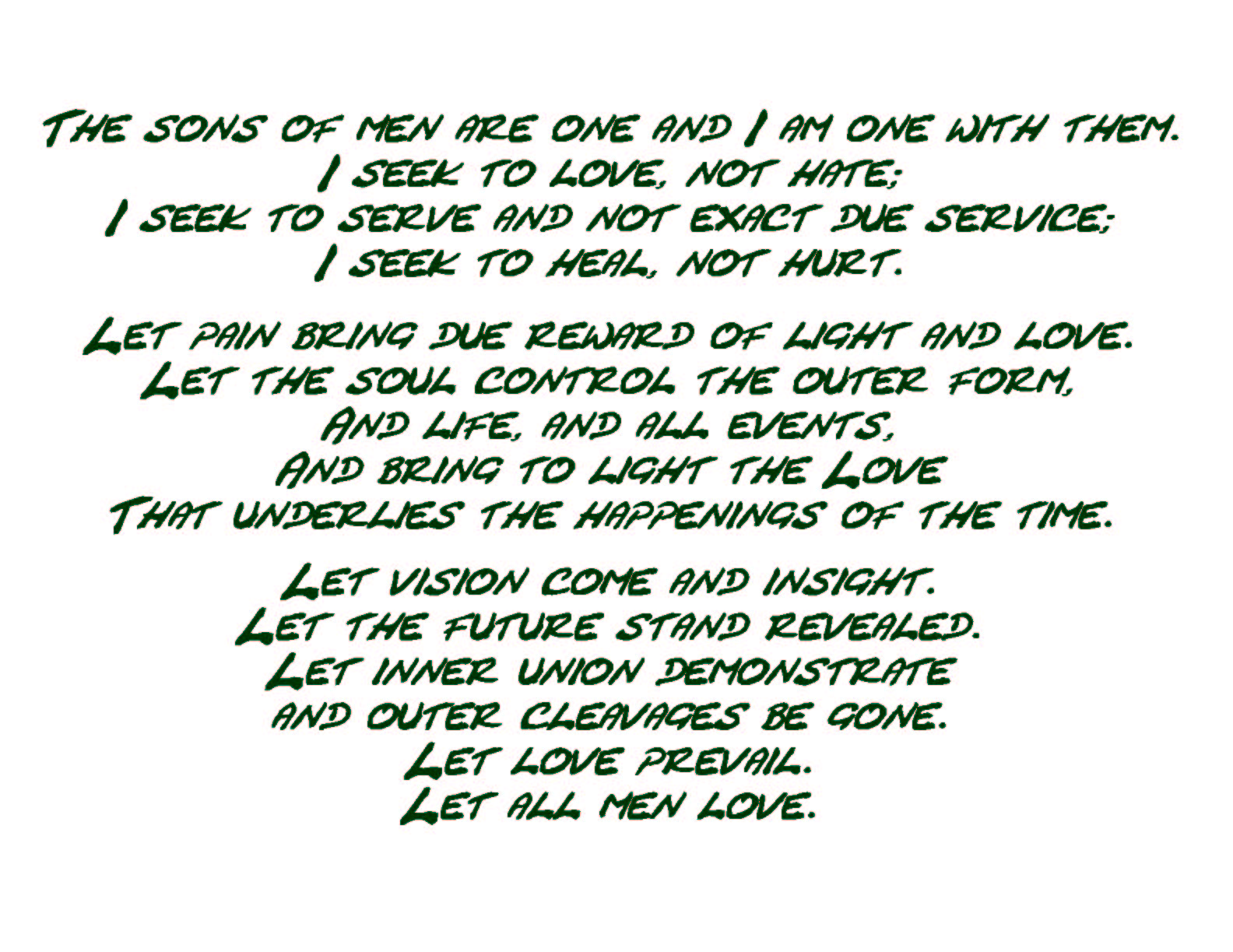
WHAT THEN IS LOVE? In a general sense love is benevolence, good will; that disposition of heart which inclines men to think favorably of their fellow men, and to do them good. In a theological sense, it includes supreme love to God, and universal good will to men. While this IS from an older definition of Charity, which IS rendered in the King James Bible from the same Greek word agape which IS generally rendered as Love, we should amend our own definition here to include the idea that in the reality of Love a man will accord to ALL men ALL things that he would accord to himself and to say that Love IS our thoughts and attitude of the equality of ALL men regardless of their outward nature or appearance…that ALL ARE equally children of Our One God.
ΑΩ•ΑΩ•ΑΩ
PLUS THE EVER IMPORTANT AND HIGH IDEAL TAUGHT TO US BY THE CHRIST: “Therefore all things whatsoever ye would that men should do to you, do ye even so to them” (Matthew 7:12).
ΑΩ•ΑΩ•ΑΩ•ΑΩ•ΑΩ•ΑΩ•ΑΩ•ΑΩ•ΑΩ•ΑΩ•ΑΩ•ΑΩ•ΑΩ•ΑΩ•ΑΩ•ΑΩ•ΑΩ•ΑΩ
In our last essay our discussion centered on the Apostle James Epistle and specifically his words on the relationship between faith and works. As we cited, there ARE several different doctrinal ideas at play regarding this relationship where, on its face, there appears to be a conflict between James’ words and those of the Apostle Paul that had been discussing. The central part of the apparent conflict IS found in the idea that Paul IS against works as a way to ‘salvation‘ while James IS telling us that “faith, if it hath not works, is dead, being alone“. While many say that there IS NOT conflict because they address different situations, this IS NOT how the ideas ARE actually viewed by most who claim that: men cannot earn their way to heaven through good works or deeds ***. The KEY idea here IS the “good works” which Paul promotes in his words from Ephesians that began our study. Paul says that “by grace are ye saved through faith; and that not of yourselves: it is the gift of God: Not of works, lest any man should boast. For we are his workmanship, created in Christ Jesus unto good works, which God hath before ordained that we should walk in them” (Ephesians 2:8-10). While the doctrines of men focus on the idea that “by grace are ye saved through faith; and that not of yourselves” and apply the idea of “Not of works, lest any man should boast” to works, they seem to miss Paul’s point in saying “we are his workmanship, created in Christ Jesus unto good works, which God hath before ordained that we should walk in them“. That some believe that these words on “good works” apply post ‘salvation‘, that IS after one IS ‘saved‘ by grace through faith, seems to rely upon the idea that everyone IS ‘saved‘ by their performance of whatever doctrinal precepts apply. However, much of the preaching remains against works even for these that ARE considered instantly ‘saved‘. In our view these ideas further add to the nebulousness of their ideas of pistis and pisteuo which ARE rendered as faith and believing.
In our reality the doctrinal ideas DO NOT work to the benefit of men who ARE Truly seeking some form of salvation which, when properly understood, IS salvation from the vanity into which they were born, nurtured and indoctrinated and NOT merely a ‘green card’ by which they can enter heaven after death. It IS unfortunate that this latter idea IS the objective of so many Christians who DO NOT think about their being “delivered made free from the bondage of corruption into the glorious liberty of the children of God” (Romans 8:20-21) here and now. This “bondage of corruption” IS their vanity which we should try to see as Vincent shows us saying that our vanity IS a: perishable and decaying condition, separate from God, and pursuing false ends 4. We should try to see and to understand that it IS through our “good works” that we can escape this condition and the primary point of these “good works” IS that we keep His words; that we strive to DO so. It IS in keeping His words that we come to KNOW God and, when we can understand that this KNOWING IS the reality of pistis and pisteuo, Paul’s words saying “by grace are ye saved through faith” take on a very different meaning. We must add to this the reality of the apostle’s intent in using the idea that salvation IS “Not of works“. Paul’s meaning here and elsewhere IS that these works ARE the rote performance of the mitzvah of the Jews, their 613 religious duties found in the Torah that guide Jewish life, ritual, and ethics, their laws which are the foundation of their traditions against which the Master constantly speaks.
We should understand that Paul IS NOT writing about the “good works, which God hath before ordained that we should walk in them“, and when doctrines combine “good works” with the rote works they commit their congregants to a deception that keeps them bound to their vanity. James tells us about this deception saying “be ye doers of the word, and not hearers only, deceiving your own selves” (James 1:22), a saying that IS unfortunately ONLY narrowly and doctrinally understood. Understanding that Paul IS NOT writing against “good works” helps us to see that James’ words ARE in NO way contradictory nor based on different situations. Their words ARE totally in sync and paint a picture of the True Way to “the glorious liberty of the children of God“. Repeating James’ words:
“What doth it profit, my brethren, though a man say he hath faith, and have not works? can faith save him? If a brother or sister be naked, and destitute of daily food, And one of you say unto them, Depart in peace, be ye warmed and filled; notwithstanding ye give them not those things which are needful to the body; what doth it profit? Even so faith, if it hath not works, is dead, being alone. Yea, a man may say, Thou hast faith, and I have works: shew me thy faith without thy works, and I will shew thee my faith by my works. Thou believest that there is one God; thou doest well: the devils also believe, and tremble. But wilt thou know, O vain man, that faith without works is dead? Was not Abraham our father justified by works, when he had offered Isaac his son upon the altar? Seest thou how faith wrought with his works, and by works was faith made perfect? And the scripture was fulfilled which saith, Abraham believed God, and it was imputed unto him for righteousness: and he was called the Friend of God. Ye see then how that by works a man is justified, and not by faith only. Likewise also was not Rahab the harlot justified by works, when she had received the messengers, and had sent them out another way? For as the body without the spirit is dead, so faith without works is dead also” (James 2:16-26).
We begin where we left off in the last essay, with James’ words saying Thou believest that there is one God; thou doest well: the devils also believe, and tremble. The point made in the end of the last essay IS that while most ALL of the church sees James’ reference to devils as his reference to those spiritual beings who were cast out of heaven*^, the reality IS that James’ IS showing us the nature of the carnally focused man. We made reference to those in the doctrinal churches whose focus IS yet carnal, those deceived according to James words cited above, and to those who DO NOT have any doctrinal allegiances; in the spirit of James’ writing, he IS referring to the former. Those who ARE “hearers only” ARE deceived in many ways and here James IS showing us one the ways as he uses the more nebulous idea of pisteuo as believing. Speaking to those whose focus IS upon the Godhead, those who by measure KNOW God, James says “thou doest well“. Regarding those whose focus IS carnal, the daimonion, those that can be understood as a dæmonic being 9a as Strong’s defines the idea, James tells us that they tremble. This idea of tremble IS from the Greek word phrisso, a word that IS ONLY used here in the New Testament. The word IS alternately rendered as shuddered and IS also expanded upon by some who render as the phrase “tremble with fear” or “shudder with fear“; these expansions highlight the doctrinal ideas of devils or demons. Strong’s tells us that the phrisso IS: apparently a primary verb; to “bristle” or chill 9a while Thayers tells us that its defining quality IS to be rough; to bristle, stiffen, stand up 9. These ideas, when applied to James words signify, that these devils ARE trembling or shuddering which IS indicating a cognizance of their appointed doom9b according to Vines.
ALL of this IS purely doctrinal fiction and this because there ARE NO devils, there ARE NO demons, except in the minds of those indoctrinated to believe such things. Vincent offers us some ideas on phrisso that can help us to apply the idea to the carnal man who James calls daimonion. Vincent tells us of phrisso that: It means, originally, to be rough on the surface; to bristle 4 and gives us examples of its use as the fields with ears of corn; of a line of battle bristling with shields and spears. In both of these examples we should try to see the idea that Thayer’s shows us; to: stiffen, stand up. Applying this to James words we can see the carnal man, the daimonion or dæmonic being, the man yet caught up in his vanity and focused upon the self and the things of the self, as stiffening, as standing up, for his nebulous beliefs. We should be able to see that this IS the general attitude of the doctrinal adherent who believes that he KNOWS God but has failed and has remained in his own deception. We should remember that John shows us the reality of KNOWING God saying “hereby we do know that we know him, if we keep his commandments. He that saith, I know him, and keepeth not his commandments, is a liar, and the truth is not in him” (1 John 2:3-4). In the midst of telling us about the relationship between faith and works James tells us “Thou believest that there is one God; thou doest well: the devils also believe, and tremble” with a purpose which IS discoverable through our right understanding of the preceding and succeeding verses.
In the last essay we discussed James’ words saying “Yea, a man may say, Thou hast faith, and I have works” and assigned this part of the verse to the idea of the Jews who lived by their works, their dead works of the law as Paul would see this. In the idea that “Yea, a man may say, Thou hast faith, and I have works” we should try to see the man who lives by works justifying his way while James’ retort IS “shew me thy faith without thy works, and I will shew thee my faith by my works“. Here, this imaginary man should be understood to have NO faith, the idea of faith as the Christian understands it IS largely absent from the Old Testament. From this perspective Jews have ONLY works, ONLY those things that they DO according to their interpretations of the law. They DO believe “that there is one God” as this IS foundational in the Jews’ religion and here perhaps we can see the idea of devils more clearly. Again the Greek word here IS daimonion and the full Strong’s definition of this IS a dæmonic being; by extension a deity. Strong’s definition, while it gives power to the rendering as devil, IS misplaced by that rendering. As we discussed, the idea here IS better understood as motivated by a spiritual force or genius and inspired; an elemental force which contains an irrepressible drive; and the dynamic unrest that exists in us all that forces us into the unknown, leading to self-destruction and/or self-discovery^. The simple rendering as devil relates ONLY doctrinal ideas and seeing daimonion in these terms can help us to understand James’ intent which we see in terms of those who have NO True faith; it IS such that while they acknowledge that there IS One God, they tremble as we discussed above. In this IS our connection between these seemingly unrelated verses; the man, the Jew or any with NO True pistis but ONLY works that comport ONLY with doctrines, IS among them that “believe, and tremble“.
In this understanding the verse IS NOT out of place but follows upon the previous verse. This IS disrupted however by the doctrinal view and the idea of demons and devils which yet permeate much of Christianity. This leads us to the next verse which we should see as addressing the man who says “Thou hast faith, and I have works“; to this man James says “But wilt thou know, O vain man, that faith without works is dead?“. The KEY word here for us is vain; in this misunderstood biblical concept IS the reality of these verses, two realities to be sure. First IS to the Jew who believes in One God and that his salvation IS through “the works of the law” (Galatians 3:10), the idea IS that such faith, such believing in this salvation, IS in vain. The second IS to the man who has that nebulous faith that poses as pistis in Christian doctrines; NOT the faith that Paul references which IS Truly KNOWING. To this man the message IS that this faith IS dead because it has NO works and to believe otherwise is vanity. James may NOT have intended to show us these two versions of faith, the nebulous faith of many in the church today and the simpler faith of the Jews in those days who believed they were saved by their works. He may NOT have had such foresight as to see what Christianity would become but here today we can have both versions clearly in mind. We should remember however that there ARE other forward looking statements in the New Testament than ARE NOT directed at the Jews in those days. People that hold onto both of these versions of faith ARE those that James calls “O vain man“, both ARE mistaken regarding the reality of their ‘salvation‘ yet today. For the Jews that still carry forth their traditions and their mitzvah sans those parts of the 613 ‘commandments’ that have become obsolete; and for the doctrinal Christian who sees his ‘salvation‘ in the rites and rituals of certain denominations or those that hold to the idea of ‘salvation‘ ONLY by faith, James makes this claim of vanity.
The Greek word used here by James IS kenos which IS generally rendered as vain and as empty in some places in the King James Bible. Others render the idea as foolish while others hint at stupidity but these ideas ARE NOT really implied in the definitions of the Greek word. Strong’s tells us that kenos means: empty (literally or figuratively) while adding (in) vain 9a as a allowable rendered word. Thayer’s tells us that the idea of kenos IS: properly, of places, vessels, etc.,which contain nothing (Judges 7:16; Genesis 37:24); metaphorically, empty, vain; devoid of truth 9. Today’s idea of vain primarily goes to ideas of personality but in Webster’s 1828 Dictionary the idea of vain was: Empty; worthless; having no substance, value or importance 1 and from this we should see how that kenos became vain in older versions of the bible. Vincent tells us that kenos IS: empty, without spiritual life 4. Can we see James point, his reasoning for calling such persons vain? While this Greek word IS different from the word rendered as vanity, mataiotes, we can gain some additional understanding of James intent through our understanding of this word which IS that this vanity IS our perishable and decaying condition, separate from God, and pursuing false ends 4. The similarities of these words IS shown more clearly by Thayer’s which defines mataiotes as in similar terms to kenos saying that it IS: what is devoid of truth and appropriateness 9. We should add here that the idea of vanity IS widespread in the Old Testament, especially in Psalms and Ecclesiastes, and the Hebrew word hebel IS rendered as mataiotes in the Septuagint thereby aligning it with the Greek. Our point IS simply that James IS telling us of the futility, another rendering of mataiotes, of having faith without works and, from our perspective, those who follow either version of faith identified above ARE living in vanity.
AS we have been posting from nearly the beginning of our blog posts, vanity IS the human condition. Vanity IS the state of mind of most ALL who have NOT yet awakened to the Truth that flows from one’s own Soul. It IS vanity that Paul frames as being “conformed to this world“, a state into which ALL ARE born and then nurtured and indoctrinated into this idea of conformance….essentially we DO NOT KNOW any better until we begin to awaken. It IS this awakening that Paul shows us as “the renewing of your mind” ( Romans 12:2) and it IS this awakening by the Truth, this sense of KNOWING if you will, that leads to our Transformation. Just as we ARE Transformed by measure, Transformed bit by bit, we ARE also awakened in the same way through our works which should be primarily understood as keeping His words. This IS the True works of the Christian from which ALL else flows and we should understand here that the principal IS the same for the non-Christian as every True religion leads us to the same spiritual values. This IS the natural relationship between pistis and works, between faith and works as the idea IS translated and it IS this that James is showing us in saying that “faith without works is dead“. To understand this we must first understand that pistis and the kindred Greek word pisteuo, ARE NOT the nebulous ideas of faith and believing that ARE bandied about in the church; pistis and pisteuo ARE both that KNOWING that comes upon a man through the works of keeping His words and striving to DO so. Perhaps in this context of keeping His words being our works we can better understand the work and the reward or wages that the Master shows us in our trifecta which we repeat saying:
- “If ye continue in my word, then are ye my disciples indeed; And ye shall know the truth, and the truth shall make you free” (John 8:31-32).
- “Not every one that saith unto me, Lord, Lord, shall enter into the kingdom of heaven; but he that doeth the will of my Father which is in heaven” (Matthew 7:21).
- “He that hath my commandments, and keepeth them, he it is that loveth me: and he that loveth me shall be loved of my Father, and I will love him, and will manifest myself to him. Judas saith unto him, not Iscariot, Lord, how is it that thou wilt manifest thyself unto us, and not unto the world? Jesus answered and said unto him, If a man love me, he will keep my words: and my Father will love him, and we will come unto him, and make our abode with him. He that loveth me not keepeth not my sayings: and the word which ye hear is not mine, but the Father’s which sent me” (John 14:21-24).
The work in each of these sayings from the Master IS that we keep His words and that this IS phrased differently in each saying has relationship to this Truth. We ARE rewarded by the Truth the sets us free and discipleship; we ARE rewarded by gaining the ability to “enter into the kingdom of heaven” and we ARE rewarded by having the Presence of the Lord in our Lives. This idea of reward IS eschewed by much of the church which sees rewards ONLY after one IS ‘saved‘ by the free gift of grace as we read above in Paul’s words to the Ephesians and then seemingly by the Will of God. The rewards cited in our trifecta however ARE the direct result of the work of keeping His words and we should see here that KNOWING the Truth, True pistis, IS a part of these rewards. We ARE NOT dealing with Greek words here, we should note that the idea of rewards in the gospels IS from the Greek word misthos which Strong’s defines as: pay for service (literally or figuratively), good or bad 9a. Through this it becomes easier to relate our works to our wages and a greater understanding of Paul’s words saying “the wages of sin is death“. Here we should try to see that sin, our carnal focus to be more accurate, is the works of those whose lives ARE carnal and the death IS, from a spiritual perspective, that such persons remain in this state of vanity. The full rendering of this verse IS “the wages of sin is death; but the gift of God is eternal life through Jesus Christ our Lord” (Romans 6:23) and here we should see that the idea of gift IS from the Greek word charisma which IS more related to grace than to any kind of gift. This word, charisma, IS a different Greek word from doron which IS the word used by Paul in Ephesians where he tells us of our ‘salvation‘ that “it is the gift of God“. The gift in Romans however IS the grace which represents ALL that flows from the Godhead and our salvation IS a part of this grace as we ARE saved from the vanity into which we were born, nurtured and indoctrinated.
Through our trifecta we should try to understand that at each point the idea IS that we keep His words and this IS our works, it IS the works of ALL who Truly seek the Lord. In the first part of our trifecta we should see that the idea IS rendered as that we should continue in His word and, as we have previously discussed, the better rendering of the Greek word meno IS abide. We should see that to abide in His words we must first endeavor, stive if you will, to keep His words; this IS the first step in our journey to True salvation and to the Truth that “shall make you free”. This IS our striving, our works to be sure, and the result IS the wages, the reward or the gift of salvation and we should understand here that we must earn it. The Christian world has operated on the idea that our salvation requires NO effort by the man in the world and should we look around at the state of the world today we could easily see the failure of this idea. The constant wars, the genocidal attitude that attacks the natural diversity of men, humanity’s failure to take care of “the least of these my brethren” (Matthew 25:40) ARE ALL minimized when those who Truly seek salvation DO the work of keeping His words. The fallacy of the idea that men’s salvation requires NO effort by man save to believe IS rooted in the misinterpreted words of the Apostle Paul, particularly his words from Ephesians that began our discussion. The idea has been expanded by some to include the idea of ‘accepting’ Jesus’ sacrifice on the cross which IS to be understood as payment for “the sins of the whole world“. In this we again have a doctrinal idea that IS based ONLY on a few out of context bible verses and then used to define a doctrine that neither the Master nor His apostles ever taught.
This begins with the words of John the Baptist who calls Jesus “the Lamb of God, which taketh away the sin of the world” (John 1:29). When we properly understand the idea of sin, that sin IS NOT the individual actions of men that ARE considered evil but rather the focus of men upon their carnal and mundane lives. It IS this focus on the self that IS the sin and it IS this focus that the entirety of the New Testament instructs us to forego. Can we see that by His words Jesus, “the Lamb of God” has DONE this albeit NOT in the way that doctrines proclaim. The Master’s mission in this world was to show us the way and by His words and His example He DID so. Our sin was and IS our focus upon the carnal and the mundane and seeing that this condition still exists should have sufficed to show that the doctrinal interpretation IS in error. The doctrinal influence IS difficult to remove from these words but this from Thayer’s may show us the better idea. Thayer’s tells us of the Greek word airo which IS rendered as “taketh away” that: to remove: 1 Corinthians 5:2 (cast out from the church, where ἀρθῇ should be read for Rec. ἐξαρθῇ); tropically: faults, Ephesians 4:31; τήν ἁμαρτίαν, John 1:29 [36 Lachmann in brackets], to remove the guilt and punishment of sin by expiation, or to cause that sin be neither imputed nor punished (αἴρειν ἁμάρτημα, 1 Samuel 15:25; ἀνόμημα, 1 Samuel 25:28, i. e. to grant pardon for an offence); but in 1 John 3:5 τὰς ἁμαρτίας ἡμῶν αἴρειν is to cause our sins to cease, i. e., that we no longer sin, while we enter into fellowship with Christ, who is free from sin, and abide in that fellowship, cf. 1 John 3:6 9.
Because the saying from John’s Gospel was hijacked by the church, its accepted meaning IS according to the idea above that Thayer’s attributes to John 1:29: to remove the guilt and punishment of sin by expiation, or to cause that sin be neither imputed nor punished. Reading further on however we see additional renderings of this Greek word as used by John and it IS this meaning that should have been applied to the words of the Baptist as well. In the idea that airo means to cause our sins to cease and that that we no longer sin IS precisely the teaching of the Master and in this sense He Truly DOES “taketh away the sin of the world“. In the ideas of “the Lamb of God” and the doctrinal defining idea that this IS to remove the guilt and punishment of sin by expiation, the church has created a doctrinal philosophy that IS based ONLY in the ideas, carnal and mundane ideas to be sure, of church leaders over the centuries. The churches’ actions ARE far from the idea that to “taketh away the sin of the world” is to cause our sins to cease, that that we no longer sin, as IS easily seen in the churches’ history of wars and corruption and an ofttimes professed hatred of those that DO NOT ‘believe’. The context of John’s words referenced by Thayers tells us much about sin and the Master’s approach to it; we read that “Whosoever committeth sin transgresseth also the law: for sin is the transgression of the law. And ye know that he was manifested to take away our sins; and in him is no sin. Whosoever abideth in him sinneth not: whosoever sinneth hath not seen him, neither known him” (1 John 3:4-6). John’s words clearly tell us that ALL that DO NOT “abideth in him“, abide in His word, ARE carnally focused and it IS this focus that IS “the transgression of the law“. Here we must forget the carnal interpretations that became the traditions of the Jews, their mitzvah, and concentrate on the reality of those commandments emphasized by Jesus and His expansions of them.
Again keeping His words IS our works, our “good works” in this world, that lead us to our individual salvation, our being saved from this Life in vanity, this Life where we ARE in that perishable and decaying condition, separate from God, and pursuing false ends 4. ALL else in a deception, an illusion decorated with a glamour that gives men an air of righteousness and salvation. This deception IS clearly shown to us by James who tell us to “be ye doers of the word, and not hearers only, deceiving your own selves” (James 1:22) yet few if any in the church Truly understand his words.
Returning to James words on faith and works we should be able to understand that the works that True faith brings IS that we keep His words; it IS from DOING so that ALL else flows. Christian “good works” DO NOT not begin after ‘salvation‘ as many surmise, Christian “good works” ARE the cause of salvation; it IS in our “good works“, our keeping His words, that we gain that pistis which IS our ability to KNOW God. James goes on to offer us some Old Testament examples, the same examples that Paul and the writer of the Book of Hebrews uses. James tells us of Abraham and while the doctrinal churches use the idea of Abraham’s faith, James uses the idea of the works that followed his faith in the Lord, that it was Abraham’s actions that were of note as a reflection of his KNOWING God. While the Old Testament story of Abraham reflects events that happened around 4000 years ago, it IS a story that IS valued by much of Christianity as a True sign of faith. To be sure it IS a fantastical story among a group of fantastical stories but it IS much relied upon yet today and told in churches as it IS factual. In contrast, Jewish tradition sees the story in a different light; they see it as a story against child sacrifice, a practice that IS a part of Near Eastern religious history. Another point from Jewish tradition shows that rather than believing he would actually have to kill his son, Abraham had perfect faith that God would somehow preserve Isaac, as God had previously promised that Isaac would be the continuation of the covenant. This should be our starting point for understanding the examples of faith and works put forth by James. While the story of Abraham and Isaac IS NOT seen as factual events by the Jews of which James IS one, it DOES show the reality of faith and works from the perspective that Abraham had perfect faith that God would somehow preserve Isaac and so he completed the task. The story IS offered by James to make the point that it was NOT that Abraham merely believed God but that he acted upon that belief. Without the works attached, Abraham’s faith would be as the nebulous faith we have in the churches yet today.
A similar idea can be seen in James other example, that of “Rahab the harlot” whose story IS told in the Book of Joshua. Here again we have a fantastical story in the fall of Jericho and there IS doubt among scholars as to the accuracy of the information found in excavating the site. Jericho did exist and it was destroyed and while the Christian takes the whole story literally, the Jews DO NOT and, again, James IS a Jew. Two things of note; first is the statement from the Book of Joshua that tells us that Rahab’s house was upon the wall which, when combined with the rest of the story, would mean that Rahab’s house fell with the walls; we read that “the wall fell down flat” (Joshua 6:20). Second IS that the story itself IS perhaps told for a different purpose as Rahab IS understood to be in the lineage of King David, his great, great grandmother, putting her, a Canaanite woman, in the lineage of Jesus. There ARE several non-Hebrew women in Jesus’ lineage; Tamar whose story IS that she pretended to be a harlot and tricked Judah into sex, Rahab, and Ruth of whom there IS an Old Testament book. There IS also Bathsheba who, while NOT mentioned by name, IS mentioned as “her that had been the wife of Urias” (Matthew 1:6). James IS familiar with ALL of this and understood the nature of both the stories of Abraham and Rahab according to his Jewish tradition. That he includes these as examples of the working of faith and works DOES NOT however attest to their veracity but rather attests to the reality that the faith, the believing of these people, was shown to us by what they DID, by their works. From our perspective these ARE but examples that showed James’ point that “faith without works is dead“, examples that would be understood by the Jews in those days including those that converted to follow the Master.
James ends his words on faith and works with a statement that IS NOT properly understood in its spiritual context. He tells us that “For as the body without the spirit is dead, so faith without works is dead also“. In this we should see an acknowledgement of the reality of Life; that the body, our presence in this world, IS enlivened by the Spirit which IS the Truth of our individual existance. The idea of James’ words IS generally seen in terms of breath, an idea which hearkens back to the Book of Genesis where we read “the LORD God formed man of the dust of the ground, and breathed into his nostrils the breath of life; and man became a living soul” (Genesis 2:7). This simplistic look at the apostle’s words IS derived from the definition of the Greek word pneuma, a word that IS used in many contexts in the King James Bible but IS never rendered as breath. The reality of pneuma IS shown to us as the secondary definition by Thayer’s where we read that pneuma IS: the spirit, i. e. the vital principle by which the body is animated 9. While this IS a better idea than the primary definition of: a movement of air (gentle) blast and then breath 9, it IS yet lacking in spiritual substance. Vincent helps us to understand the idea of pneuma saying that it IS: It is used as parallel with yuch soul, and kardia heart. But while yuch soul, is represented as the subject of life, pneuma spirit, represents the principle of life, having independent activity in all circumstances of the perceptive and emotional life, and never as the subject. Generally, pneuma spirit, may be described as the principle, yuch soul, as the subject, and kardia heart, as the organ of life 4. In a most general way Vincent’s words accurately describe the relationships but we should try to see this in a deeper spiritual way. Spirit IS the principle of Life; it IS the Truth of Life which has NO real relationship to the body or this world; it IS part and parcel of the Godhead of which we read that “God is a Spirit” (John 4:24).
Understanding this we should be able to see that James’ words saying “the body without the spirit is dead“, it IS NO longer animated by the principle of Life as the Life, the True man, has vacated its temporary dwelling in this world. It IS then in this way that “faith without works is dead also” which should be understood as that it IS works that gives Life to faith, to pistis, to KNOWING God.
We will continue with our thoughts in the next post.
| Aspect | Potency | Aspect of Man | In Relation to the Great Invocation | In relation to the Christ |
| GOD, The Father | Will or Power | Spirit or Life | Center where the Will of God IS KNOWN | Life |
| Son, The Christ | Love and Wisdom | Soul or Christ Within | Heart of God | Truth |
| Holy Spirit | Light or Activity | Life Within | Mind of God | Way |
- 1 Webster’s Revised Unabridged Dictionary, 1828 and 1913 from https://1828.mshaffer.com/
- 4 Word Studies in the New Testament; Marvin R Vincent D.D. 2nd edition
- 9 Thayer’s Greek Lexicon on blueletterbible.org
- 9a The New Strong’s Exhaustive Concordance of the Bible on blueletterbible.org
- 9b Vine’s Expository Dictionary on blueletterbible.org
- ** Google AI on defining faith
- *^ Google AI James 2:19 defining devils
- ^ Wikipedia on diamonic
- *** Google AI answering: how men can earn their way to heaven
those who walk on the well-trodden path always throw stones at those who are showing a new road
Voltaire, Writer and Philosopher