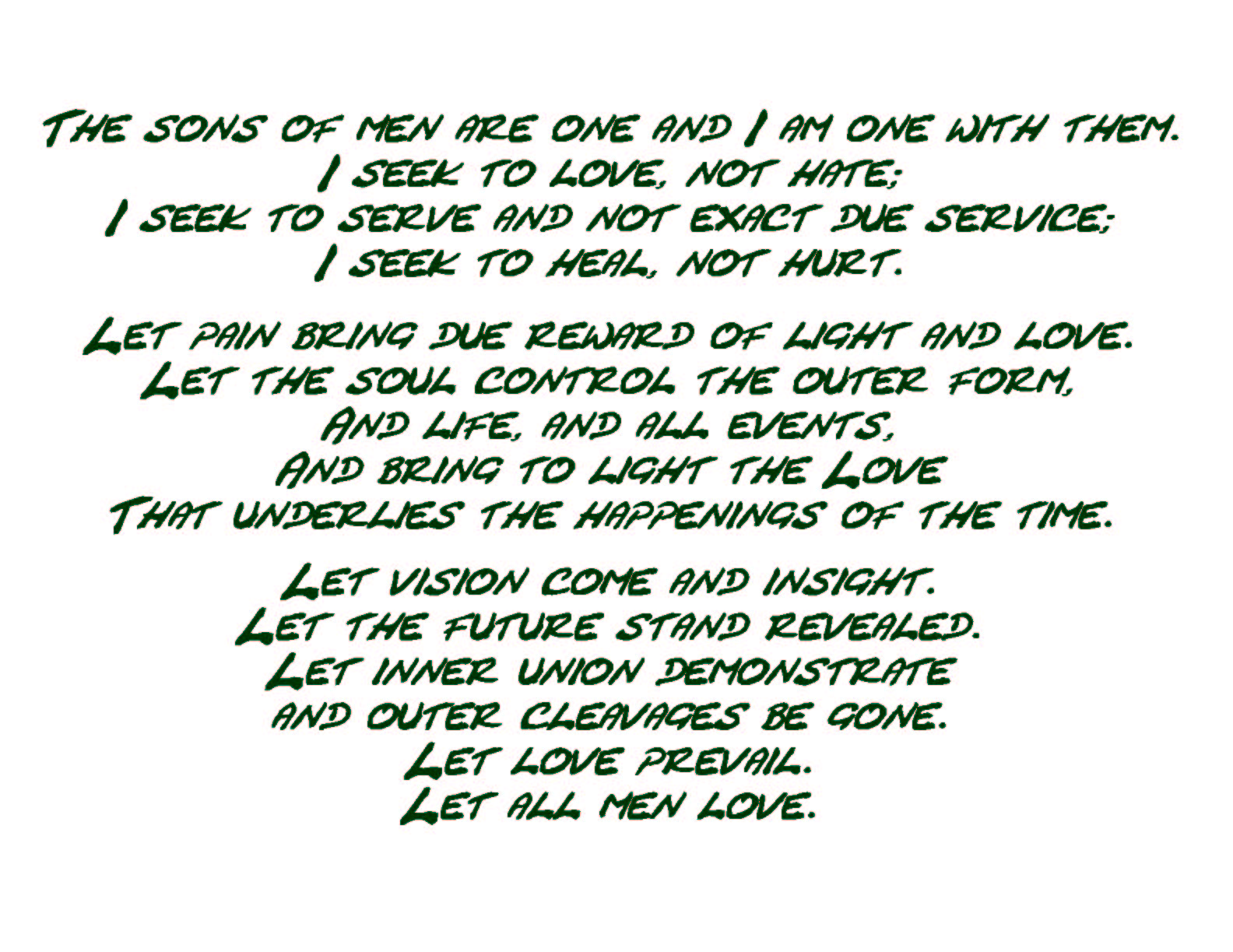
ON LOVE; PART MDLXXXI
Ω•ΑΩ•ΑΩ•ΑΩ•ΑΩ•ΑΩ•ΑΩ•ΑΩ•ΑΩ•ΑΩ•ΑΩ•ΑΩ•ΑΩ•ΑΩ•ΑΩ•ΑΩ•ΑΩ•ΑΩ
FIRST IS THE GREAT COMMANDMENTS: “The first of all the commandments is, Hear, O Israel; The Lord our God is one Lord: And thou shalt love the Lord thy God with all thy heart, and with all thy soul, and with all thy mind, and with all thy strength: this is the first commandment. And the second is like, namely this, Thou shalt love thy neighbour as thyself. There is none other commandment greater than these” (Mark 12:29-31).
ΑΩ•ΑΩ•ΑΩ
WHAT THEN IS LOVE? In a general sense love is benevolence, good will; that disposition of heart which inclines men to think favorably of their fellow men, and to do them good. In a theological sense, it includes supreme love to God, and universal good will to men. While this IS from an older definition of Charity, which IS rendered in the King James Bible from the same Greek word agape which IS generally rendered as Love, we should amend our own definition here to include the idea that in the reality of Love a man will accord to ALL men ALL things that he would accord to himself and to say that Love IS our thoughts and attitude of the equality of ALL men regardless of their outward nature or appearance…that ALL ARE equally children of Our One God.
ΑΩ•ΑΩ•ΑΩ
PLUS THE EVER IMPORTANT AND HIGH IDEAL TAUGHT TO US BY THE CHRIST: “Therefore all things whatsoever ye would that men should do to you, do ye even so to them” (Matthew 7:12).
ΑΩ•ΑΩ•ΑΩ•ΑΩ•ΑΩ•ΑΩ•ΑΩ•ΑΩ•ΑΩ•ΑΩ•ΑΩ•ΑΩ•ΑΩ•ΑΩ•ΑΩ•ΑΩ•ΑΩ•ΑΩ
In the last essay we addressed the synergy between our selected verses from Paul, Peter and James. In each of these we should try to see the apostle’s statement regarding the Way out of this morass of vanity in which we live. Paul shows us the expectation of the Soul and while this IS portrayed as the hope of God, the reality IS found in our KNOWING that it IS our Souls that represent the Godhead in our lives. It IS in this expectation that the Soul constantly prompts the carnal mind to spiritual ends and we should understand that these spiritual ends begin and end with agape. It may be difficult to understand the constancy of this prompting which goes unheard by most ALL as the din of daily Life IS ever so loud. This IS especially True for the man yet grounded in vanity which Paul also shows us as our “bondage of corruption” and while this encompasses most ALL men, there ARE some that can hear a glimmer of Truth that results in expressions of agape in this world. Whensoever a man can see ALL men equal or, at a minimum, understand that this IS a Life’ goal, he stands on the precipice of Truth. Should he act upon such vision of Truth, he can be counted among those that ARE Truly seeking what Paul calls “the adoption, to wit, the redemption of our body“. This IS a reality which Paul presents to us as our Union with the Godhead; a Union that should be seen through the idea applied to Jesus; that He DID “make in himself of twain one new man” (Ephesians 2:15). This reality comes to us through a most misunderstood and misapplied word; huiothesia. This Greek words which IS rendered as adoption IS used ONLY by Paul and IS doctrinally understood in the church as: a judicial and relational act of God where a justified believer is legally brought into the family of God and given all the rights, privileges, and responsibilities of a full heir**.
The doctrinal reality of being a justified believer IS based upon the same ideas that ARE commonly understood as being ‘saved‘ through faith in Jesus Christ and believing that He died for our sins. In this we should be able to see the doctrinal idea of adoption pertains to every believer in the church, to everyone that claims their ‘salvation‘. Our view of adoption IS much deeper and separates the adopted son of God from the average man in the church. We should be able to see this through the ideas offered by Paul that tell us first of having “the firstfruits of the Spirit“, then of the waiting, and finally of the equivalency of the adoption with “the redemption of our body” which idea IS not understood in the church. Our working idea of adoption and therefore of Redemption comes from Vincent who, quoting Mr. Merivale, tells us that: We have but a faint conception of the force with which such an illustration would speak to one familiar with the Roman practice; how it would serve to impress upon him the assurance that the adopted son of God becomes, in a peculiar and intimate sense, one with the heavenly Father 4. Adoption IS the Path outlined in what ARE seen as obscure terms by the unawakened but understood as the Way by the man who has some measure of Truth from which to work. Repeating Paul’s word regarding our journey we read again that:
“For the earnest expectation of the creature waiteth for the manifestation of the sons of God. For the creature was made subject to vanity, not willingly, but by reason of him who hath subjected the same in hope, Because expectation that the creature itself also shall be delivered made free from the bondage of corruption into the glorious liberty of the children of God. For we know that the whole creation groaneth and travaileth in pain together until now. And not only they, but ourselves also, which have the firstfruits of the Spirit, even we ourselves groan within ourselves, waiting for the adoption, to wit, the redemption of our body” (Romans 8:19-23).
Peter takes us on a different journey which shows us the idea of our vanity as the worldly ways that we must escape. While Paul’s approach IS the culmination of the preceding words in the eighth chapter, Peter begins with our ability to KNOW God. Going into Peter’s words we must have an understanding of the Way that we come to KNOW God; we again show the reality of this through the words of the Master and of the Apostle John. The Master tells us that we KNOW the Truth by keeping His words as we read in the first part of our trifecta while John tells us that “we know him, if we keep his commandments” (1 John 2:3). KNOWING God IS the result that flows from keeping His words and it IS to those that DO so or strive to DO so that Peter addresses the idea that there “are given unto us exceeding great and precious promises: that by these ye might be partakers of the divine nature“. In this we should see the same idea of Union that IS presented in Paul’s words on the adoption and while Paul DOES NOT share with us the mechanism by which we defeat our vanity and arrive a these “exceeding great and precious promises“, Peter tells us that we must escape. The Greek word apopheugo which IS rendered as escape IS simply defined as: to flee from, escape 9 and is used ONLY by Peter. The common understanding of escape DOES NOT apply here as the ideas ARE strictly carnal. Our dictionary defines escape as: to slip or get away, as from confinement or restraint; gain or regain liberty and to slip away from pursuit or peril; avoid capture, punishment, or any threatened evil*. Peter tells us:
“Grace and peace be multiplied unto you through the knowledge of God, and of Jesus our Lord, According as his divine power hath given unto us all things that pertain unto life and godliness, through the knowledge of him that hath called us to glory and virtue: Whereby are given unto us exceeding great and precious promises: that by these ye might be partakers of the divine nature, having escaped the corruption that is in the world through lust” (2 Peter 1:2-4).
We should understand that the idea of escape IS a primary component of Peter’s words; it IS the KEY to gaining “the knowledge of God” and the ability to become “partakers of the divine nature“. We should also understand that this idea of escape IS available to us according to the idea of measure. In the Master’s words saying “with the same measure that ye mete withal it shall be measured to you again” (Luke 6:38), our striving to escape IS the “measure that ye mete” while the results of “the knowledge of God” and the ability to become “partakers of the divine nature” ARE what “shall be measured to you again“. What we should try to see here IS a similarity between the idea of escaping “the corruption that is in the world through lust” and our Transformation which Paul frames as being “transformed by the renewing of your mind” (Romans 12:2). Through these ideas which likely remain unseen by most we should be able to discern that the idea of escape IS NOT in any way the same as we commonly understand it nor the way that it IS defined for us. Our escape in this context implies that we make every effort to build a life of free from our desires which ARE the product of our vanity and, if we can understand it as pulling oneself away from old patterns through a conscious awareness of the corruption, we can better understand the whole of Peter’s words. It IS in our escape that we can, by measure, become “partakers of the divine nature” which idea signifies a similar idea to that which we have in adoption, that in a peculiar and intimate sense we can become one with the heavenly Father.
James, in his blunt manner of writing, gives us the same result through the idea that one “shall be blessed in his deed“. In the last essay we explored this idea of blessing which IS another word that IS misunderstood and misapplied in the doctrinal church. In much of the church there IS the idea that we can ‘bless the Lord’, an idea that IS carried over from the Old Testament. None of the biblical definitions for makarios can apply to this idea of blessing and, from our perspective, the ONLY place where the idea of makarios can be Truly understood as it IS intended IS in its use in the Beatitudes. While many translations render the idea as happy in the Beatitudes, this IS a totally misplaced idea as the reality of the Master’s words here CAN NOT be understood from a carnal perspective. Nor can the idea of happy apply to makarios in its other uses but several translations DO render it so. Vincent offers us a lengthy dissertation on makarios which we CAN NOT repeat here but from which we have picked out some important points. The full text can be found at https://www.studylight.org/commentaries/eng/vnt/matthew-5.html. Vincent tells us first that: It is commonly rendered blessed, both in the A. V. and Rev., and that rendering might properly be given it in every instance 4 and, as we state above, with this we DO agree. After some thoughts on the pagan use of the idea pertaining to the dead, he tells us that: The biblical use of the word lifted it into the region of the spiritual, as distinguished from the merely intellectual, and besides, intrusted to it alone the task of representing this higher conception 4. While Vincent’s idea of spiritual IS NOT the same as ours, he DOES separate the biblical use from it carnal interpretations, he continues saying of makarios that: it almost universally occurs in connections which emphasize, as its principal element, a sense of God ‘s approval founded in righteousness which rests ultimately on love to God and from this we should be able to see the spiritual significance of being blessed 4. Finally, after some discourse on the Stoic interpretation and pagan uses, Vincent tells us that: The vague outlines of an abstract good vanish from it, and give place to the pure heart ‘s vision of God, and its personal communion with the Father in heaven 4. In this last idea from Vincent as well as his view of the spiritual significance, we should be able to equate this idea that “this man shall be blessed in his deed” with that sense of communion with the Godhead that results from becoming “partakers of the divine nature” and from “the adoption, to wit, the redemption of our body“. This IS the significance of James words saying:
“But be ye doers of the word, and not hearers only, deceiving your own selves. For if any be a hearer of the word, and not a doer, he is like unto a man beholding his natural face in a glass: For he beholdeth himself, and goeth his way, and straightway forgetteth what manner of man he was. But whoso looketh into the perfect law of liberty, and continueth therein, he being not a forgetful hearer, but a doer of the work, this man shall be blessed in his deed” (James 1:22-25).
James IS showing us that it IS through keeping His words, being “doers of the word” as he frames it, that we ARE “blessed in his deed” and in this we should see the idea of our spiritual fulfillment as we discussed in the last essay or, better, our communion with the Godhead. We should note one more thing here and that IS the way that James phrases our keeping His words as “the work” making equivalent the ideas of being “doers of the word” and “a doer of the work“. Both phrases require the idea of DOING and the use of the Greek word poietes in this context IS ONLY found in James Epistle. In both uses cited above we should be able to see a conscious effort at keeping His words and this we should contrast with the conscious effort from Peter which IS that we must escape. We should also be able to see that being “doers of the word” IS in effect our means of escape from “the corruption that is in the world through lust“. Can we see the point here? And can we also see that it IS in being “doers of the word” that we can “have the firstfruits of the Spirit“?
In these three selections from Paul, Peter and James we should try to see a picture of the journey of a man from his birth in vanity to his communion with the Lord with each shown to us from a very different perspective. Our point here IS to show the reality of the epistles, to show the reality of the way that they amplify and clarify the Master’s own words which ARE also intended to show us the Way. That the world has missed the point for 2000 years IS product of that vanity into which ALL are born and here we should see the dual nature of the Greek word ktisis which IS rendered as creature in Paul’s words; that it can refer to the individual or to the totality of creation. In the idea that vanity IS a: perishable and decaying condition, separate from God, and pursuing false ends 4 we should be able to glimpse the way that this idea of creation applies to the individual and the corporate creation of humankind and a deeper look will reveal that the ideas go ever deeper. In the Master’s teaching, especially in the synoptic gospels, He approaches men with an understanding that they ARE yet in that “bondage of corruption” as Paul frames this for us. While the Master DOES NOT explain our plight in words, He DOES so by implication through a litany of comments regarding the faults of the Jews and their religious efforts. We should remember here that in His own birth in Bethlehem He was born into the Jewish ‘race’ and state and it IS from there that He builds upon the original Truths offered to Moses centuries earlier and reinforced by the prophets.
We should try to understand that the Pentateuch, the five books of Moses, were written after the fact and in many ways ARE the beginning of the Jewish doctrinal ideas. The Pentateuch was NOT written as fact but rather as a compilation of stories that were carried forward for centuries. To believe that the Pentateuch IS fact IS to believe that the Lord, the same Lord of which John tells us “God is love agape” (1 John 4:8, 16), ordered the murder of innocent women and children, that He willingly participated in the killing of entire cultures. We must understand that the people in the Pentateuch were both barbarous and superstitious and that this was still True when the words were recorded centuries later. While the words ARE attributed to God, they ARE the product of men and while the laws, called the “law of Moses” (Luke 2:22), ARE considered to be from God, they ARE in reality the laws of men, perhaps Moses, that were ordained to control a barbarous and superstitious population. To be sure the Prophet Moses DID offer us the Ten Commandments based upon his view of the Godhead. The point here IS simply that the original Truths offered by Moses ARE NOT the reality of the Pentateuch, his prophetic Truths ARE a minor portion of the text. In our view the original prophetic Truths ARE those that ARE supported by the teachings of the Master and we should note here that even in those that He supported, He changed the way that they were to be understood. In this statement IS the reality of the Sermon on the Mount and even here we should understand that this name IS given by men. ALL that we Truly KNOW about this Sermon IS that these ARE the reported words of the Master and the ONLY way that we can ascertain the veracity of the written words IS by analyzing what they say.
Jesus’ words that we call the Sermon on the Mount IS a compilation of sayings that ONLY Matthew places into the context of a single Sermon. Regardless of the source of the words, this compilation provides us with the Master’s view of the Way out of our vanity and it IS this Way that IS summarized in each of the three selections from His apostles that we have been studying. The Sermon on the Mount IS the source document for much of James’ writings and Peter’s and Paul’s commentaries on the Way ARE the product of Jesus’ teaching. We must understand here that the apostles saw much more in the Master’s words that the average man DOES yet today and through this they were able to amplify and clarify much of what He said. We will begin here a new study on the Sermon on the Mount using Matthew as our guide while supplementing his text with Luke’s observations. As we go through the many points covered in these three chapters from Matthew, we will try to show how that our selections above from Paul, Peter and James reference Jesus’ points.
We begin with the Beatitudes and again the idea of being blessed. Before we begin here we should try to understand that the Master’s message that we call the Sermon on the Mount was delivered to His disciples first; they were His primary audience. Much of what the Master says IS said with His disciples in mind and perhaps stated in ways that would draw the attention of others in the crowd of people, “the multitudes” as Matthew frames this, that were gathered. The Beatitudes however should be understood as addressing His disciples directly. While we DO NOT KNOW the exact direction of His words, we can take from the text the idea that some of what He says, His disciples would already KNOW. Other points however were likely obscure to “the multitudes“. In Matthew’s telling, after the introduction, Jesus begins with the Beatitudes:
“And seeing the multitudes, he went up into a mountain: and when he was set, his disciples came unto him: And he opened his mouth, and taught them, saying, Blessed are the poor in spirit: for theirs is the kingdom of heaven. Blessed are they that mourn: for they shall be comforted. Blessed are the meek: for they shall inherit the earth. Blessed are they which do hunger and thirst after righteousness: for they shall be filled. Blessed are the merciful: for they shall obtain mercy. Blessed are the pure in heart: for they shall see God. Blessed are the peacemakers: for they shall be called the children of God. Blessed are they which are persecuted for righteousness’ sake: for theirs is the kingdom of heaven. Blessed are ye, when men shall revile you, and persecute you, and shall say all manner of evil against you falsely, for my sake. Rejoice, and be exceeding glad: for great is your reward in heaven: for so persecuted they the prophets which were before you” (Matthew 5:1-11).
In the last essay and above in this one we discussed this idea of blessing in some detail. To be blessed IS a concept that IS misunderstood and misused by most ALL of the church and while its rendering as happy may suffice for the doctrinally minded, the reality IS much deeper. There ARE two words that ARE rendered as blessed in the New Testament, makarios which IS the idea that we ARE addressing in both James’ words above and in the Beatitudes, and eulogeo. The word eulogeo should NOT have been rendered in terms of blessing but should have been understood in terms of praise and worship. We should try to see from our previous discussion that makarios IS a personal idea, it applies to a person’s spiritual status if you will. This IS the way that it IS used by James who tells us of those that ARE “doers of the word” and the one that IS “a doer of the work” that he “shall be blessed in his deed“. Being blessed IS a status gained. The idea of being blessed IS used in the same way in the Beatitudes; in each statement the state of being blessed IS the state of the man to whom the ideas apply and this IS reflected in the result. The resultant ideas ARE NOT to be understood in a carnal tone however as the Master IS speaking of spiritual things. This IS easy to see in the first where the result IS gaining “the kingdom of heaven” and should we comport this with another saying with the same result we can perhaps get a clearer picture of what it means to be “poor in spirit“. While we have discussed this idea in previous essays, our view today IS based in the reality of being blessed which we should understand as spiritual fulfillment or, as we read above, Vincent tells us of being blessed that: the pure heart ‘s vision of God, and its personal communion with the Father in heaven 4.
Later in the Sermon the Master tells us again about gaining the Kingdom of God. In a saying that we use as the second part of our trifecta we read that “Not every one that saith unto me, Lord, Lord, shall enter into the kingdom of heaven; but he that doeth the will of my Father which is in heaven” (Matthew 7:21). In the synergy of ideas from the Master we should try to see the relationship between DOING “the will of my Father which is in heaven” and being among “the poor in spirit“. From the perspective that there must be a relationship because the result IS the same we must come to a proper understanding of what it means to be “poor in spirit“. First we should note that the idea IS written as “poor spirit“; there is NO word that IS rendered as “in” in the Greek phrase. Second we should note that in Luke’s Gospel the idea IS written as “Blessed be ye poor: for yours is the kingdom of God” (Luke 6:20). We should try to see here that from a spiritual perspective the idea of Spirit can be redundant as the Master IS speaking about the Soul infused man and this leaves us with the idea of poor. The Greek word ptochos IS defined in strictly carnal terms except for the idea presented by Thayer’s where we also read: lacking in anything: as respects their spirit, destitute of wealth of learning and intellectual culture which the schools afford (men of this class most readily give themselves up to Christ’s teaching and proved them selves fitted to lay hold of the heavenly treasure). In relation to this Beatitude this IS a rather meaningless statement but it DOES show off the ‘spiritual’ ideas created by doctrines.
The last time we addressed the Beatitudes we used the idea presented in Jesus’ criteria for discipleship as a guide to understanding ptochos. Jesus tells us that “whosoever he be of you that forsaketh not all that he hath, he cannot be my disciple” (Luke 14:33) and in these words we should be able to see this idea of being poor by giving up ALL, forsaking ALL if you will. In this we should try to see the Master’s words on treasure where we read “Lay not up for yourselves treasures upon earth, where moth and rust doth corrupt, and where thieves break through and steal: But lay up for yourselves treasures in heaven, where neither moth nor rust doth corrupt, and where thieves do not break through nor steal: For where your treasure is, there will your heart be also” (Matthew 6:19-21). In His admonition regarding treasure and His criteria for discipleship we should see the idea that we should intentionally make ourselves poor and that the result of this IS that “theirs is the kingdom of heaven“. We read a similar idea in Luke’s Gospel; in the Parable of the Rich Fool we read “God said unto him, Thou fool, this night thy soul shall be required of thee: then whose shall those things be, which thou hast provided? So is he that layeth up treasure for himself, and is not rich toward God” (Luke 12:20-21). As we cite above, such ideas as this may have been understood by the disciples to whom the Master IS speaking and, as we should be able to see yet today, His words were NOT understood by “the multitudes“. In the end this idea of being poor, “poor in spirit” (“poor spirit“) or just poor as Luke shows us, DOES have to DO with our poorness as men in this world but we should understand that this IS NOT the intent. While being poor may encompass our carnal lives, it IS the effect of this upon one’s spiritual Life that IS the idea to be considered. Here we must understand that the objective of every Soul IS to be a disciple in this world and most ALL of the Master’s words ARE offered to help us in this journey.
We should understand however that this idea of being poor DOES NOT require for us to be destitute; we should consider the idea in accord with the Master’s words on treasure and His words on forsaking. To begin our journey toward this aspect of discipleship requires that we DO NOT focus upon material things but that we must focus on the things of God, “treasures in heaven” to be sure. In this change of focus we NO longer desire “treasures upon earth” and, to be sure, this change of focus IS effectively our forsaking. This idea IS incorporated into the defining ideas of apotassomai; Strong’s defines this as: literally, to say adieu (by departing or dismissing)9a. Vincent tells us that the idea of apotassomai IS: Bids good – by to. Rev., renounceth 4. What we should try to see here IS that being poor IS NOT so drastic an idea as we may at first believe….it IS more an attitude than the idea shown by the Master to the rich young ruler as He instructs him to “sell all that thou hast, and distribute unto the poor, and thou shalt have treasure in heaven: and come, follow me” (Luke 18:22). While this may be an end result, it IS NOT how the process begins; it begins with an attitude of focus upon the things of God and, in this focus, one can progress through ALL stages of forsaking. We should NOT lose sight of the fact that the Master IS speaking to disciples, to those that have already made themselves poor to the desires of the self. As we said at the beginning, the Master IS also speaking to “the multitudes“, those who desire discipleship; these should begin their individual journey by changing the focus of their lives which IS the reality of Repentance.
The next Beatitude seems to concern mourning but we should try to see that this IS NOT that idea of mourning that we would express at the loss of a Loved one. The Master tells us “Blessed are they that mourn: for they shall be comforted” and in this saying we have two words to parse: mourn from the Greek pentheo and comforted from the Greek parakaleo. While pentheo IS defined in terms of mourning and grieving, the idea must be understood spiritually and NOT according to the common understanding. First we should understand that mourning IS in NO way a virtue or an act or feeling that one should look forward to. The doctrinal understanding of this IS based in one’s mourning one’s own condition of vanity; however, when one comes to the point in Life that he can understand and decry his own vanity, he IS already past the idea of mourning. Luke DOES NOT address this Beatitude but he DOES use the idea of mourning telling us that the Master says “Woe unto you that laugh now! for ye shall mourn and weep” (Luke 6:25). Luke it seems DOES NOT see that the Master IS speaking to His disciples within earshot of “the multitudes” as statements like this ARE addressed to “the multitudes“; there may have been multiple occasions when Jesus addressed “the multitudes” in this manner and perhaps Luke IS referring to a different time. We however ARE addressing the Beatitudes from Matthew’s perspective and this statement in Luke DOES NOT apply.
This idea of mourning must be understood spiritually and NOT carnally. From the perspective of the disciple what IS it that he would be mourning? While this may seem an unanswerable question, there IS a most basic reality that should tell us that the disciple IS NOT mourning his past sinful state but rather the sinful state of the world around him, a world that IS yet consumed by vanity. The last time we addressed this Beatitude we concluded, through relating the idea to a saying from James, that we could be mourning our own difficulty in reaching past our own vanity. While this could be True for the aspirant to discipleship who IS working on his Repentance and Transformation, this DOES NOT apply to the disciple who has already past that point. If then the Master IS speaking to disciples, our current position would be more correct and here we should try to see through the ideas presented. First the Master IS calling the twelve disciples and in this we should likely assume that they have met the criteria for discipleship. Second we must understand that these twelve, and perhaps others, were NOT random people that the Master called but rather they were men who had sufficient measure of spiritual collateral to come into incarnation to aid the Master in His work; this idea IS alien to the church. Finally we should note that they have naught to mourn in their own lives as to be in such condition would be contrary to the Life of a disciple in the Presence of the Master.
Understanding this mourning as we cite here would be in accord with the Life of the disciple who has committed his Life to agape and Truth and it IS in this sense of agape that one could mourn the state of others much as the Master shows us in His teachings that ARE intended to move men to Repent. We can see a picture of this idea of mourning in Jesus’ words saying “O Jerusalem, Jerusalem, thou that killest the prophets, and stonest them which are sent unto thee, how often would I have gathered thy children together, even as a hen gathereth her chickens under her wings, and ye would not!” (Matthew 23:27). It IS to those among the disciples that ARE so mourning that there comes the relief of being comforted. The Greek word here, parakaleo, has several meanings, most of which DO NOT apply here. For our purposes we should look to the idea of “another Comforter” (John 14:16) where Comforter IS rendered from the noun form of parakaleo, parakletos. Taking this idea to the noun form of parakletos brings us a spiritually oriented view of being comforted and it IS this that we should try to understand as the ‘reward‘ for them that mourn. The idea of parakletos should NOT be a confusing one; although it IS rendered in several ways, as comforter, counselor, advocate, companion, helper and even friend, and IS ONLY transliterated into paraclete by others, the idea IS defined for us by the Master. The idea of parakletos is developed for us in the fourteenth chapter of John’s Gospel; there we read that that the idea can be understood in several spiritual ways including Comforter, “Spirit of Truth“, and the “Holy Ghost” (Holy Spirit). And, if we read carefully and can see past the words, we can perhaps glimpse the idea that the parakletos IS also the Christ. This we can discern from the Master’s words saying “And I will pray the Father, and he shall give you another Comforter, that he may abide with you for ever; Even the Spirit of truth; whom the world cannot receive, because it seeth him not, neither knoweth him: but ye know him; for he dwelleth with you, and shall be in you. I will not leave you comfortless: I will come to you” (John 14:16-18). We will develop this idea in the next essay. Here, because we DID NOT get to use our trifecta, we close with the Master’s words saying:
- “If ye continue in my word, then are ye my disciples indeed; And ye shall know the truth, and the truth shall make you free” (John 8:31-32).
- “Not every one that saith unto me, Lord, Lord, shall enter into the kingdom of heaven; but he that doeth the will of my Father which is in heaven” (Matthew 7:21).
- “He that hath my commandments, and keepeth them, he it is that loveth me: and he that loveth me shall be loved of my Father, and I will love him, and will manifest myself to him. Judas saith unto him, not Iscariot, Lord, how is it that thou wilt manifest thyself unto us, and not unto the world? Jesus answered and said unto him, If a man love me, he will keep my words: and my Father will love him, and we will come unto him, and make our abode with him. He that loveth me not keepeth not my sayings: and the word which ye hear is not mine, but the Father’s which sent me” (John 14:21-24).
We will continue with our thoughts in the next post.
| Aspect | Potency | Aspect of Man | In Relation to the Great Invocation | In relation to the Christ |
| GOD, The Father | Will or Power | Spirit or Life | Center where the Will of God IS KNOWN | Life |
| Son, The Christ | Love and Wisdom | Soul or Christ Within | Heart of God | Truth |
| Holy Spirit | Light or Activity | Life Within | Mind of God | Way |
- 2 New Testament Greek lexicon on biblestudytools.com
- 4 Word Studies in the New Testament; Marvin R Vincent D.D. 2nd edition
- 9 Thayer’s Greek Lexicon on blueletterbible.org
- 9a The New Strong’s Exhaustive Concordance of the Bible on blueletterbible.org
- * Dictionary.com Unabridged Based on the Random House Unabridged Dictionary, © Random House, Inc. 2020
- ** Google AI on: doctrinal view of adoption
those who walk on the well-trodden path always throw stones at those who are showing a new road
Voltaire, Writer and Philosopher