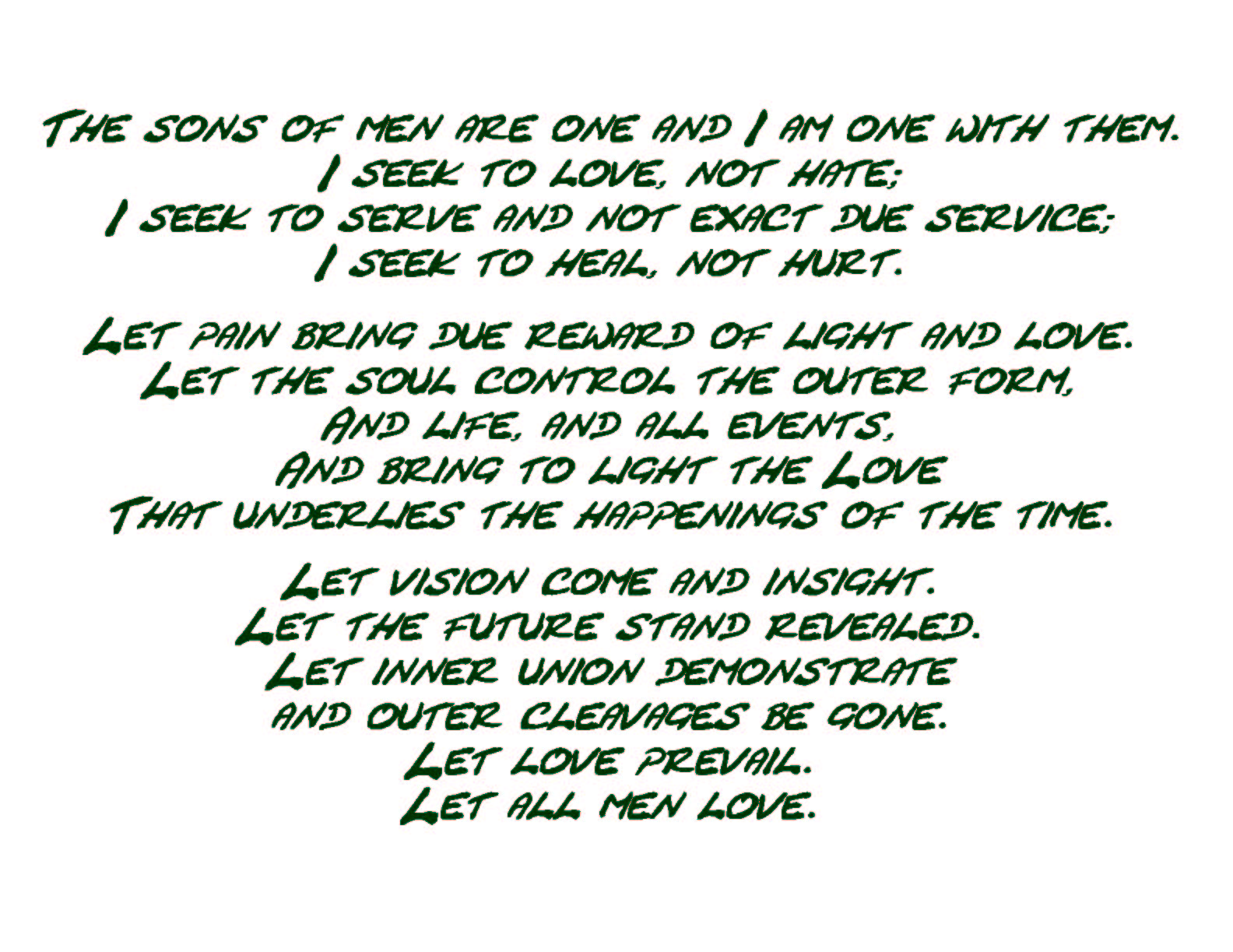
ON LOVE; PART MDLXXVI
ΑΩ•ΑΩ•ΑΩ•ΑΩ•ΑΩ•ΑΩ•ΑΩ•ΑΩ•ΑΩ•ΑΩ•ΑΩ•ΑΩ•ΑΩ•ΑΩ•ΑΩ•ΑΩ•ΑΩ•ΑΩ
FIRST IS THE GREAT COMMANDMENTS: “The first of all the commandments is, Hear, O Israel; The Lord our God is one Lord: And thou shalt love the Lord thy God with all thy heart, and with all thy soul, and with all thy mind, and with all thy strength: this is the first commandment. And the second is like, namely this, Thou shalt love thy neighbour as thyself. There is none other commandment greater than these” (Mark 12:29-31).
ΑΩ•ΑΩ•ΑΩ
WHAT THEN IS LOVE? In a general sense love is benevolence, good will; that disposition of heart which inclines men to think favorably of their fellow men, and to do them good. In a theological sense, it includes supreme love to God, and universal good will to men. While this IS from an older definition of Charity, which IS rendered in the King James Bible from the same Greek word agape which IS generally rendered as Love, we should amend our own definition here to include the idea that in the reality of Love a man will accord to ALL men ALL things that he would accord to himself and to say that Love IS our thoughts and attitude of the equality of ALL men regardless of their outward nature or appearance…that ALL ARE equally children of Our One God.
ΑΩ•ΑΩ•ΑΩ
PLUS THE EVER IMPORTANT AND HIGH IDEAL TAUGHT TO US BY THE CHRIST: “Therefore all things whatsoever ye would that men should do to you, do ye even so to them” (Matthew 7:12).
ΑΩ•ΑΩ•ΑΩ•ΑΩ•ΑΩ•ΑΩ•ΑΩ•ΑΩ•ΑΩ•ΑΩ•ΑΩ•ΑΩ•ΑΩ•ΑΩ•ΑΩ•ΑΩ•ΑΩ•ΑΩ
In the last essay we nearly concluded our discussion on our selection from Paul’s words to the Romans. In this essay we will explore the real Life realities embodied in Paul’s words as they DO take us from our birth in this world to our communion with the Lord. We should try to see that it IS this communion that makes us disciples and saints that ARE able to understand the reality of “the mystery which hath been hid from ages and from generations“. This mystery “which is Christ in you, the hope of glory” (Colossians 1:26, 27) IS the KEY to ALL mysteries. Once we can KNOW the “Christ in you” we can also KNOW God and in this come to KNOW the reality of what Paul calls “the adoption, to wit, the redemption of our body“. This IS the culmination of our Life as a man in this world and the beginning of the Life of one who DOES “know the truth“. It IS this Truth that will Truly “make you free” from the vanity into which we ARE born. This reality IS beyond the ideas of birth and death as we understand those carnal ideas; this IS the reality of being freed from sin, freed from our focus upon our little lives in this world. This focus IS the result of our vanity and IS the reality of our “bondage of corruption“; here we should try to understand that it IS this focus that IS the reality of sin. The idea of sin has been hijacked by religion and made to pertain to the illicit actions of men; this however IS NOT the reality of hamartia.
The Greek word hamartia IS defined by the lexicon as: to be without a share in; to miss the mark; to err, be mistaken; to miss or wander from the path of uprightness and honour, to do or go wrong; to wander from the law of God, violate God’s law, sin 2. Viewing these ideas from the perspective of the Soul we should see that our sinful nature IS simply to remain succumbed to our vanity. It is in our vanity that we ARE in that perishable and decaying condition, separate from God, and pursuing false ends 4. When we wander from the path of uprightness and honour we ARE exhibiting our perishable and decaying condition; as Souls we can ONLY watch as our opportunity to Repent and Transform passes by as we waste precious time. Surely as Souls we can prompt the carnal mind to Repent but this seldom results in the necessary Life changes without some motivating event. So long as our focus IS on our lives in the world, upon the self if you will, we ARE without a share in “the glorious liberty of the children of God“. And, so long as we live in our deception, the deception of believing that we ARE saved by our allegiance to our doctrinal ideas, we continue to miss the mark. While this last idea may seem unduly harsh, it IS nonetheless the Truth from the perspective of the Soul that wants ONLY to take advantage of this time in this world and to accomplish what Paul shows us as “the adoption, to wit, the redemption of our body“. Repeating the text of our discussion from Romans we read:
“the creature was made subject to vanity, not willingly, but by reason of him who hath subjected the same in hope, Because expectation that the creature itself also shall be delivered made free from the bondage of corruption into the glorious liberty of the children of God. For we know that the whole creation groaneth and travaileth in pain together until now. And not only they, but ourselves also, which have the firstfruits of the Spirit, even we ourselves groan within ourselves, waiting for the adoption, to wit, the redemption of our body” (Romans 8:20-23).
In the last essay we touched upon the last idea which Paul represents as “waiting for the adoption, to wit, the redemption of our body” while linking this with Peter’s words saying “Grace and peace be multiplied unto you through the knowledge of God, and of Jesus our Lord, According as his divine power hath given unto us all things that pertain unto life and godliness, through the knowledge of him that hath called us to glory and virtue: Whereby are given unto us exceeding great and precious promises: that by these ye might be partakers of the divine nature, having escaped the corruption that is in the world through lust” (2 Peter 1:2-4). While we DID discuss Peter’s words in some depth in the last essay, we DID so from the perspective of equating the ideas of being “partakers of the divine nature” with entering “into the glorious liberty of the children of God“, we DID NOT discuss the way that being “partakers of the divine nature” relates to the communion that IS represented by “the adoption, to wit, the redemption of our body“. Our first point here IS that we should remember that the Jesus and His apostles ARE speaking and writing to people who DO NOT yet comprehend the spiritual depth of the ideas that they present. It IS for this reason that the idea of the Father and the Son ARE introduced but never Truly explained and why the whole idea of the Holy Spirit remains undefined. From John the Baptist’s declaration that the Master will “baptize you with the Holy Ghost, and with fire” (Matthew 3:11) to the Master own words saying “the Comforter, which is the Holy Ghost, whom the Father will send in my name, he shall teach you all things, and bring all things to your remembrance, whatsoever I have said unto you” (John 14:26), the entirety of the Trinity remains a mystery and purposefully so. We must understand that mysteries ARE NOT hidden as one would presume that idea; even within the Master’s parables where there ARE ‘hidden’ meanings, the Truths ARE available to ALL who can see them. And this IS the point: it IS when one IS keeping His words that the realizations of the Truths, the mysteries if you will, become clear and this the Master tells us in such sayings as “Who hath ears to hear, let him hear” which words follow His telling of the Parable of the Sower. Later, just before the Master’s explanation of the parable to His disciples, He tells them “blessed are your eyes, for they see: and your ears, for they hear” (Matthew 13:9, 16). Ponder on this.
In using the ideas of the Trinity, a word that IS NOT found in scripture, representing the Father, Son and Holy Spirit, the Master IS humanizing the spiritual concepts so that there can be a starting point for understanding. Doctrines however have used these word ideas as the end point and has doctrinally defined the individual ideas while coining the idea of the Trinity. In addition to DOING this, humanizing the idea of God, the Truth remains ‘hidden’ behind the Master’s words and those of His apostles. Among the many Truths that the Master offers us IS the three parts of our trifecta which show us in rather clear terms the reality of the relationship between man and the Godhead. We should rephrase this to say that the words of our trifecta ARE clear to us….they ARE NOT clear to most ALL of the doctrinal church which has applied their doctrinal norms to these spiritual words. Repeating our trifecta we read:
- “If ye continue in my word, then are ye my disciples indeed; And ye shall know the truth, and the truth shall make you free” (John 8:31-32).
- “Not every one that saith unto me, Lord, Lord, shall enter into the kingdom of heaven; but he that doeth the will of my Father which is in heaven” (Matthew 7:21).
- “He that hath my commandments, and keepeth them, he it is that loveth me: and he that loveth me shall be loved of my Father, and I will love him, and will manifest myself to him. Judas saith unto him, not Iscariot, Lord, how is it that thou wilt manifest thyself unto us, and not unto the world? Jesus answered and said unto him, If a man love me, he will keep my words: and my Father will love him, and we will come unto him, and make our abode with him. He that loveth me not keepeth not my sayings: and the word which ye hear is not mine, but the Father’s which sent me” (John 14:21-24).
In these words we have the Way to discipleship; the Way to KNOWING the Truth and the freedom it brings. In the Master’s words that ARE our trifecta we have the Way to the Kingdom, NOT as a place to go after death but as a state to enter into here and now. The final part of our trifecta has some ideas that ARE easily understood but ignored by the doctrinal churches; the Master clearly tells us that if we Love God that we will keep His commandments and while this idea IS entirely missed by the doctrines of men, this IS NOT because this IS a mystery. There IS however the mystery of having the Presence of God through the idea that the Father and the Son “will come unto him, and make our abode with him“. Everything here, save for the idea of Loving the Lord, remains a mystery in a church where the Truth IS ‘explained’ in doctrines that dilute and change the reality that was intended. From KNOWING the Truth and being a disciple, to understanding the reality of entering the Kingdom, the Master’s words have been hijacked by the doctrines of men and made to have ONLY carnal meanings that masquerade as spiritual Truths. This IS what the church has DONE to the Master’s words. As for the apostles’ words, the church has DONE even worse; they have taken snippets of their words, especially Paul’s, and created their doctrines from them rather than from the source. ALL that CAN NOT be Truly understood by doctrines remain as mysteries waiting to be discovered by the man who strives to keep His words, the man who Truly Repents and Transforms. Among these mysteries ARE our subject words above: the “exceeding great and precious promises: that by these ye might be partakers of the divine nature” and “waiting for the adoption, to wit, the redemption of our body“. While we CAN NOT explain these ideas so that they can be understood by those that ARE NOT ready to understand; we can explain them from our own perspective and our own ability to KNOW the Truth, an ability that grows by measure as we continually strive and Transform.
While the idea of adoption has been discussed frequently in our essays, the reality of the idea IS difficult to understand by any who DO NOT see the relationship between the Soul and the personality that IS grounded in this world. When one can understand that he IS a Soul, that ALL men ARE Souls absent the carnal differences that have resulted in milenia of prejudices, then one can begin to understand the reality of the Great Commandment: “Thou shalt love agapao thy neighbour as thyself“. Although this may seem unrelated to the idea of the adoption that Paul speaks of, this understanding IS a necessary component for any realization of the Truth of adoption which we should see according to Mr. Merivale’s words saying “the adopted son of God becomes, in a peculiar and intimate sense, one with the heavenly Father”4. This Oneness IS Universal and while the idea of adoption ONLY serves to enable our understanding of this relationship which IS stated in terms of Father and Son so that our finite minds can make some sense of it. As Souls we ARE ever One with the Godhead, part and parcel if you will, and, as we come to understand this we can bring this Oneness into our heretofore carnal lives as our realization of the Truth. In the idea of adoption we should see the reality of our Transformation and here we should add that both our Transformation and our realization that we ARE Souls in this world living through a body of flesh ARE both the product of our Repentance.
We should try to see adoption as an endpoint and Repentance as a beginning as we try to understand that so long as we ARE bound to our vanity, neither Repentance nor adoption ARE possible. Trying to see ourselves as Souls can be understood as a precursor of Repentance. Other means of coming to Repentance require some form of motivation; this can come through a dissatisfaction with our lives or through a sudden awakening as we see in the lives of the apostles. For some their awakening was the result of their proximity to the Master which awakened a predisposition based upon some degree of spiritual collateral and here we should understand that many in this world have some degree of collateral of their own. For others, like Paul, there was a sudden awakening that was perhaps sparked by his participation in the death of Stephen. Many in this world today DO have some degree of spiritual collateral that lies dormant because we become so engrossed in carnal living that it IS never recognized. Others, may feel some motivation to move past their vanity but resist because of the unknown nature of spiritual living. Still others DO feel some motivation and choose to pursue esoteric teachings or Eastern religions while failing to understand that the ideas of Repentance and Transformation ARE Universal and necessary for True discipleship in every religion.We should understand that we ARE looking to be disciples of the Christ which idea should be understood as becoming disciples of our own Souls, the Christ Within which idea tears down any religious differences. Discipleship IS beyond religion and to hold on to religious discipline IS to hold on to the doctrines that keep us away from the Truth.
Regardless of how one arrives as his awakening, it IS one’s awakening to the Truth of the Soul and the Oneness with ALL Souls that of the greatest importance. In the end we come under the reality of the anointing where “ye need not that any man teach you: but as the same anointing teacheth you of all things” (1 John 2:27) but we must first get to this point. During this journey we may rely upon the teaching of another and while this teaching may come from scripture, it must be free from the doctrines that dilute and change it. In Christian scripture we have a starting point; we have the Master’s words and through our study of His words and the clarifying and amplifying words of His apostles we can discern the Truth. The very first Truth that we should try to understand IS “Thou shalt love agapao thy neighbour as thyself“. This IS NOT carnal Love, this IS NOT that mental and emotional attraction to others that IS understood as Love in this world. Agapao Love IS based in the reality that ALL ARE Souls and ALL ARE the same; through this understanding we NO longer see the differences of race, color, culture or social status; we see ONLY other Souls. This IS for many a difficult task as we must overcome a our own vanity, nurturing and indoctrination plus the systemic prejudices that ARE ‘baked into’ our cultures. In our undertaking this change we have the basis of agapao and the ability to “agapao thy neighbour as thyself“. As we strive to see this way, we ARE effectively striving to keep His words and it IS in this striving that we build, measure upon measure, the necessary realizations that will take us to the next plateau.
Perhaps it would be right to look at this change of attitude from seeing the world around us in colors, races, cultures and social status as the beginning of our Repentance. From a True Christian perspective this IS the most important change that a man must undertake and by ‘forcing’ oneself to accomplish this, one IS Truly stepping upon the Path to “the glorious liberty of the children of God“. This IS True freedom; free from hatreds and prejudices and free to see the world as it was intended to be; while this vision is limited to one’s personal perspective, it IS the reality of the Master’s words saying “Let your light so shine before men, that they may see your good works, and glorify your Father which is in heaven” (Matthew 5:16). The reality of Repentance, that virtuous alteration of the mind and purpose as begets a like virtuous change in the life and practice 4, IS the beginning of our Transformation where we strive to accomplish Paul’s words saying “be not conformed to this world: but be ye transformed by the renewing of your mind, that ye may prove what is that good, and acceptable, and perfect, will of God” (Romans 12:2). It IS in our conformance we hold onto our prejudices and it IS in our Transformation that we ARE freed. It IS in our Transformation that we can escape “the corruption that is in the world through lust“. There IS a reality in Peter’s use of the Greek word epithymia which IS here rendered as lust. While the common understanding of epithymia IS: a longing (especially for what is forbidden)9, 9a according to Strong’s and Thayer’s and as a desire, craving, longing, mostly of evil desires 9b by Vine’s, the idea IS much broader. We should not that whenever the idea of epithymia IS deemed to NOT be in regard to ‘sin‘, it IS rendered as desire and it IS the doctrines of men have made these distinctions. Our point here IS that doctrinal authorities and bible translators ARE frequently wrong in these distinctions and this error IS aided by the doctrinal perspective on the ideas of sin and evil. Here in Peters words the idea of desires IS much more foundational that the rendering as lust.
The “the corruption that is in the world” IS based in the desires of men which in turn are based in the cumulative vanity of humanity through the ages. These desires that ARE founded in vanity include a desire to be different which has led to the formation of much of prejudices that exist yet today. Our individual desires ARE generally selfish and perhaps often take the form of the more intense idea of lust and we should understand that this idea of lust IS far greater than the sexual ideas that it engenders. The primary definitions for lust in today’s dictionary ARE: intense sexual desire or appetite; uncontrolled or illicit sexual desire or appetite; lecherousness; this IS how most view this word. This IS NOT Peter’s reference however; Peter’s reference IS ALL that we desire for the self in this world, desires that ARE contrary to the reality that the Master teaches us. James tells us about a more general idea of lust or desire saying: “From whence come wars and fightings among you? come they not hence, even of your lusts that war in your members? Ye lust, and have not: ye kill, and desire to have, and cannot obtain: ye fight and war, yet ye have not, because ye ask not. Ye ask, and receive not, because ye ask amiss, that ye may consume it upon your lusts” (James 4:1-3). From this mixture of personal and corporate ideas we should be able to understand the role of desire and how that, through wars, such desires feed the prejudices and the hatreds that consume the world.
Bringing this back to our Repentance, we should try to see that in forcing ourselves to see ourselves and others as Souls occupying bodies in this world we ARE forcing ourselves to shed our prejudices and our hatreds. We ARE forcing ourselves to see past race, color, culture and social status and to see each individual as we see ourselves. This allows us to see the deeper reality of that ancient phrase “Thou shalt love agapao thy neighbour as thyself“. Changing our attitude toward others in this way IS the fundamental meaning of agape that IS hidden in the phrase “Thou shalt love agapao thy neighbour as thyself“. Do we still see race? Of course. DO we still see color? Of Course. DO we still see culture and social status? Yes we DO but we DO NOT allow such differences to affect our view of the person….we see the person as a Soul and as ourselves. In this IS the reality of another ancient phrase: Unity in diversity. This idea of diversity covers ALL aspects of human appearance and attitude; we ARE unified because we share the same essential nature as Soul’s living as men and women in this world regardless of our appearances and attitudes, our religions and our cultures. We ARE One Humanity living on One World under One God.
While we discussed the idea of awakening and the need to be motivated to awaken and Repent, we should try to see here another way. Forcing ourselves to see ALL as Souls effectively brings us to the point of seeing ALL as we see ourselves and in this we can initiate our Repentance. Developing a firm commitment to the idea of Unity in diversity DOES NOT happen in an instant as we ARE struggling against the developed ideas of a Lifetime and the inherent ideas that vanity, individual and corporate, have instilled in us. Bringing this ALL back to our initial point of the mysteries shown us as the “exceeding great and precious promises: that by these ye might be partakers of the divine nature” and “waiting for the adoption, to wit, the redemption of our body“, we should try to see that Peter and Paul ARE showing us the endpoint of our Transformation. We should remember here that Paul tells us that, as Souls, we expect to “be delivered made free from the bondage of corruption into the glorious liberty of the children of God” and that the whole of creation pains for this expectation to be realized. The carnal mind, the man yet caught up in his own vanity DOES NOT have realization of this Truth and most ALL who read these words DO NOT understand them beyond the ideas offered by their own doctrines. John Gill shows gives us the flavor of the doctrinal view saying: the bondage they were in, not only to their sinful lusts, but to Satan the god of this world; and particularly to their idols, by which they corrupted themselves, and to which they were enslaved: they hope for a deliverance from hence 8. Mr. Gill makes the hope a personal idea here and DOES NOT connect this to the previous idea that it IS the Godhead that has so subjected His creation. This follows his idea from the previous verse where the idea IS that we ARE subjected to vanity “not willingly, but by reason of him who hath subjected the same in hope” where Mr. Gill tells us: Though they were willingly vain, yet they were not willingly made subject to vanity; they willingly went into idolatrous and other evil practices, but the devil made them subject, or slaves unto them; he led them captive at his will, and powerfully worked in them, by divine permission 8. In this doctrinal view the whole of our vanity IS blamed on Satan but here the question should be what IS “divine permission” and who would it be that hopes for freedom from “the bondage of corruption“.
As we previously discussed this idea IS nonsensical and to compensate for this Mr. Gill begins his commentary with the idea that this idea of vanity IS: the vanity and emptiness of the minds of the Gentiles 8 which idea IS NOT in the text nor in the context that Paul IS presenting throughout this chapter. Our point here IS that this IS a view held by much of the doctrinal church. Another doctrinally oriented view of this tells us that: Human rebellion in Genesis cursed the physical earth, causing natural disasters, disease, and decay. God legally subjected the world to this frustration, but did so with a temporary timeline and a promise of rescue. The physical universe will be completely renewed and freed from decay at the exact moment believers are resurrected**. In both these doctrinal views the idea of our personal responsibility IS missed; both rely strictly upon doctrinal ideas that ARE steeped in ideas from Genesis and a misinformed vision of resurrection.
When we can understand that this vanity IS the human condition, ‘ordained’ by the Plan of God and understood by the Soul, and that this condition will be overcome by those that ARE Truly “led by the Spirit of God” (Romans 8:14), we can then begin to see the endpoint that Paul IS showing us. This IS the reality of Paul’s words and in this we should see that it IS our individual personal responsibility to overcome our vanity and to use our groaning and travailing as our motivation to DO so. It IS in overcoming our vanity that we can stand with the Master saying “I have overcome the world” (John 16:33) and in this we stand ready for “the adoption, to wit, the redemption of our body“. Mr. Merivale shows us that this idea of adoption IS to become in a peculiar and intimate sense, one with the heavenly Father”4 and what we should try to see here IS that it IS this Oneness that also defines the idea of Redemption. Our Redemption illustrates the Oneness of the Soul with his vehicle of expression which is his body and mind in this world. Our Redemption illustrates the final step of being a human in this world and here we should see that this idea IS shown to us by the Master who tells us that “He that believeth on me, the works that I do shall he do also; and greater works than these shall he do” (John 14:12). We must understand however that this idea that to “believeth on me” IS so much more than the nebulous ideas of faith and believing understood by doctrines, This idea of “believeth on me” requires that: to believe on the Lord Jesus Christ is not merely to believe the facts of His historic life or of His saving energy as facts, but to accept Him as Savior, Teacher, Sympathizer, Judge; to rest the soul upon Him for present and future salvation, and to accept and adopt His precepts and example as binding upon the life 4. The KEY word idea here IS binding; accepting and adopting His precepts and example must be bound to one’s way of Life. In this we should be able to see that same idea of Oneness that IS found in the reality of “the adoption” IS the greater reality of Paul’s words saying of the Master that “Having abolished in his flesh the enmity, even the law of commandments contained in ordinances; for to make in himself of twain one new man, so making peace” (Ephesians 2:15). In this idea of twain we have the mortal and the spiritual man bound together as One so that the fullness of one’s spiritual Power can flow through the mortal body….”the redemption of our body“. It IS in this context that we should see our ability to DO such “greater works” in much the same way as we read about in the Book of Acts regarding Peter and Paul.
This IS the promise held out for ALL mankind as they ARE able to channel the Power of the Soul through the mortal body and mind and it IS in this realization that we will have completed the threefold requirements of Repentance, Transformation and Redemption. It IS this same promise that Peter shows us in the idea of becoming “partakers of the divine nature“. The same idea of Oneness IS found here; it IS the “divine nature” of the Master who made “in himself of twain one new man” that we can partake in. This idea of partaking IS from the Greek word koinonos which IS defined by Strong’s as: a sharer 9a and it IS rendered as such in our subject verse in several translations. Vincent tells us that Peter uses this word differently than other writers saying that: This use of the word, expressing a present realization of something not yet attained, occurs in no other writer in the New Testament 4. His usage in our subject verse IS indeed different than the idea of sharing and while Vincent puts this idea as a present realization of something not yet attained, Peter DOES explain the Way to that realization. This makes Peter’s use of koinonos much deeper than an associate, a partner or a companion which ARE other ideas affiliated with the word. While the idea IS NOT rendered as such in the New Testament, Vine’s shows us that the idea of koinonos can be understood as communion 9b according to Old Testament usage transferred to koinonos by the Septuagint. We should try to see that this idea of “partakers of the divine nature” contains the same idea of Oneness as we discuss above regarding Paul’s words on adoption and when we consider the idea of communion as the realization that comes upon the partaker, we can better understand Peter’s point.
To be “partakers of the divine nature” IS to be in communion with that nature which IS to bring forth from the Soul, the Christ Within, the sense of divinity that IS the reality of the Christ. We should try to understand how we get here which IS the purpose of the way that Peter frames this Unity of the Soul with the mortal man. Peter begins with the idea that it IS “through the knowledge of God, and of Jesus our Lord” that we are eligible for the “grace and peace” that he further explains. The idea of grace here, and in most ALL uses, refers to ALL that comes from the Godhead and therefore from our own Souls. Peace should be seen in the context of Paul’s words saying of Jesus that He made “in himself of twain one new man, so making peace“; this sense of peace IS far beyond the common understanding. We should try to see that this use of eirene reflects the cessation of the conflict between the Soul and the mortal man, between the “divine nature” and vanity; as “one new man” in full communion of the twain. It IS then through KNOWING God that we have this grace and peace and in these we have “all things that pertain unto life and godliness“. Peter repeats the idea that this IS through KNOWING God saying that we have “all things….through the knowledge of him that hath called us to glory and virtue“. KNOWING God IS NOT merely words on a page however; John shows us this idea of KNOWING God saying “He that saith, I know him, and keepeth not his commandments, is a liar, and the truth is not in him” (John 2:4) and it IS here that we can tie KNOWING God to the reality of believing on the Master; the dynamic IS the same and comes through keeping His words. It IS in our KNOWING God that “are given unto us exceeding great and precious promises” and these promises ARE the reality that we can be “partakers of the divine nature“, that we can be in communion, in Oneness with “the divine nature“
Here again IS the endpoint of our existence here in this world, NOT our death but rather our birth into “the glorious liberty of the children of God“. This IS our “adoption, to wit, the redemption of our body“. This IS why we ARE here and this IS the great mystery of Life “which hath been hid from ages and from generations, but now is made manifest to his saints” (Colossians 1:26). For most that may read these words they will remain a mystery; for others they will be seen as heretical ideas that perhaps border on blasphemy. For some, for those that DO “Strive to enter in at the strait gate” (Luke 13:24), there may be a spark of understanding and a desire to go deeper and perhaps make “in himself of twain one new man, so making peace“. One final note here. The idea of being “born again” has also been hijacked by the doctrinal church and the idea has been bent to meet the doctrinal ideas of men. This idea from the Master’s words saying “Except a man be born again, he cannot see the kingdom of God” (John 3:3) pertains to the same idea as we cite above, our birth into “the glorious liberty of the children of God” as “partakers of the divine nature“. In this IS our new birth as the adopted son of God who becomes, in a peculiar and intimate sense, one with the heavenly Father 4.
ALL of this begins with our Repentance, that virtuous alteration of the mind and purpose. It proceeds with our Transformation, our virtuous change in the life and practice, where we NO longer live “conformed to this world” but ARE “transformed by the renewing of your mind“. Finally we become the adopted son of God and one with the heavenly Father thereby making “in himself of twain one new man, so making peace“….finally we ARE Redeemed.
We will continue with our thoughts in the next post.
| Aspect | Potency | Aspect of Man | In Relation to the Great Invocation | In relation to the Christ |
| GOD, The Father | Will or Power | Spirit or Life | Center where the Will of God IS KNOWN | Life |
| Son, The Christ | Love and Wisdom | Soul or Christ Within | Heart of God | Truth |
| Holy Spirit | Light or Activity | Life Within | Mind of God | Way |
- 2 New Testament Greek lexicon on biblestudytools.com
- 4 Word Studies in the New Testament; Marvin R Vincent D.D. 2nd edition
- 8 Bible commentaries on BibleStudyTools.com
- 9 Thayer’s Greek Lexicon on blueletterbible.org
- 9a The New Strong’s Exhaustive Concordance of the Bible on blueletterbible.org
- 9b Vine’s Expository Dictionary on blueletterbible.org
- * Dictionary.com Unabridged Based on the Random House Unabridged Dictionary, © Random House, Inc. 2020
- ** Google AI on: Romans 8:20-21
those who walk on the well-trodden path always throw stones at those who are showing a new road
Voltaire, Writer and Philosopher