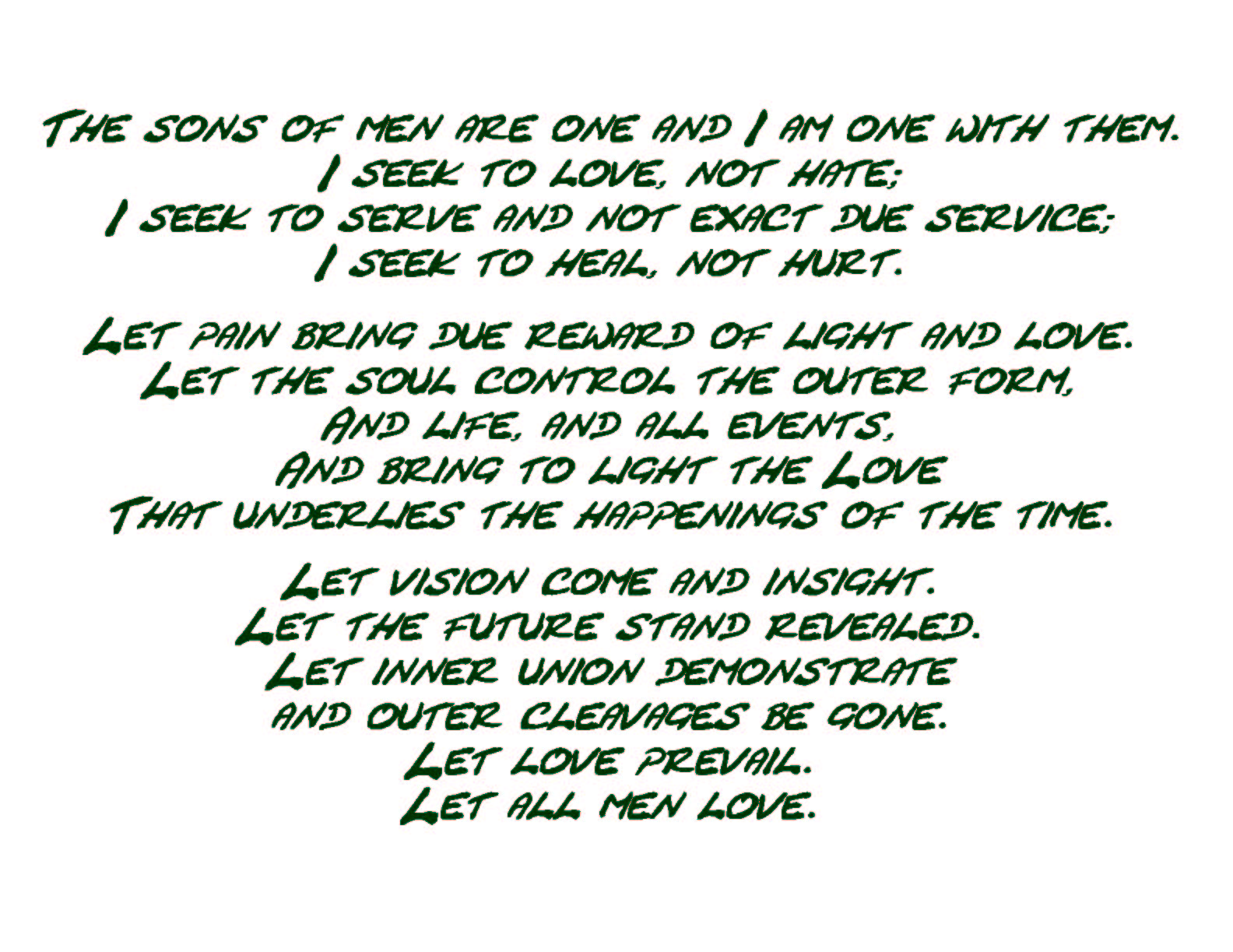
ON LOVE; PART MDLXXX
ΑΩ•ΑΩ•ΑΩ•ΑΩ•ΑΩ•ΑΩ•ΑΩ•ΑΩ•ΑΩ•ΑΩ•ΑΩ•ΑΩ•ΑΩ•ΑΩ•ΑΩ•ΑΩ•ΑΩ•ΑΩ
FIRST IS THE GREAT COMMANDMENTS: “The first of all the commandments is, Hear, O Israel; The Lord our God is one Lord: And thou shalt love the Lord thy God with all thy heart, and with all thy soul, and with all thy mind, and with all thy strength: this is the first commandment. And the second is like, namely this, Thou shalt love thy neighbour as thyself. There is none other commandment greater than these” (Mark 12:29-31).
ΑΩ•ΑΩ•ΑΩ
WHAT THEN IS LOVE? In a general sense love is benevolence, good will; that disposition of heart which inclines men to think favorably of their fellow men, and to do them good. In a theological sense, it includes supreme love to God, and universal good will to men. While this IS from an older definition of Charity, which IS rendered in the King James Bible from the same Greek word agape which IS generally rendered as Love, we should amend our own definition here to include the idea that in the reality of Love a man will accord to ALL men ALL things that he would accord to himself and to say that Love IS our thoughts and attitude of the equality of ALL men regardless of their outward nature or appearance…that ALL ARE equally children of Our One God.
ΑΩ•ΑΩ•ΑΩ
PLUS THE EVER IMPORTANT AND HIGH IDEAL TAUGHT TO US BY THE CHRIST: “Therefore all things whatsoever ye would that men should do to you, do ye even so to them” (Matthew 7:12).
ΑΩ•ΑΩ•ΑΩ•ΑΩ•ΑΩ•ΑΩ•ΑΩ•ΑΩ•ΑΩ•ΑΩ•ΑΩ•ΑΩ•ΑΩ•ΑΩ•ΑΩ•ΑΩ•ΑΩ•ΑΩ
We spent much of the last essay discussing the reality of agape and what it Truly means to “agapao thy neighbour everyman as thyself“. We should note here that we eliminated the word Love as the rendering for agapao and left the Greek word to stand on its own as our instruction, our commandment if you will. We also converted the idea of the neighbor to everyman which idea IS the product of the context in which the Greek word plesion is used in the New Testaments and the Hebrew word ahab in the Old Testament. Our shortened version of the Great Commandment then becomes “agapao everyman as thyself“. While these changes simplify the saying, they DO NOT DO much to help us to understand the meaning and, to further our understanding, we also introduced the Golden Rule. Matthew shows this saying “Therefore all things whatsoever ye would that men should do to you, do ye even so to them” (Matthew 7:12) while Luke shows us the idea as “as ye would that men should do to you, do ye also to them likewise” (Luke 6:31). Both of these mean the same thing and DO help us to understand the idea of agape by showing us that we must treat everyman as we would want to be treated; the idea of everyman IS implicit in these sayings which refer simply to men….ALL men.
In these ideas we can rather firmly see that the idea of everyman IS the intent of both the Great Commandment and the Golden Rule; we can see that we must agapao everyman in the same way as we agapao ourselves. In the end we were still left with trying to understand just what agapao IS and how DO we express it to everyman which IS the commandment. Here we should try to see that the idea of expression IS inherent in the word agapao and we should try to understand that agapao IS NOT a thing but a spiritual impulse hence the idea of expression. It IS something we ARE commanded to DO but since it IS an attitude that requires our use of mind and emotions in this world, expression IS a proper way to frame this idea so that we can see that the commandment IS that we must express agape to everyman as we express agape to ourselves. While this idea contains ALL of the reality of the commandment, it makes little sense without Truly understanding just what agape IS. In our effort to better understand agape we centered our discussion on the idea of Oneness as we try to grasp the idea that in agape we come to KNOW that everyman IS the same so that the difference between the self and the other fades in regard to this commandment. To help this we tried to show that as Spirit and as Souls we ARE ALL the same; we are without the forms in this world that create the differences and lead us to see oneself through the vanity into which we ARE born.
In our own minds we each see ourselves as a person and, most often, we see ourselves as the center of our own little universe; in this we hold ourselves above others. In agape, rightly understood, however we come to see ourselves as Souls and it IS in this view that we lose sight of the self in the Oneness that IS agape. This idea of Oneness however DOES NOT define agape, it simply shows us a view of agape’s nature as the Essential Oneness of ALL Souls as part and parcel of the Godhead. We must try to see that to understand this one must have some measure of Truth; a measure that will enable us to understand that as “God IS agape” (1 John 4:8, 16), so IS everyman as Spirit and as Souls. In this we should try to see the reality that “God IS agape” and that our Souls ARE the Christ Within: “the mystery which hath been hid from ages and from generations“, the mystery “which is Christ in you“. It IS in unlocking this mystery that we can come to Truly understand agape as the necessary expression of our lives in this world and it IS likely because this IS a mystery that so few understand the nature and the expression of agape.
This of course DOES NOT help the world at large as few ARE in a position to understand these mysteries or the way that it IS in this understanding of our Oneness that we can Truly express agape. So what of the world of men? Are they doomed to see agape as a Love that IS impossible to express to everyman? This IS a complex question; the view of agape as Love is a substitute founded in the early church’s inability to understand “the mystery which hath been hid from ages and from generations“; an inability that continues to today. We should understand that there ARE choices to the simple rendering as Love which presents a rather impossible task; these include a redefining of agape as GoodWill as well as an understanding of the way that James’ words must apply to our redefinition. Let us begin by redefining agape as we again explain how it is that we came upon this idea. Agape, in addition to its rendering as Love in the King James Bible, IS also rendered as charity and it IS in the older definitions of charity that we can find a suitable understanding of agape that can be used by most everyman. Going back to Webster’s 1828 Dictionary we find charity defined as: benevolence, good will; that disposition of heart which inclines men to think favorably of their fellow men, and to do them good. In a theological sense, it includes supreme love to God, and universal good will to men 1.
Because charity has lost this meaning over the years, we CAN NOT substitute charity for Love as words that define agape for the man in this world who DOES NOT have access to the mysteries. We can however use the ideas of benevolence and GoodWill; these should be the expression of everyman toward everyman in this world; universal good will to men. While the definitions of GoodWill and benevolence DO NOT express the level understanding that the world needs, they ARE the better choice. Where Love fails, benevolence and GoodWill can succeed. In a word benevolence IS defined as: desire to do good to others; goodwill; charitableness* and here we should not be concerned with the idea of charitableness. GoodWill IS defined as: friendly disposition; benevolence; kindness* and here we should note the return to benevolence as our primary idea. For our use, we have chosen the more discernible idea of GoodWill as the substitute for agape in this world of men so that we now have two sayings that both say the same thing at different depths. Spiritually we have the commandment that we should “express agape to everyman” along with an understanding of the Oneness that IS yet a mystery to the carnally focused man. And, in this world, we have the commandment that we should “express GoodWill to everyman” which idea IS easily understood through the converse idea of the Will to Good. What we should try to see here IS that there IS a way to accomplish this commandment regardless of our ability to Truly see the Oneness of ALL men and that way IS the expression of GoodWill. GoodWill eliminates that baggage that IS attached to the idea of Love and the uncertainty of the meaning of agape that has stalled our understanding of the Master’s words for 2000 years.
To this we add an adage which we borrow from esoteric literature: ‘GoodWill IS Love in action’ or, better from our perspective, ‘GoodWill IS agape in action’. This idea can be understood as: Goodwill is love in action is a well-known philosophical and spiritual phrase that describes kindness and benevolence not just as a feeling, but as a practical, everyday choice**. In this the emotional ideas of Love ARE replaced by a mental approach to the way that we see and treat others; in this we should be able to see a practical way to view the Great Commandment for everyman regardless of whether one’s focus IS spiritual or still carnal. Esoterically the idea IS explained as: while the word “love” can feel complicated or heavy, “goodwill” is a simple, practical attitude anyone can practice toward others**. The roots of the idea however ARE found in the New Testament; the Apostle John tells us “My little children, let us not love in word, neither in tongue; but in deed and in truth” ( John 3:17-18). While the idea of GoodWill IS NOT cited here, it IS the very meaning of Loving “in deed and in truth“. In the totality of the apostle’s thought we should see the additional burden that he places on those who have the means in this world, especially those that proclaim their Christianity; John tells them “whoso hath this world’s good, and seeth his brother have need, and shutteth up his bowels of compassion from him, how dwelleth the love of God in him?” (1 John 3:18, 17). Can we see the point here?
Having redefined the idea of our expression of agape, we turn to James’ words which, in either understanding of that expression, spiritual or carnal, must be a part of our expression. James tells us “If ye fulfil the royal law according to the scripture, Thou shalt love agapao thy neighbour as thyself, ye do well: But if ye have respect to persons, ye commit sin, and are convinced of the law as transgressors” (James 2:8-9). In the last essay we discussed the first idea of the Great Commandment being “the royal law” and in understanding James intent in telling us that this special commandment sums up the entire law. It is the royal law; the king of all laws 4 we can see the Master’s words saying of the Great Commandments that “There is none other commandment greater than these” (Mark 12:31). It IS in understanding the importance of this law, this precept that IS carried over from the words of Moses to being the single idea that incorporates the entirety of the ALL commandments that we ARE able to proceed with our spiritual lives. In the absence of this understanding we ARE doomed to remain in our vanity throughout our lives in this world. While the words “Thou shalt love agapao thy neighbour as thyself” ARE left off of the list of the Ten Commandments, Jesus, James and Paul show us how that they ARE the essence of those commandments that pertain to our actions that can affect others. While there IS NO direct link in the Old Testament, the words ARE ONLY found in the secondary laws outlined in Leviticus, the Master corrects this error by telling us that they ARE an integral part of the Great Commandments. To be sure, James words that show us this saying as “the royal law“, confirm the Master’s intent and this idea IS also shown us by Paul who tells us “For this, Thou shalt not commit adultery, Thou shalt not kill, Thou shalt not steal, Thou shalt not bear false witness, Thou shalt not covet; and if there be any other commandment, it is briefly comprehended in this saying, namely, Thou shalt love agapao thy neighbour as thyself. Love Agape worketh no ill to his neighbour: therefore love agape is the fulfilling of the law” (Romans 13:9-10).
We should understand here that while these words ARE elevated to their importance, they CAN NOT stand alone. Above we have tried to show how that these words should be understood in terms of GoodWill and as the singular idea of agape and that the reference to Love must be eliminated from our view of our expression of agape. Again, from a spiritual perspective that KNOWS the Oneness of ALL through the reality that ALL ARE Spirits manifesting as Souls and living through the various human forms in this world, the idea of agape can define itself through this Oneness. From a worldly perspective that DOES NOT KNOW this idea of Oneness, this mystery “which is Christ in you“, the defining ideas for our expression becomes “express GoodWill to everyman” and here the idea can be better understood as the Will to Good. Neither of these ideas IS complete however without out application of the second part of James words saying “if ye have respect to persons, ye commit sin”. As we have discussed, the way that James shows us this idea causes some to believe that the whole of the concept IS ONLY in regard to wealth, that we should see the poor and the rich alike. While this IS True, the idea should be understood in a much broader way that includes every aspect of every interaction between men. Here, whether we use the spiritual or the carnal way of understanding the commandment to “express agape to everyman“, we have the missing link to Truth which comes in seeing ALL men the same. James tells us that this IS a necessary component and equates our failure to DO so to such failures of adultery and killing. He continues his thought saying “For whosoever shall keep the whole law, and yet offend in one point, he is guilty of all. For he that said, Do not commit adultery, said also, Do not kill. Now if thou commit no adultery, yet if thou kill, thou art become a transgressor of the law. So speak ye, and so do, as they that shall be judged by the law of liberty” (James 2:10-12). Can we see the point here? Can we understand that in his own way James IS showing the working of “the royal law“? In addition, based on James words, even the carnally oriented man IS forced to at least glimpse the idea of Oneness if ONLY in regard to the reality of One Humanity.
There IS another facet of James’ words that we have NOT previously discussed and that IS his notation of being “judged by the law of liberty“. The idea of judgement here IS NOT by God as the doctrinal church teaches but rather being judged by the law itself, “the law of liberty“. While James DOES NOT explain this save to tell us that we ARE to be judged as “a transgressor of the law” and extending this transgression to the idea of having NO “respect to persons“, he DOES offer us more in the previous chapter. There James tells us “be ye doers of the word, and not hearers only, deceiving your own selves. For if any be a hearer of the word, and not a doer, he is like unto a man beholding his natural face in a glass: For he beholdeth himself, and goeth his way, and straightway forgetteth what manner of man he was. But whoso looketh into the perfect law of liberty, and continueth therein, he being not a forgetful hearer, but a doer of the work, this man shall be blessed in his deed” (James 1:22-25). Vincent tells us that this idea should be understood as: Lit., the perfect law, the law of liberty. So Rev. The law of liberty is added as defining the perfect law 4; and this IS the way that the Revised Version and several others render the idea. In this text we should try to understand that “the perfect law” IS the reality of being “doers of the word” which can again bring us to the Great Commandment that we should “agapao thy neighbour everyman as thyself“.
In the idea of “the law of liberty” we have the Greek word eleutheria which IS the noun form of the verb eleutheroo which IS used in the first part of our trifecta and in Paul’s words that we have been discussing where it IS erroneously rendered as delivered. Using our trifecta we can piece together a deeper meaning for James’ using the idea of “perfect law of liberty” or, as it IS otherwise rendered “the perfect law, the law of liberty“. First however we should try to understand that the context in which this phrase IS placed IS that of keeping His words, or, as James phrases it being “doers of the word“. The whole of this segment IS in regard to keeping the words of “the Lord Jesus Christ” (James 1:1, 2:1). Although His name IS used but twice in the entire epistle, Jesus words ARE the subject of James writing as he amplifies and clarifies much of what the Master said. It IS the Master’s words that James IS calling “the perfect law, the law of liberty” and we should be able to see the difference between this and “the royal law” which IS specific to the Great Commandment. As we discussed in the last essay Vincent shows us this; he tell us of “the royal law” that: James here speaks of a single commandment, the proper word for which is ejntolh, while nomov is the body of commandments. It IS nomov that IS used in “perfect law of liberty“. Our focus here IS on the idea of liberty, “the law of liberty” as we try to see how James’ words relate to the Master’s words of the first part of our trifecta which we repeat saying:
- “If ye continue in my word, then are ye my disciples indeed; And ye shall know the truth, and the truth shall make you free” (John 8:31-32).
- “Not every one that saith unto me, Lord, Lord, shall enter into the kingdom of heaven; but he that doeth the will of my Father which is in heaven” (Matthew 7:21).
- “He that hath my commandments, and keepeth them, he it is that loveth me: and he that loveth me shall be loved of my Father, and I will love him, and will manifest myself to him. Judas saith unto him, not Iscariot, Lord, how is it that thou wilt manifest thyself unto us, and not unto the world? Jesus answered and said unto him, If a man love me, he will keep my words: and my Father will love him, and we will come unto him, and make our abode with him. He that loveth me not keepeth not my sayings: and the word which ye hear is not mine, but the Father’s which sent me” (John 14:21-24).
We should try to see that both James words and the Master’s words above ARE in regard to keeping His words which Jesus refers to in our trifecta as to “continue in my word” which IS better understood as “If ye continue abide in my word“. Continue IS rendered from the Greek word meno which IS most always rendered as abide when the subject leans spiritual; while both continue and abide work in this use, the idea of abiding relates better to the idea of the third part of our trifecta where the Greek word mone IS rendered as abode; mone IS the noun form of the verb meno. The word mone IS used only twice in the New Testament and both in this chapter. It IS rendered as abode in our trifecta while it IS rendered as mansions in the second verse. While this seems an unfortunate choice, the idea of mansions had a very different understanding when the idea was developed. Despite the fact that it IS rendered as mansions in ONLY about a third of the translations in our library, it IS today’s idea of mansions that has become the most widespread defining idea in much of the church….mansions in heaven. Our point here IS to show how that biblical words can be both deceiving and enlightening. In rendering eleutheroo as delivered there IS a sense of deception while in the idea of liberty from the Greek word eleutheria can offer us some enlightenment. As we cite above, the Greek word eleutheroo, the verb form, IS used by the Master in regard to keeping His words as He tells us that in so DOING “ye shall know the truth, and the truth shall make you free”; it IS eleutheroo that IS rendered as “make you free“.
There ARE two links here; first there IS the singularity of subject; both James and the Master ARE referring to the idea of keeping His words. The second in found in the way that both offer us the same idea of freedom; Jesus tells us specifically that “the truth shall make you free” while James tells us that in being “doers of the word we ARE looking “into the perfect law of liberty” and, if we “continueth therein” that “this man shall be blessed in his deed“. What we should try to see here IS that this blessing IS the freedom that comes from continuing in “the perfect law of liberty“. In the idea of blessing we have a very important yet undiscovered meaning that we can ONLY equate with the idea of grace as ALL that comes from the Godhead….from one’s own Soul. In the Beatitudes the idea IS shown as acquiring the Kingdom, gaining comfort, inheriting the earth, being filled with righteousness, obtaining mercy, seeing God and being among the “children of God” (Matthew 5:9). In ALL this we should be able to understand that ALL of these blessings ARE spiritual, that there IS nothing carnal to be gained. Perhaps what we should see in James’ words, words that ARE thought by some to pertain directly to the Sermon on the Mount, IS the reality that in keeping His words one can have ALL these blessings. While the idea of the Greek word makarios which IS rendered as blessed IS seen by many as happy, this IS a very inadequate understanding and rendering it as such as IS done by several translations IS very misleading. While the word has some links to happiness, it also has other pagan links to death and immorality; Vincent writes extensively on makarios, too much to post here. His complete dissertation can be found at verse 5 on : https://www.studylight.org/commentaries/eng/vnt/matthew-5.html .
The idea of being blessed IS likely a confusing one for most in and out of the church. The real meaning IS lost in the ideas of happiness and we should try to glean what we can from the Master’s use of the word rather than from bible dictionaries and commentaries. Our question here IS what DOES it mean to “be blessed in his deed” and if we can see the idea here of spiritual fulfillment we can perhaps better understand James’ point. Perhaps in this Greek word makarios we have yet another word that IS NOT translatable into a single word but rather into an idea which, from its usage, must be a spiritual idea. Looking again to Google’s Gemini for a summary answer to the question of being blessed we find that the common idea IS used: to describe positive life circumstances—such as good health, financial stability, a nice home, a good job, or a happy family. They then ascribe similar ideas to the biblical use of the idea saying that makarios IS: being blessed means being truly fortunate, deeply satisfied, and secure in God’s kingdom, regardless of physical or financial circumstances** but this IS also a carnal view of the idea. We should try to see that aside from the idea of being deeply satisfied, and secure in God’s kingdom, none of these ideas are applicable to the True spiritual lives of men. When the whole idea within Christianity seems to say that: It represents God’s loving attention directed toward a person, granting inner peace, forgiveness of sins, and eternal life through Jesus Christ**, the whole idea that “there is no respect of persons with God” (Romans 2:11) must be discarded in favor of the church view of favor to certain persons.
The blessing that James IS citing here IS the relative reward to those that ARE “doers of the word” and here we avoid the idea of favor by understanding that as we become “doers of the word” we ‘earn’ True spiritual collateral, by measure, in return for our efforts and that this applies to everyman. Paul shows us this saying “Be not deceived; God is not mocked: for whatsoever a man soweth, that shall he also reap. For he that soweth to his flesh shall of the flesh reap corruption; but he that soweth to the Spirit shall of the Spirit reap life everlasting. And let us not be weary in well doing: for in due season we shall reap, if we faint not” (Galatians 6:7-9). We should understand that our sowing here IS that we express agape to everyman with NO “respect to persons” and that the blessing that we obtain contributes to our sense of spiritual fulfillment as we travel on the Path to True discipleship. In a rather straightforward way that IS NOT understood by most ALL of the church, James IS showing us the Way to spiritual fulfillment and it IS in this fulfillment that we should see the two themes that we have been discussing in recent posts. Here today we can now see three separate ideas from three different apostles that ALL show us the Way:
“Grace and peace be multiplied unto you through the knowledge of God, and of Jesus our Lord, According as his divine power hath given unto us all things that pertain unto life and godliness, through the knowledge of him that hath called us to glory and virtue: Whereby are given unto us exceeding great and precious promises: that by these ye might be partakers of the divine nature, having escaped the corruption that is in the world through lust” (2 Peter 1:2-4).
“For the earnest expectation of the creature waiteth for the manifestation of the sons of God. For the creature was made subject to vanity, not willingly, but by reason of him who hath subjected the same in
hope, Becauseexpectation that the creature itself also shall bedeliveredmade free from the bondage of corruption into the glorious liberty of the children of God. For we know that the whole creation groaneth and travaileth in pain together until now. And not only they, but ourselves also, which have the firstfruits of the Spirit, even we ourselves groan within ourselves, waiting for the adoption, to wit, the redemption of our body” (Romans 8:19-23).
“But be ye doers of the word, and not hearers only, deceiving your own selves. For if any be a hearer of the word, and not a doer, he is like unto a man beholding his natural face in a glass: For he beholdeth himself, and goeth his way, and straightway forgetteth what manner of man he was. But whoso looketh into the perfect law of liberty, and continueth therein, he being not a forgetful hearer, but a doer of the work, this man shall be blessed in his deed” (James 1:22-25).
In each of these ideas we have a picture of the Way. Peter tells us that the Way to becoming “partakers of the divine nature” lies in our ability to escape “the corruption that is in the world through lust” and to DO so “through the knowledge of God” which comes to us as we Repent and Transform….as we keep His words. Paul tells us that we can enter “into the glorious liberty of the children of God” and there wait for our eventual “adoption, to wit, the redemption of our body” which IS our showing, as a man in this world, that one has “overcome the world” (John 16:33). While he DOES NOT tell us directly the Way, we can discern the reality that we must keep His words through the reality of having “the firstfruits of the Spirit” plus His earlier words from this same chapter. Finally James shows us the same idea in his blunt manner as he tells us that the Way IS that we become “doers of the word” and in this, in being “a doer of the work“, we will then be “blessed in his deed” which IS the spiritual fulfillment of our lives in this world.
The greater point here IS that the entirety of the New Testament should serve to show us this same theme of spiritual fulfillment through keeping His words which IS the Way to our True salvation; the salvation of our mortal lives through our freedom from our “bondage of corruption“. The church IS right in declaring that a man CAN NOT save himself but the whole of their argument IS misplaced in ideas of worship and in the idea that we can be saved ONLY by the hand of God through our faith and believing. This IS a false argument that has supplanted the Truth that ONLY a man can save himself, an idea however that must be rightly understood. The True man, the Soul, the Christ Within, IS our salvation as men in this world and it IS when this True man can overcome the vanity and ALL that our vanity DOES in our lives that we can realize our individual spiritual fulfillment. We should remember here that our vanity IS our: perishable and decaying condition, separate from God, and pursuing false ends 4. This defines the human condition into which ALL ARE born and which IS greatly exacerbated by years of nurturing and indoctrination. The New Testament IS our instruction manual for overcoming this vanity and the resultant self centered person that it has produced. We should understand here that every world religion has this same objective and while we have the teachings of the Master, others have their own sacred teachings which ARE intended for the cultures into which such Avatars of Truth came. Unfortunately the doctrinal presentations of every religion have obnubilated the Truth and left humanity with men’s interpretations through their doctrinal presentations of the Truth.
Throughout the New Testament the Master and His apostles left us with the Truth but left it to us to decipher much of it. Not ALL however IS clouded in mystery, much of their words ARE clearly phrased and constructed to help us on our way. This IS especially True with those sayings that tell us about agape and we should remember here that it was the choice of people, beginning with the church fathers, to see agape as the common idea of Love. While the word agape may have been a difficult concept from the beginning, the reality of it IS NOT totally hidden from view. In the contexts where we find it today rendered as both Love and charity we can easily see the importance of agape. Mankind however chose to ignore it and create doctrinal ideas that dilute and change the reality of the ancient words saying: “Thou shalt love thy neighbour as thyself“. In this essay we have ourselves changed the idea that has been presented by the church but we have NOT diluted the idea; we have instead enhanced it and showed how that this admonition can be viewed in two ways. Spiritually we have changed the idea to read that we should “express agape to everyman“; this along with an understanding of the Oneness that IS yet a mystery to most, shows us that we must see everyman the same including oneself. This sense of agape, while still undefined, shows us that we must see ALL men the same and with the added precept that we should have NO “respect to persons” we have the complete idea of how we must react to ALL others. In this IS the essence of the idea of “Unity in Diversity”.
At the end of each essay we include these words regarding Unity in Diversity: Anyone who sees that all activities certainly in all respects are the result of material conditioning and that one as the soul is not the doer, sees perfectly. When one following that tries to see that the diversity of the living beings is resting in oneness and that it expanded to that reality, at that time one attains the Absolute of the Spirit. (Bhagavad Gîtâ 13:30-31). The Bhagavad Gita shows us the idea of attaining the Absolute of the Spirit which in our reality IS the same as the ideas that we cite above: becoming “partakers of the divine nature“; “the adoption, to wit, the redemption of our body“; and the sense of spiritual fulfillment that James shows us as being “blessed in his deed“. What we should see here IS that it IS in our understanding of the Universal idea of Oneness which IS the reality of our Unity in Diversity that we can conduct our lives with NO “respect to persons“; this IS the reality of the undefined idea of agape.
The above can be the reality of Life for ALL that seek spiritual fulfillment, ALL that ARE willing to hear the call of their own Souls to Repentance and Transformation. Most however DO NOT seek the reality of spiritual fulfillment, most ARE content to live their lives as men in this world minding “the things of the flesh” (Romans 8:5) and fulfilling their chosen role in vanity. The doctrinal churches, while denying that they ARE minding “the things of the flesh“, nurture and indoctrinate men into this role while those who live without religion simply flounder as their Souls await some Life changing event that will spark them to see the greater Truth. Surely the Souls of those in the doctrinal churches also await some event but, because they believe that they have already found their ‘salvation‘, they ARE less inclined to hear the call. For ALL that DO NOT seek such spiritual fulfillment, there can be another way out of the morass of living in vanity, a way that IS also attached to the ancient words “Thou shalt love agape thy neighbour as thyself“. For the carnal man in and out of the church, the man content with his Life in this world, it IS the idea of GoodWill that can make the ancient words come to Life. First however there must be a revelation of this idea that the man can understand and, to be sure, today that revelation must come from the churches. For 2000 years the reality of the words “Thou shalt love agape thy neighbour as thyself” have been but a trite saying, an adage if you will, and it IS high time that the world begins to understand this Truth in terms of GoodWill….that we must “express GoodWill to everyman“.
We will continue with our thoughts in the next post.
| Aspect | Potency | Aspect of Man | In Relation to the Great Invocation | In relation to the Christ |
| GOD, The Father | Will or Power | Spirit or Life | Center where the Will of God IS KNOWN | Life |
| Son, The Christ | Love and Wisdom | Soul or Christ Within | Heart of God | Truth |
| Holy Spirit | Light or Activity | Life Within | Mind of God | Way |
- 1 Webster’s Revised Unabridged Dictionary, 1828 and 1913 from https://1828.mshaffer.com/
- 4 Word Studies in the New Testament; Marvin R Vincent D.D. 2nd edition
- 9 Thayer’s Greek Lexicon on blueletterbible.org
- 9a The New Strong’s Exhaustive Concordance of the Bible on blueletterbible.org
- ** Google AI on: the meaning of being blessed
those who walk on the well-trodden path always throw stones at those who are showing a new road
Voltaire, Writer and Philosopher