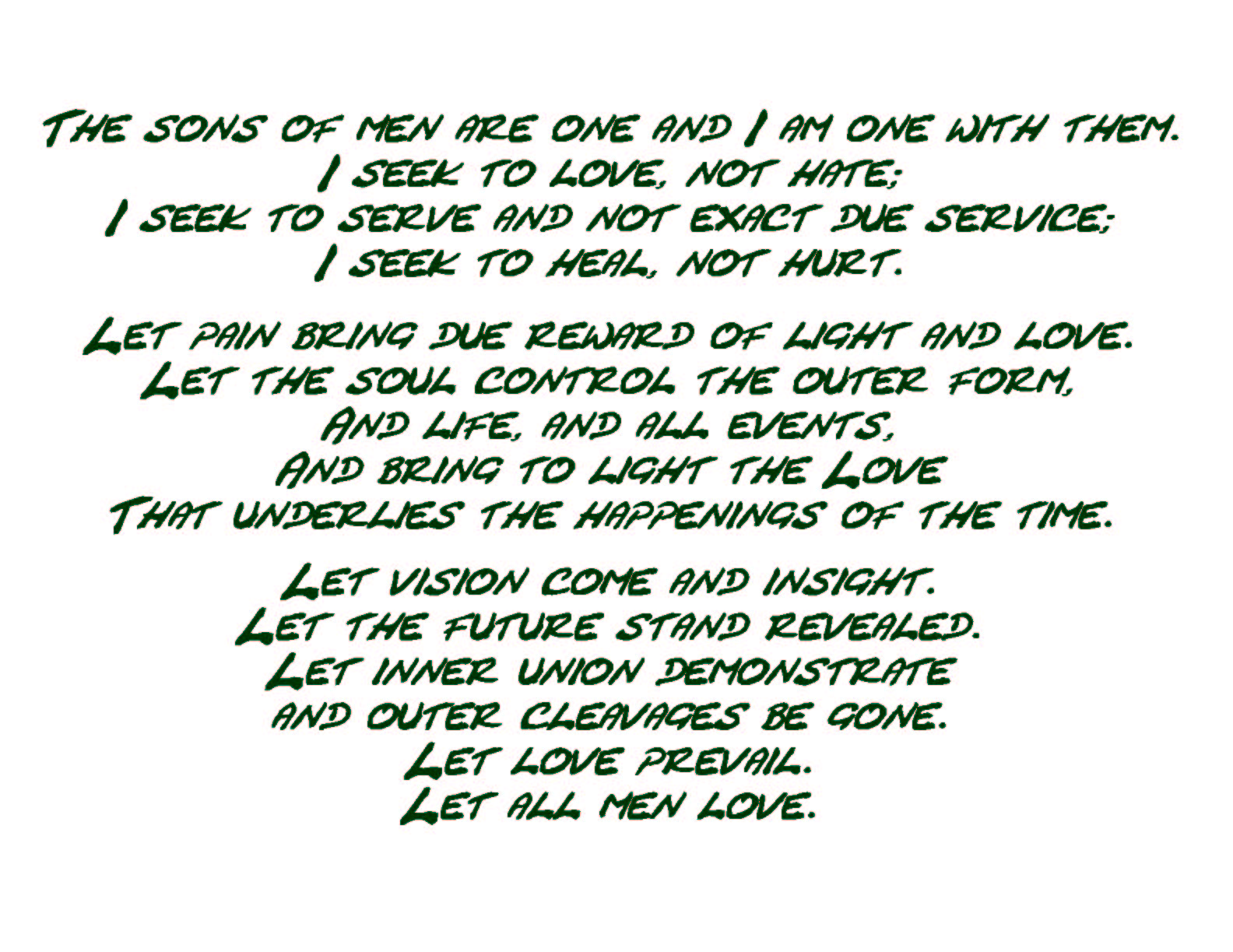
ON LOVE; PART MDLXXVII
ΑΩ•ΑΩ•ΑΩ•ΑΩ•ΑΩ•ΑΩ•ΑΩ•ΑΩ•ΑΩ•ΑΩ•ΑΩ•ΑΩ•ΑΩ•ΑΩ•ΑΩ•ΑΩ•ΑΩ•ΑΩ
FIRST IS THE GREAT COMMANDMENTS: “The first of all the commandments is, Hear, O Israel; The Lord our God is one Lord: And thou shalt love the Lord thy God with all thy heart, and with all thy soul, and with all thy mind, and with all thy strength: this is the first commandment. And the second is like, namely this, Thou shalt love thy neighbour as thyself. There is none other commandment greater than these” (Mark 12:29-31).
ΑΩ•ΑΩ•ΑΩ
WHAT THEN IS LOVE? In a general sense love is benevolence, good will; that disposition of heart which inclines men to think favorably of their fellow men, and to do them good. In a theological sense, it includes supreme love to God, and universal good will to men. While this IS from an older definition of Charity, which IS rendered in the King James Bible from the same Greek word agape which IS generally rendered as Love, we should amend our own definition here to include the idea that in the reality of Love a man will accord to ALL men ALL things that he would accord to himself and to say that Love IS our thoughts and attitude of the equality of ALL men regardless of their outward nature or appearance…that ALL ARE equally children of Our One God.
ΑΩ•ΑΩ•ΑΩ
PLUS THE EVER IMPORTANT AND HIGH IDEAL TAUGHT TO US BY THE CHRIST: “Therefore all things whatsoever ye would that men should do to you, do ye even so to them” (Matthew 7:12).
ΑΩ•ΑΩ•ΑΩ•ΑΩ•ΑΩ•ΑΩ•ΑΩ•ΑΩ•ΑΩ•ΑΩ•ΑΩ•ΑΩ•ΑΩ•ΑΩ•ΑΩ•ΑΩ•ΑΩ•ΑΩ
In the last essay we completed our discussion on our selection from Paul’s Epistle to the Romans. Our selection was a small part of the eighth chapter which IS, from our perspective, one of the most revealing chapters in ALL the epistles and in the entire New Testament. While we have discussed the entirety of the eighth chapter in previous posts we again addressed our selection because it trended with our previous discussion and because of our ongoing use of that part of it that outlines the human condition in this world: vanity. We ended with the understanding that Paul’s words, along with spiritually similar words from Peter, outline for us our entire journey as men in this world. Men ARE born in vanity, into a: perishable and decaying condition, separate from God, and pursuing false ends 4 which IS exacerbated by years of nurturing and indoctrination; ALL of which leave a man unaware of his True identity as a Soul living for a time in a body in this world. This IS the starting point for ALL according to Paul’s words saying:
“For the earnest expectation of the creature waiteth for the manifestation of the sons of God. For the creature was made subject to vanity, not willingly, but by reason of him who hath subjected the same in hope, Because expectation that the creature itself also shall be delivered made free from the bondage of corruption into the glorious liberty of the children of God. For we know that the whole creation groaneth and travaileth in pain together until now. And not only they, but ourselves also, which have the firstfruits of the Spirit, even we ourselves groan within ourselves, waiting for the adoption, to wit, the redemption of our body” (Romans 8:19-23).
Paul tells us that there IS an expectation that we will be “delivered made free” from this condition of vanity which Paul also calls our “bondage of corruption” and while he fails to tell us how in these verses, his previous words in this chapter surely show us the way. Although we must dissect his words ourselves, doctrines ARE of little help, Paul DOES give us the guidelines in such words as “they that are after the flesh do mind the things of the flesh; but they that are after the Spirit the things of the Spirit. For to be carnally minded is death; but to be spiritually minded is life and peace. Because the carnal mind is enmity against God: for it is not subject to the law of God, neither indeed can be” (Romans 8:5-7). ALL of this shows us that we must move past our being “conformed to this world“, that we must stop being “carnally minded“, that we must be “spiritually minded” by thinking as acting according to the Master’s words. Our decision to DO this IS our Repentance; this IS our change of mind which we should understand as Vincent presents it saying that Repentance IS our: virtuous alteration of the mind and purpose as begets a like virtuous change in the life and practice 4. While Vincent offers these words as a proper definition of Repentance, we see it as much more; separating the ideas we should see both our Repentance and our Transformation. Our Repentance IS found in the first part where we decide to change, where we decide to make a virtuous alteration of the mind and purpose which IS, in Paul’s terms, a decision to stop being “carnally minded” as we pursue a new purpose. In the second part we should see our Transformation our decision to make that virtuous alteration of the mind and purpose then begets a like virtuous change in the life and practice. This IS the action necessary to Transform according to Paul’s words saying “be not conformed to this world: but be ye transformed by the renewing of your mind, that ye may prove what is that good, and acceptable, and perfect, will of God” (Romans 12:2).
As we accomplish these things, the change of Repentance and the beginning of our Transformation, we can then beginn to realize the expectation of being free from our “bondage of corruption” as we ARE Transformed into “the glorious liberty of the children of God“. This IS NOT done in and instant however, it IS a process by which we ARE Transformed measure by measure according to the Master’s words saying “with what measure ye mete, it shall be measured to you again” (Matthew 7:2). This IS the Way to discipleship which IS defined by the Master as applying to those that will “continue abide in my word” (John 8:31). Here we should try to see that it IS “with what measure ye mete” in keeping His words that determines the measure of our Transformation. Paul continues, first telling us that in this process we will “groaneth and travaileth in pain” as we work the vanity out of our lives and he then shows us the reality of our spiritual lives. Paul tells us that in this process we ARE “waiting for the adoption, to wit, the redemption of our body” which IS that we ARE waiting for the final stage of True discipleship, our Redemption which IS defined for us in the idea of adoption.
The idea of waiting in this phrase IS from the Greek word apekdechomai, a word that IS defined as much more that merely standing by until. Another Greek word, a related word, ekdechomai IS used for that kind of waiting,with and without an air of expectation. While both ARE rendered the same way in the New Testament, apekdechomai has a much deeper meaning. Strong’s defines apekdechomai as: to expect fully 9a while Thayer’s defines it as: assiduously and patiently to wait for 9; the idea of assiduously here means: doing something with great care, close attention to detail, and tireless persistence*. ALL of this should show us that Paul’s idea of waiting IS an active waiting whereby we continue in our Transformation with great care and tireless persistence while ‘awaiting‘ our adoption and Redemption. This idea of waiting with full expectation should be understood in the same way as the expectation mentioned earlier by Paul but which IS wrongly rendered as hope; it IS also rendered as expectation in the previous verse where we read of the “earnest expectation of the creature waiteth for the manifestation of the sons of God” which verse we have included in our selection in this essay. What we should try to understand here IS that Paul IS showing us that it IS in our Transformation with great care and tireless persistence that our realization of the adoption will occur. We must try to see here that ALL spiritual Truths come to us as realizations, seldom as a sudden KNOWING, that we ARE changed and, because this happens measure by measure, there may be NO great awakening.
James shows us a picture of this idea of expectation and waiting and while he DOES NOT use the same Greek words, the message can be clearly seen. The apostle tells us “Be patient therefore, brethren, unto the coming of the Lord. Behold, the husbandman waiteth for the precious fruit of the earth, and hath long patience for it, until he receive the early and latter rain. Be ye also patient; stablish your hearts: for the coming of the Lord draweth nigh” (James 5:7-8). While the doctrinal churches see James words as applying to our death or the last judgement 8, we see the reality of James words as an explanation if you will of the reality of our “waiting for the adoption, to wit, the redemption of our body“. The coming of the Lord IS NOT intended to imply death or the Master’s return but rather that communion of the Lord and the man, the communion of the Soul and the Transformed mind which brings us to “the adoption“. While most ALL of James’ Epistle IS clearly written and easily understood by ALL that Truly “Strive to enter in at the strait gate” (Luke 13:24), his words in this fifth chapter ARE more elusive and must be assembled into a spiritual diatribe with redeeming qualities. James’ words above are among the redeeming ideas as ARE his words saying “Take, my brethren, the prophets, who have spoken in the name of the Lord, for an example of suffering affliction, and of patience. Behold, we count them happy which endure. Ye have heard of the patience of Job, and have seen the end of the Lord; that the Lord is very pitiful, and of tender mercy” (James 5:10-11). In the prophets’ affliction we should try to see Paul’s idea that the disciple “groaneth and travaileth in pain” and in their patience we should see the same “earnest expectation” and their “waiting for the adoption, to wit, the redemption of our body“. The adoption, the redemption of our body was the experience of at least one of the prophets albeit in a rather strange way; we read of Elijah that “it came to pass, as they still went on, and talked, that, behold, there appeared a chariot of fire, and horses of fire, and parted them both asunder; and Elijah went up by a whirlwind into heaven” (2 Kings 2:11). We should understand that this IS a bible story that IS just that, a story. However, in this depiction of the ‘translation‘ of Elijah we should try to see the Way of the True disciple which, while colored in a fanciful story, should show us the Power of Redemption and Transfiguration.
We should NOT forget the bible story of another True disciple, Enoch. While we KNOW little of his Life he IS held out in a special way; we read “Enoch walked with God: and he was not; for God took him” (Genesis 5:24). The story IS given strength by the writer of Hebrews where we read that “By faith Enoch was translated that he should not see death; and was not found, because God had translated him: for before his translation he had this testimony, that he pleased God” (Hebrews 11:5). The idea of Transfiguration IS ONLY shown to us in the New Testament and while this IS rendered from the same word as IS Transformed which IS the rendering in Romans above, these should be understood as two distinctively different things. Both uses of metamorphoo reflect a change but the change that the Master undergoes as Transfiguration IS NOT the idea that Paul IS presenting to us in Romans. From our perspective the idea of Transfiguration IS the result of Redemption and IS the final stage of a man’s supremacy as a Soul over the mortal world. In Romans the idea of metamorphoo IS used in conjunction with the idea of being “conformed to this world“. There it represents the change, the Transformation of the mind away from one’s vanity wherein the mind IS concerned with the self and the things of the self which IS to be “conformed to this world“. In its rendering as Transfiguration the idea of metamorphoo reflects a complete change and one that reflects a complete change of nature, one that IS described by Mark as “after six days Jesus taketh with him Peter, and James, and John, and leadeth them up into an high mountain apart by themselves: and he was transfigured before them. And his raiment became shining, exceeding white as snow; so as no fuller on earth can white them” (Mark 9:2-3). This idea of Transfiguration should be understood as the display of the Master’s complete dominance over His physical form and the physical world, a dominance that IS the deeper meaning of the Master’s words saying “I have overcome the world” (John 16:33). This idea of Transfiguration can also be seen in such ideas as Mark’s telling us of the Master “that he appeared in another form unto two of them, as they walked, and went into the country” (Mark 16:12). This IS a shortened version of Luke’s writing about two disciple walking when “And it came to pass, that, while they communed together and reasoned, Jesus himself drew near, and went with them. But their eyes were holden that they should not know him“. The idea that “their eyes were holden” tries to show that the disciples were prevented from seeing Jesus but this IS NOT the reality of this situation where the Master DID appear “in another form“. Luke concludes his version of this event saying that “their eyes were opened, and they knew him; and he vanished out of their sight” (Luke 24:15-16, 31).
There ARE several other instances where the Master simply appears or appears to be in a different form. John tells us that “Then the same day at evening, being the first day of the week, when the doors were shut where the disciples were assembled for fear of the Jews, came Jesus and stood in the midst, and saith unto them, Peace be unto you” (John 20:19). This IS another example of the Power that we call Transfiguration or the Master’s dominance over the physical world and here we should try to see and to understand that this idea of Transfiguration IS available to ALL who can reach that point of “the adoption, to wit, the redemption of our body“. Again we must remember that the Master Himself tells us that as disciples that fully keep His words “the works that I do shall he do also; and greater works than these shall he do” (John 14:12). We should note that there ARE similar stories regarding the Apostle Peter in the Book of Acts and although Luke’s text tells us that an angel released Peter’s chains and let him out of a heavily guarded jail, the reality IS based in his own “adoption, to wit, the redemption of our body“. We DO NOT make such claims lightly but rather based upon our understanding that men ARE alone in this world, there ARE NO angels coming to our aid; there IS ONLY the reality of our own Souls. As we have often said over the course of our blog posts, there IS a dichotomy between Life in this world and the Godhead that IS ONLY reconciled by our own Souls. This separation IS shown us by James who tells us “know ye not that the friendship of the world is enmity with God? whosoever therefore will be a friend of the world is the enemy of God” (James 4:4). In these words we should try to see that there IS NO relationship between the Godhead and the world and that there ARE NO earthly rewards given by God to men as the church teaches. ALL that happens in this world IS happenstance but we should try to understand that one’s own Soul, one’s own Christ Within, sees his Life in this world spiritually. The Soul can, when seeing a calamity that IS NOT yet due, intervene and while this IS attributed to God, it IS in reality our own Souls. How this works out in Life we CAN NOT with any certainty say but it does work out in a sudden awakening while one’s car IS head toward a wall or other close calls that endanger one’s Life.
It IS when the Soul, the Christ Within, has been able to overcome the vanity of one’s Life in this world that men can, by measure, express the reality of agape and Truth that IS the very nature of God. And it IS when this overcoming has reached its apex that a man can say with the Master that “I have overcome the world” and stand apart as an adopted son of God who becomes, in a peculiar and intimate sense, one with the heavenly Father 4. In this IS our Redemption, our ability to stand in this world as a Soul that has accomplished the fullness of discipleship who IS himself able to be Transfigured. The Way to this point begins with our Repentance and our ensuing Transformation according to Paul’s words saying that we should “be not conformed to this world: but be ye transformed by the renewing of your mind, that ye may prove what is that good, and acceptable, and perfect, will of God” (Romans 12:2). The word rendered here as prove should be understood as discern, that we can discern “what is that good, and acceptable, and perfect, will of God” and in this we should see the idea of KNOWING God. It IS by “the renewing of your mind” through our growing ability to express the agape and Truth that we ARE Transformed, measure by measure, in a process that takes us from worldly thought and action to spiritual thought and action. Paul shows us another view of this journey saying “to be carnally minded is death; but to be spiritually minded is life and peace. Because the carnal mind is enmity against God: for it is not subject to the law of God, neither indeed can be” (Romans 8:6-7). Here again we should try to see the dichotomy between the carnal and the spiritual and understand that so long as we ARE bound to our vanity we ARE at “enmity against God” as James shows us above.
Our Repentance IS our NOT our change of mind but rather our decision to change and while it may take several attempts for our Repentance to work out in our lives, it IS our first True endeavor in spiritual Life. Several posts back we tried to show this idea of Repentance and Transformation through the Parable of the Sower. In that series of discussions we looked at the four stages, the wayside, “stony ground“, thorns and “good ground” as they relate to our attempts at Repentance and Transformation. In this we should see that while we may Repent, decide to change, and then try to Transform, we may fail and be brought back to our Life in vanity. It IS in our success at Transformation that we move forward and we should try to see that at every failure, at every stage shown us in the parable, we have gained something that may allow us to go forward again to greater success. Paul shows us this along with another perspective on the dichotomy between things carnal and spiritual; Paul tells us: “Be not deceived; God is not mocked: for whatsoever a man soweth, that shall he also reap. For he that soweth to his flesh shall of the flesh reap corruption; but he that soweth to the Spirit shall of the Spirit reap life everlasting. And let us not be weary in well doing: for in due season we shall reap, if we faint not” (Galatians 6:7-9). In the idea that “in due season we shall reap, if we faint not” Paul offers us our motivation to go forward again to greater success. While Vincent defines Repentance for us as: a virtuous alteration of the mind and purpose as begets a like virtuous change in the life and practice 4, we break this down into the two components of Repentance and Transformation.
As we have said above, in the first part of Vincent’s statement Repentance IS defined as a virtuous alteration of the mind and purpose. This IS our decision to change from our heretofore carnal ways to a new outlook that IS defined by agape and the Truth. At the outset we may NOT be sure of just what IS involved in True Repentance or what motivated us to undertake this Life’ task. In Christianity Repentance should be understood as the decision to keep His words or, better, to strive toward that goal and while other religions vary in their approach to agape and Truth, these ARE nonetheless the goal of ALL. In a fuller understanding of Vincent’s words on matenoeo which IS rendered as Repent, he tells us that: Metanoia (repentance) is therefore, primarily, an after – thought, different from the former thought; then, a change of mind which issues in regret and in change of conduct 4. In regard to the common idea of Repentance for some wrong this IS a valid idea but one that DOES NOT address the reality of Repentance as a spiritual tool. As a spiritual tool we ARE addressing the wrong of living carnally, of being “conformed to this world” and although this IS the result of that vanity into which we were born, we ARE tasked as Souls to overcome it. It IS against our living in our “bondage of corruption” that we Repent and this IS the way that the idea IS presented by the Master who refers to NO specific wrong in saying “The time is fulfilled, and the kingdom of God is at hand: repent ye, and believe the gospel” (Mark 1:15). While we often say that this IS the way that Repentance should be understood, we seldom cite the dual use of this word idea against our spiritual understanding. We should try to see the idea of alteration as our decision to change the direction of our thoughts, our decision to change our very purpose away from our pursuing false ends and toward pursuing “the glorious liberty of the children of God“.
Repentance then IS our starting point and we should understand that we can go through this phase without ever realizing that we ARE DOING so. While there IS some modicum of change involved in our Repentance, it IS predominantly a decision to change. It IS however so closely followed by the beginning of our Transformation that these two aspects can be seen as one continuous movement. This idea of Transformation IS cited by Vincent as: a like virtuous change in the life and practice. In the combined saying then we have an alteration of our thinking followed by a change in life and practice. This IS True in most every aspect of human Life; it IS True in both our carnal endeavors and in our spiritual although in our carnal endeavors we DO NOT define it as Repentance. There IS a phrase that comes to mind here: energy follow thought. this can be explained both carnally and spiritually as: your focus, attention, and mental intent direct where your vitality, actions, and life outcomes go**.
The decision to change that IS Repentance IS a decision to change the focus of our thoughts, to alter our focus if you will. Our focus IS the reality of those things that take our attention and here another of the Master’s sayings can help us to understand. Jesus tells us “Lay not up for yourselves treasures upon earth, where moth and rust doth corrupt, and where thieves break through and steal: But lay up for yourselves treasures in heaven, where neither moth nor rust doth corrupt, and where thieves do not break through nor steal: For where your treasure is, there will your heart be also” (Matthew 6:19-21). The Master offers us a choice here and in that choice IS a decision that must be made; we can continue in our vanity, continue to “lay…up for yourselves treasures upon earth or we can decide to change our focus and “lay up for yourselves treasures in heaven“. In these words the Master IS defining our focus as treasures which idea IS NOT ONLY riches and possession but rather ALL that takes our attention. His final words tell us that wherever our focus IS, “there will your heart be also” and in this we should try to see that the reality of the heart IS the essence of the personality. In what direction DOES our personality move? Toward agape and Truth or toward the self and the things of the self. As men in this world we have this choice. To follow the dictates of our own Souls in Repentance and Transformation or to follow the dictates of the carnal mind and remain in our vanity, remain in our perishable and decaying condition, separate from God, and pursuing false ends 4.
It IS important to understand here that while it takes a decision to Repent and Transform, it also takes a decision to remain “conformed to this world“. Both can be silent decisions that ARE made seemingly unaware but nonetheless these ARE decisions. We should remember here that the idea of Repentance, while sparsely spoken of in the New Testament, IS the very first precept that the Master offers us. The full saying above from Mark’s Gospel shows us this; we read “Now after that John was put in prison, Jesus came into Galilee, preaching the gospel of the kingdom of God, And saying, The time is fulfilled, and the kingdom of God is at hand: repent ye, and believe the gospel“. This immediately follows the forty days of temptation and is followed by Jesus seeing “Simon and Andrew his brother casting a net into the sea“. This IS the Master’s first appearance after His encounter with John the Baptist of whom we read “John did baptize in the wilderness, and preach the baptism of repentance for the remission of sins” (Mark 1:14:15, 16, 4). We should try to understand the reality of baptism here, that it signifies an immersion and here an immersion into the change that IS Repentance. In “the remission of sins” we should try to see that the Greek word aphesis which IS rendered as remission IS defined by Strong’s as freedom 9a and by Thayer’s as: release, as from bondage, imprisonment, etc 9. We have then our immersion into Repentance, symbolized by the immersion in water, for the freedom from sin; a release from our “bondage of corruption“.
The Master’s first precept IS similarly recorded in Matthew’s Gospel where we read of the Baptist that “In those days came John the Baptist, preaching in the wilderness of Judaea, And saying, Repent ye: for the kingdom of heaven is at hand” (Matthew 3:1-2). Then, after Jesus forty days of temptation, we read “when Jesus had heard that John was cast into prison, he departed into Galilee; And leaving Nazareth, he came and dwelt in Capernaum, which is upon the sea coast, in the borders of Zabulon and Nephthalim: That it might be fulfilled which was spoken by Esaias the prophet, saying, The land of Zabulon, and the land of Nephthalim, by the way of the sea, beyond Jordan, Galilee of the Gentiles; The people which sat in darkness saw great light; and to them which sat in the region and shadow of death light is sprung up. From that time Jesus began to preach, and to say, Repent: for the kingdom of heaven is at hand” (Matthew 4:12-17). Following this the Master encounters Peter and Andrew. Our point here IS simply that this idea of Repentance IS the first teaching from the Master, His first precept.
In Luke’s Gospel the story of John the Baptist IS framed in much the same way; Luke tells us of John that “he came into all the country about Jordan, preaching the baptism of repentance for the remission of sins” (Luke 3:3). Luke however skips over the Master’s use of the idea as His first precept as he gives a very detailed account of the words of the Baptist. Luke DOES mention the idea a bit later however as Jesus has an encounter with the “scribes and Pharisees“; we read Luke’s words saying “their scribes and Pharisees murmured against his disciples, saying, Why do ye eat and drink with publicans and sinners?“. To this the Master answers saying “They that are whole need not a physician; but they that are sick. I came not to call the righteous, but sinners to repentance” (Luke 5:30, 31-32). Although it IS NOT formed as a precept by Luke, we should still see here the importance of Repentance. John’s Gospel IS a different type of writing; it IS NOT considered in the same way as ARE the synoptic gospels. While it DOES contain several ideas in common with the synoptics, John never uses the word Repent. Nonetheless, we should be able to see the importance of this spiritual act through the words of the synoptic writers.
The entire journey of mankind begins in vanity which IS exacerbated by a near continual nurturing and indoctrination into the ways of this world and we should understand that this indoctrination includes ALL aspects of Life. Religion, politics, national customs and prejudices ARE among the things that we suffer indoctrination into as we ARE taught by church and state to be “conformed to this world“. This IS the starting place for ALL as Paul shows us and it IS this that must be escaped according to Peter. In two specific verses Paul’s and Peter’s words outline Life in this world and while they ARE NOT explained in ways that the average man can easily understand, they ARE laid out for us to explore. Paul tells us that “the creature was made subject to vanity, not willingly, but by reason of him who hath subjected the same in hope, Because expectation that the creature itself also shall be delivered made free from the bondage of corruption into the glorious liberty of the children of God“. In these words Paul IS showing us our natural state of being, in vanity, which idea we understand as being born into: a perishable and decaying condition, separate from God, and pursuing false ends 4. Paul also tells us that it IS by the Will of God, the purpose of the Godhead if you will, that IS the cause of this human condition and that there IS expectation that we will be delivered made free from the bondage of corruption into the glorious liberty of the children of God“. The church sees vanity as the ‘fall of man’ with ALL of the doctrial trimmings that go along with this, they also see that we will be delivered which idea IS generally aligned with choosing Christianity and participating in it and being delivered from the hands of Satan by the hand of God. We should understand here that this deliverance IS better understood as being made free and here we should look to our trifecta to understand how we ARE made free. Our trifecta NOT only defines this but also other components of Truth that can secure our being made “partakers of the divine nature” in “the glorious liberty of the children of God“. Repeating our trifecta we read:
- “If ye continue in my word, then are ye my disciples indeed; And ye shall know the truth, and the truth shall make you free” (John 8:31-32).
- “Not every one that saith unto me, Lord, Lord, shall enter into the kingdom of heaven; but he that doeth the will of my Father which is in heaven” (Matthew 7:21).
- “He that hath my commandments, and keepeth them, he it is that loveth me: and he that loveth me shall be loved of my Father, and I will love him, and will manifest myself to him. Judas saith unto him, not Iscariot, Lord, how is it that thou wilt manifest thyself unto us, and not unto the world? Jesus answered and said unto him, If a man love me, he will keep my words: and my Father will love him, and we will come unto him, and make our abode with him. He that loveth me not keepeth not my sayings: and the word which ye hear is not mine, but the Father’s which sent me” (John 14:21-24).
In the Master’s words IS the reality that “the truth shall make you” and that the Way to this Truth IS to “continue in my word” which idea IS better understood as that we should abide in His words. Peter, in his own way shows us this same idea while putting the onus on the man to free himself which IS in accord with the Master’s words above and with Paul’s words telling us that we ARE expected to be made free. We should understand here that this expectation IS both individual and corporate; the individual Soul has this expectation for himself as a man in this world and the Godhead has this expectation for the whole. For both we should try to see that the Way IS shown to us by Peter as that we must escape; we must escape our being “conformed to this world“, we must escape our “bondage of corruption“. What Paul shows us here as our expectation, he explains in great detail in his earlier words from this chapter where the whole theme can be understood through his words saying “if ye live after the flesh, ye shall die: but if ye through the Spirit do mortify the deeds of the body, ye shall live“. This IS the Way to escape our “bondage of corruption“, our Way out of the morass of vanity that IS our lives in this world as men that “live after the flesh“. While Peter shows us the Way, his words ARE NOT understood as they ARE intended by the church and his Truth IS as alien to the church as ARE Paul’s words. Peter tells us “Grace and peace be multiplied unto you through the knowledge of God, and of Jesus our Lord, According as his divine power hath given unto us all things that pertain unto life and godliness, through the knowledge of him that hath called us to glory and virtue: Whereby are given unto us exceeding great and precious promises: that by these ye might be partakers of the divine nature, having escaped the corruption that is in the world through lust” (2 Peter 1:2-4). Peter tells us that we must escape.
We will continue with our thoughts in the next post.
| Aspect | Potency | Aspect of Man | In Relation to the Great Invocation | In relation to the Christ |
| GOD, The Father | Will or Power | Spirit or Life | Center where the Will of God IS KNOWN | Life |
| Son, The Christ | Love and Wisdom | Soul or Christ Within | Heart of God | Truth |
| Holy Spirit | Light or Activity | Life Within | Mind of God | Way |
- 4 Word Studies in the New Testament; Marvin R Vincent D.D. 2nd edition
- 9 Thayer’s Greek Lexicon on blueletterbible.org
- 9a The New Strong’s Exhaustive Concordance of the Bible on blueletterbible.org
- ** Google AI on: energy follow thought
those who walk on the well-trodden path always throw stones at those who are showing a new road
Voltaire, Writer and Philosopher